Page:Punch Vol 148.djvu/607
ESSENCE OF PARLIAMENT.
(Extracted from the Diary of Toby, M.P.)
House of Commons, Monday, June 21st.—When just now the new Chancellor of Exchequer walked up to Table carrying folded sheet of foolscap paper purporting to be copy of War Loan Bill, the hearty cheer that greeted him suggested that the nine hundred millions he had been talking about was to be divided among members of the House in addition to humble salary of £400 a year ruthlessly charged with income-tax. On the contrary, it meant that we and our constituents are, for purposes of the War, to provide colossal sum unheard of in the story of nations. What pleased the House was the clever construction of the scheme and the clear manner in which it was expounded.
It was McKenna's first appearance as Chancellor of Exchequer. Handicapped by succession to one of whom it might be said (omitting local allusion which supplies one of the most delightful non sequiturs in the language),
And he has chambers in the King's Bench Walks.
He did not attempt to compete with predecessor in those touches of genuine eloquence that from time to time uplift a prosaic business statements. Beginning without exordium he ended without peroration. Occupied only an hour in making clear as noonday to dullest apprehension a proposal equally prodigious and minute.
Whilst Prime Minister was still Chancellor, he emancipated Budget speech from thraldom of old tradition which, handed down from heyday of Disraeli and Gladstone, prolonged delivery over a minimum of two hours, with purple passages of sustained eloquence and the introduction of at least one quotation from Greek or Roman poet, which invariably drew emphatic cheer from classical scholars below the Gangway. This afternoon Asquith's favourite disciple, dealing with intricate financial subject, whilst equalling the licidity of the Master, even excelled him in severity and simplicity of style.

"Asquith's favourite disciple."
The speech punctuated with approving cheers, culminating in demonstration when, preliminary Resolutions by common consent passed through all its stages, the Bill based upon it was "brought in."
If House of Commons truly represents national feeling the War Loan will be a stupendous success.
Business done.—Bill read a first time, authorising raising of War Loan unlimited in amount. Understood that Chancellor of Exchequer, a man of moderate views, will be satisfied if nine hundred million sterling be forthcoming.
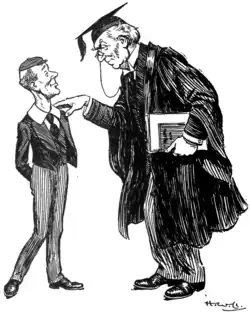
The Lord Hugh Query.
House of Lords, Tuesday.—House in rather awkward predicament to-day. Since his elevation to Woolsack the ex-Solicitor-General has found himself in invidious position. Though Lord Chancellor, permitted to preside over proceedings in what is sometimes called the Upper Chamber, he was not yet a peer. To-day, invested with peerage, Lord Buckmaster of Cheddington took the oath and was fully installed in office.
Proceedings attendant upon swearing in of new peer preserve quaint ceremonial going back to Stuart times. The novice, fully robed, is brought in by two noble lords also wearing the red gown of a blameless peerage. Having presented him to Lord Chancellor seated on Woolsack, to whom on bended knee he hands a roll of parchment engrossed with patent of his peerage, his sponsors lead him to Table and watch over him as he signs Roll of Parliament. Then Garter King-at-Arms appears on scene, clad in all his ancient panoply. By circuitous route he leads the way to back-bench below Gangway on Opposition side. What would happen to the British constitution if the group proceeded thither by shortest way Heaven only knows. Possible catastrophe is by Garter King's strategy sedulously avoided.
Arrived at their destination the new peer and his escort, at bidding of Garter King, seat themselves. At another signal, turning towards the Woolsack, they thrice salute it by gravely raising their cocked hats. The Lord Chancellor, who has also possessed himself of a cocked hat usually worn askew on top of full-bottomed wig, returns the salute. Thereupon the three red-gowned peers rise and, conducted part of the way by Garter King, quit the House by the door behind Woolsack, presently returning clothed in common-place twentieth-century garb.
To-day difficulty alluded to inevitably took place at stage of ceremonial where the new peer salutes the Lord Chancellor on the Woolsack. On historic occasion John Bright informed House of Commons that he "could not turn his back upon himself." Lord Chancellor seated on back bench below the Gangway could not render obeisance to himself simultaneously occupying the Woolsack. However there was the Woolsack, immemorial, immovable. Thrice the new Lord Chancellor with inflexible gravity saluted its august irresponsive presence and straightway proceeded to sit upon it.
Business done.—Commons, after brief conversation congratulatory of Chancellor of Exchequer, read War Loan Bill a second time.