Page:Punch Vol 148.djvu/580
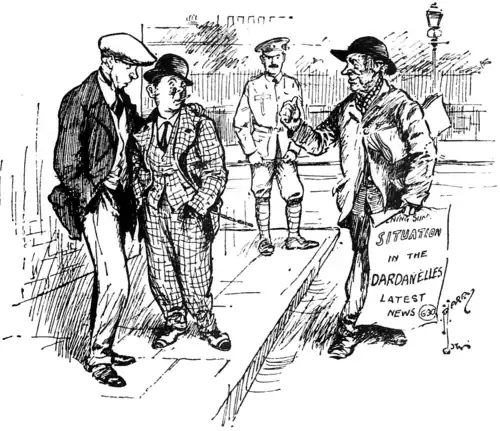
Facetious Slacker (as he notes wording on bill). "Any chawnce o' gettin' the job, guynor?"
Newspaper Seller. "No worry at all, mate. My secertary at the corner there'll sign ye on wivout any delay."
MOSES.
I must begin by affirming that this is a true story.
Everyone who ever idled in Paris in the good days when the world was happy must have passed now and again across the Gardens of the Tuileries and stopped to watch that engaging old gentleman, M. Pol, conversing with his friends the sparrows. Whether or no in these dark times M. Pol still carries on his gracious work of charming the birds I cannot say; he was looking very frail when last I saw him, a year and more ago; but that his influence still persists is proved by the extraordinary events which I am about to relate, and which, as I said before, and shall probably have to say again, are true. One must not claim too much for M. Pol or underrate the intelligence of Moses. None the less I feel strongly that, had it not been for M. Pol's many years of sympathetic intercourse with those gamins of the air, the Parisian sparrows, and all his success in building that most difficult of bridges―the one uniting bird and man―the deeds of Moses might never have come before the historian.
"Moses?" you say, "who is this Moses?" The question is a very proper one and it shall be answered.
Let us begin at the beginning. In the city of Paris, in an appartement not very distant from the Étoile or Place of the Arc de Triomphe dwell two little boys. They are American boys, and they have a French governess. In addition to this they are twins, but that has nothing to do with Moses. I relate the fact merely to save you the trouble of visualising each little boy separately. All that you need do is to imagine one and then double him.
Well, after their lessons are done these two little boys go for a walk with their governess in the Champs Elysées, or the Parc Monceau, or even into the Bois itself, wherever, in fact, the long-legged children of Paris take the air; and no doubt as they walk they put a thousand Ollendorffian questions to Mademoiselle, who has all her work cut out for her in answering, first on one side and then on the other. That has nothing to do with the story either, except in so far as it shows you the three together.
Well, on one morning in the Spring one of the little boys saw something tiny struggling in the gutter, and, dragging the others to it, he found that it was a young bird very near its end. The bird had probably fluttered from the nest too soon, and nothing but the arrival of the twins saved its life.
"Voilà un moineau!" said Mademoiselle, "moineau" being the French nation's odd way of saying sparrow; and the little creature was picked up and carried tenderly home; and since sparrows do not fall from the heavens every day to add interest to the life of small American boys in Paris this little bird had a royal time. A basket was converted into a cage for it and fitted with a perch, and food and drink were pressed upon it continually. It was indeed the basket that was the cause of the bird's name, for as one of the twins, who was a considerable Biblical scholar, very appositely remarked, "We ought to call it Moses because we took it out of the water and put it in a thing made of rushes." Moses thus gained his name and his place in the establishment; and every day he grew not only in vigour but in familiarity. After a little while he would hop on the twins' fingers; after that he proceeded to Mademoiselle's shoulder; and then he sat on the desk where the boys did their little lessons and played the very dickens with their assiduity.
In short Moses rapidly became the most important person in the house.
And then, after two or three weeks, the inevitable happened. Someone left a window open, and Moses, now an accomplished aviateur, flew away. All befriended birds do this sooner or later, but rarely do leave behind them such a state of grief and desolation behind them as Moses did. The light of the twins' life was extinguished, and even Mademoiselle, who, being an instructor of youth, knew the world and had gathered fortitude, was conscious of a blank.
So far, I am aware, this narrative has not taxed credulity. But now comes the turning point where you will require all your powers of belief. A week or so after their bereavement, as the twins and their governess were out for their walk, scanning, according to their new and perhaps only half-conscious habit, with eager glances every group of birds for their beloved renegade, one of them exclaimed, "Look, there's Moses!" To most of us one sparrow is exactly like another, but this little boy's eye, trained by affection, did not err, for Moses it truly was. There he was pecking away on the grass with three or four companions.
"Moses!" called the twins; "Moses!" called the governess, "Moses! Moses!" moving a little nearer and nearer all the time. And after a few moments' indecision, to their intense rapture Moses flew up and settled in his old place on Mademoiselle's shoulder and very willingly allowed himself to be held and carried home again.
And there he is to this day.
This is a free country (more or less) and anyone is at liberty to disbelieve my story and even to add that I am an Ananias of peculiar distinction, but the story is true none the less, and very pretty too, don't you think?
From a description of the New Derby:―
"The sky was a bright, burnished blue; everything was quivering in the heat; it was an ideal day for a picnic and all the people were pinkicking."―The Times.
It sounds a painful way of spending a holiday, and very bad for their boots.
"By the light of the moon I saw the door in the wall open gently and the heads of some of the albino women appear through the overture."
"The Holy Flower," by Rider Haggard.
Waiting to join in the chorus, we suppose.
"War map of German East Africa lithographed in Four Colours. This is the most reliable Map of German S.W. Africa ever offered for sale."―Advt. in "Cape Times."
This is a result, we suppose, of General Botha's success in altering the map in the latter region.