Page:Punch Vol 148.djvu/568
Prig asserted on historical occasion, House and country have suffered serious loss.
That stormy petrel, Arthur Markham, all over the place, pecking at everyone. Began at Question time with harmless President of Board of Trade, whom he accused of shielding an enemy firm concerned in construction of chimneys; of keeping up price of coal; and of encouraging large bluebottle flies to frequent butchers' shops.
Impression naturally conveyed that Markham was in league with small body of Radicals irresistibly inclined to dissemble their love for members of Coalition Government. Illusion happily removed when, towards end of squabble that lasted a couple of hours, he blandly alluded to "a party growing up in the House who are friends of the Germans."
Finally suggested that House should conduct debate with closed doors. General shrinkage from proposition. Sufficiently alarming to have the stormy petrel flying round in full light of criticism. What might happen if doors were locked and Press Galleries emptied fathers of families do not like to think about.
Business done.—Ministry of Munitions Bill read a Third time and sent on to Lords, who passed first stage in less than a jiffy.
Wednesday.—Making first appearance in capacity of member of new Government, Prince Arthur on rising was greeted with general cheer. He brought good news, supplementing announcement by important statement. Another German submarine has been sunk. After manner of British sailors, foreign to habit of the enemy, her crew of six officers and a score of men were rescued and brought in as prisoners.
In course of Winston's reign at the Admiralty no action of comparatively minor importance was more heartily or more unanimously applauded than his insistence that men systematically engaged in practices which Prince Arthuer to-day described as "mean, cowardly and brutal," ought not to be placed upon equality of treatment with other prisoners of war. The submarine crews were accordingly isolated in their internment. As everyone knows, the Kaiser retorted by taking thirty-nine British officers, and subjecting them to special privations, including solitary confinement.
It happened earlier to-day that Lord Robert Cecil was asked whether it would not be well in view of proposal to exchange invalid civil prisoners of war to placate Germany by reconsidering question of treatment of submarine crews.
"I think," said the new Under-Secretary for Foreign Affairs, "it would be a very unfortunate precedent if this House allowed itself to be blackmailed by the German Government."
Loud cheer approved this noble sentiment. Equally loud applause, twenty minutes later, greeted Prince Arthur's announcement that the alleged blackmailing had been successful. Neither demonstration was so enthusiastic as that which followed upon Winston's original statement on the subject.
A concatenation of circumstances which shows how strange and fickle a thing is public opinion.
Business done.—The Lords pass Ministry of Munitions Bill through all its stages. Commons interrupted in engrossing study of Scotch Estimates to repair to other House and hear Royal Assent given by Commission.
Thursday.—Interesting debate on increased cost of food stuffs, coal and other necessaries of life. In one of his quietly delivered, forcibly argued, lucidly expressed speeches, Runciman made it clear that Board of Trade is doing the utmost within its power to grapple with unexampled condition. Debate carried on till twenty minutes past eight, unusually late sitting for these times.
Business done.—Vote for Board of Trade and other Civil Service Estimates carried without a division.
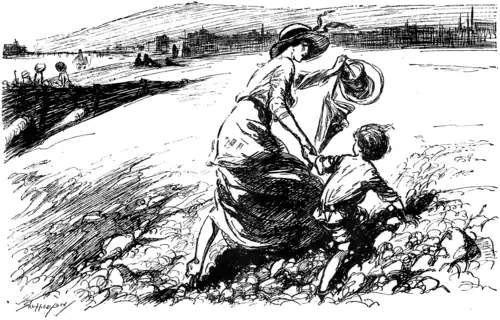
Little Boy. "How angry the sharks must be with these German submarines—of course I mean the English sharks."