Page:Punch Vol 148.djvu/548
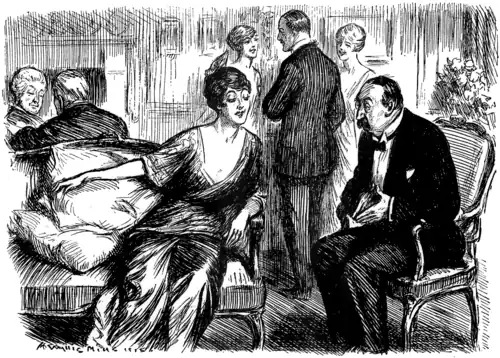
Special. "One of the bombs fell less than twenty yards from where I was on duty the other night."
She. "Really! How exciting! Did it wake you?"
REPENTANCE.
At the unusual sound of cheering in a London street—at so undemonstrative an hour as 9.15 A.M.—I turned and stopped. Down Charing Cross Road came three taxis, each containing many bags and many young men—certainly seven young men in each, packed high and low—and each containing two or more of that beautiful red-white-and-green flag which flutters so gaily and bravely over public buildings in Rome and Florence and Turin, Venice, Verona and Milan, and on festa days (which come several times a week) in all the villages of the loveliest land on earth.
The young men waved and shouted, and apathetic London, which has never yet cheered its own soldiers through the street, shouted back. For these were young Italians on their way to Italy, and there is something about a foreigner hastening home to fight for his country that would seem to be vastly more splendid than the sight of our own compatriots leaving home for the same purpose. So oddly are we English made.
Still, these young fellows were so jolly and eager, and even in the moment of time permitted by their sudden apparition it was so possible to envisage war's horrors in front of them, that no wonder there was this unwonted enthusiasm in the Charing Cross Road at 9.15. A.M. Besides, Italy had been a long time coming in...
A block brought the taxis to a standstill just by me, and I was conscious of something familiar about the youth in grey on the very summit of the first. He had perched himself on the fixed fore-part of the cab, and knelt there waving a straw hat in one hand and his country's flag in the other. And suddenly, although his face was all aglow and his mouth twisted by his clamour, I recognised him as a waiter at the—well, at a well-known restaurant, whose stupidity had given me from day to day much cause for irritation and to whom I have again and again been, I fear, exceedingly unpleasant. Less than a week ago I had been more than usually sharp. And now I found myself trying to catch his eye and throw into my recognition of him not only admiration but even affection—a look that would convince him instantly that I wished every impatient word unsaid. But he was too excited to see anything in particular. His gaze was for the London that he had lived in and was now leaving, and for that London as a whole; and his thoughts were on his native land and the larger life before him. He had no eyes for a bad-tempered English customer. (And quite right too.)
In a few moments off they all went again, and with them went my thoughts—to their beautiful land of sunshine and lizards, blue skies and lovely decay, and absurd gesticulating men with hearts of gold. With them went my envy too, for it must be wonderful to be young and able to give up waiting and strike a blow for one's country.
Since then I have found myself saying to myself, I don't know how many times, "I wish he had seen me."
Old lady, selling red-white-and-green flags during the passing of the Italian procession through the West-end: "'Ere you are; on'y a penny; all silk; another Alien for England!"