Page:Punch Vol 148.djvu/448
Galicia, Bukowina and Transylvania, would Great Britain and France be prepared to sanction such separate settlement?
Young Primrose shook his head. Couldn't personally assume responsibility of speaking for Allies on such grave matter. Doubtless they would find opportunity of considering the proposal when set forth in Parliamentary Report.
Our Mr. John quite content. Felt that so happy a scheme of settlement needed only to be known to gain acceptance. No desire to push himself forward. But if England and her Allies thought his counsel and assistance of any value they were unreservedly at their disposal.
Lloyd George looked on admiringly. Gallant little Wales, long condemned by obtrusive neighbour to a position of comparative insignificance, coming to the front at last.
Business done.—On Post Office vote Hobhouse gave interesting account of work of his Department. The War has largely increased its labours. Every day trainloads of from eighty to ninety tons of letters and parcels are sent to France. To Egypt and Dardanelles go weekly a quarter of a million letters and five thousand parcels. To the Fleet four and a half million letters and forty-five thousand parcels. "This," Hobhouse modestly remarked, "requires a very efficient organisation."
Thursday.—Ronald M'Neill's most famous parliamentary achievement suggests possibility of exceptional performance as a bomb-thrower in the trenches in Flanders. Stops at home and does almost equally good work in keeping his eye on things generally. Emulous of Our Mr. John's collaboration with the Foreign Office, he brings under notice of still absent Secretary of State particulars that have reached him of a new German device, less barbarous than poisoning the atmosphere with asphyxiating gas as a preliminary to the safe bayoneting of the enemy when found in a state of stupor, but just as carefully thought out.
Export of foodstuffs and other cargoes useful in war permitted to Scandinavian countries on the understanding that their Governments prohibit re-export to Germany. M'Neill has discovered a pretty plan for circumventing this arrangement. Cargoes are consigned in proper form to a neutral Baltic fort. On arrival they are re-consigned to another port in the same or a neighbouring neutral state.
That all in order. But arrangements have been made with the consignee by wily German agents to waylay the ship en voyage, capture it and carry it off. Primrose admits there is something in this romance of the sea. The Swedish Government have issued regulations intended to prevent addition of new chapters. If this proves ineffective things may happen.
Business done.—Chancellor of the Exchequer submitted Resolution affecting sale of alcoholic drinks. Spoke for two hours to House crowded for these times when many gallant members are at the Front. In respect of taxation proposal exceeded conjecture. Duty on spirits to be doubled; on wines quadrupled. Beer tax sensibly increased, even for lighter ales, not in favour with workers on the Clyde and elsewhere, who are turning out munitions of war. Irish Members up in arms against what Tim Healy described as "assassin taxation." William O'Brien breaking long silence declared that effect upon distilling and brewing industries in Cork would be as horrible as if the City were bombarded and sacked by the Germans.
Division challenged, the first since outbreak of war. William O'Brien and his once more Truculent Tim led into Lobby thin party of three. Eighty nine members, including some of the regular Opposition, voted with the Government. Big majority. But there is trouble ahead in the way of carrying's through a drastic scheme.
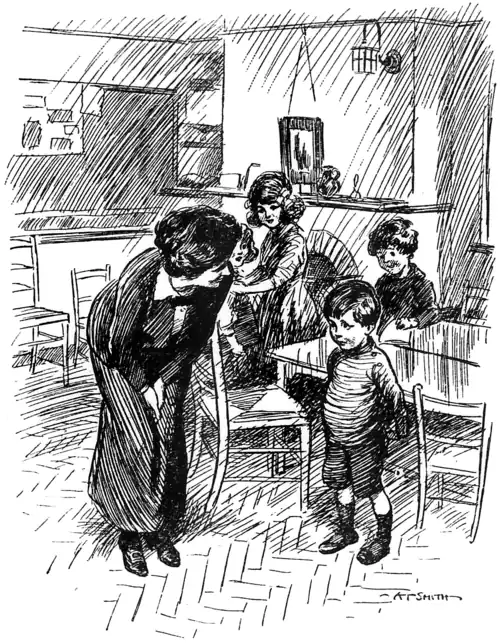
Schoolmistress. "Well, Freddie, what did you learn yesterday?"
New Boy (after deep thought). "You ought to know—you teached me."
THE GREAT UNHUNG.
The following works though many of their titles are reminiscent of popular pictures, will not be found adorning the walls of Burlington House.
Potsdam: looking East AND West. By W. Hohenzollern.
When did you last see your Father? By General von Kluck. Dedicated by the artist to H.I.H. the Crown Prince.
A Study in Still Life. By the Captain of the Goeben.
Belts. A fancy portrait of Samuel Browne, Esq. By a Subaltern.
Portrait of David Jones, Esq. By Von Tirpiz. An example of this painter's water-colour work. The use of ultra-submarine is particularly noticeable.
Mirage à la Mode. By Enver Bey. (German School.)
The Hay Wane. By a German Remount Officer.
Britannia Ruling the Waves. A North Seascape. By J. Jellicoe. (Sea Chantey Bequest.)
The Non-Fighting "Prince Eitel" Tugged to her last berth. By a U.S.A. Customs Officer.
"A public meeting was held on February 9th at the Popular Town Hall to urge the Government to take over the control of fool supplies."
Times of Ceylon.
Up to the present we have not heard of any steps being taken in this direction; but Parliament is still sitting.
"Revs. Kerr and C. T. Bennett, B.A., will exchange pulpits next Sabbath morning. Evening services will be hell in their respective churches as usual."
Welland Telegraph, Ont.
For choice we should have attended the morning service, in the hope that it might be more like "a little heaven below."