Page:Punch Vol 148.djvu/447
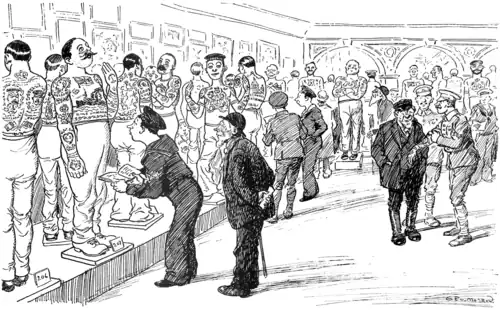
Simultaneously with the Private View of the Royal Academy, the Royal Society of tattooists open their Annual Exhibition.
ESSENCE OF PARLIAMENT.
(Extracted from the Diary of Toby, M.P.)
House of Commons, Tuesday, 27th April.—Both Houses engaged in consideration of treatment of British prisoners in Germany. In time past have had sharp differences. To-day united in detestation of barbarities practised upon helpless captives. Idea of retaliation unanimously discarded. As Lord Newton put it, if there is to be competition in brutality there is no doubt that we should be outdistanced. Possible, indeed probable, that one result of the War will be capture of German trade, but, when it comes to brutalities "made in Germany," competition hopeless.
Idea of paying off on bodies of German prisoners in this country the cowardly cruelty dealt out to our gallant officers and men who have fallen into human hands less merciful than Death is unthinkable. Great Britain is not going to soil her hands because Germany has irretrievably fouled hers. Still, something must be done in the way of meting out due punishment to responsible authorities who have encouraged or permitted their subordinates to torture, starve and grossly insult those whom the fortunes of war have left defenceless in their custody.
Kitchener, not given to strong language, put his indictment in a few terse sentences, not based upon rumour but substantiated by unquestioned personal testimony.
"Our prisoners," he said, "have been stripped and maltreated in various ways. In some cases evidence goes to prove that they have been shot in cold blood. Our officers, even when wounded, have been wantonly insulted and frequently struck."
No passion displayed during debate in either House. There is a profundity of human anger too deep for words. But something ominous in the sharp stern cheer which greeted the Premier's emphatic declaration.
"When we come to an end of this war—which please God we may—we shall not forget, and we ought not to forget, this horrible record of calculated cruelty and crime. We shall hold it to be our duty to exact reparation against those who are proved to have been the guilty agents and actors."
Business done.—German brutality to British prisoners taken note of.
Wednesday.—Abroad and at home generally accepted that in Edward Grey British Foreign Office has efficient and trustworthy representative. Nevertheless it is, as the proverb shrewdly says, well to have two strings to your bow. House observed with satisfaction that a second is provided in person of Member for East Denbighshire. Mr. John—that way of putting it suggests allusion in servants' hall to a son of the house—keeps a comprehensive eye on progress of the War. Ahead of most folk, he for the moment concentrates his gaze upon the dawn of peace. To-day invited Secretary of State for Foreign Affairs to say whether, seeing the Government has undertaken that the Overseas Dominions shall be effectively consulted when terms of peace come to be formulated, the fullest facilities will also be accorded to the people of Great Britain and Ireland to make known their views and desires.
Secretary of State, judiciously absent, left that promising lion-cub of the Foreign Office, Neil Primrose, to reply. Answer brief and non-committal.
So far, so good. Our Mr. John next ascended loftier heights. Surveying relations of Austria-Hungary and Russia, propounded detailed terms of separate peace. Provided that Bosnia and Herzegovina are transferred to Servia, Austria undertaking to withdraw personally from association and military co-operation with Germany, Russia making such terms as may be considered advisable with regard to