Page:Punch Vol 148.djvu/434
scores by one adventurer after another, ending with the victorious emergence of Hallard. Practically all the tales have this feature in common, that the persons swindled are no better than the swindlers, so there is no one for whom you need be sorry; paste cuts paste throughout, and the moral of the whole appears to be that when rogues fall out there will generally be a third and greater rogue to come by the booty. Which may all be quite good fun, if a little mechanical. There is one excellent illustration, which the publishers were so certain I should like that they have triplicated it (it appears on wrapper, cover and frontispiece), but without acknowledgment of the artist's name.
Patricia (Putnam) I should call a placid novel rather than a brilliant. Edith Henrietta Fowler (Mrs. Robert Hamilton) has considerable gifts of observation, though in her character drawing she is perhaps a little prone to overemphasis. Also she knows the life of which she treats; has seen, for example, what a singularly uncomfortable abode a country rectory can be, and is not afraid to say so. Patricia had to go and live in the rectory with a kind uncle and aunt on the death of her father. Before that she had been quite well off and by way of leading the fuller life. Her frocks, for instance, were of the latest. At the same time her taste in dress was not what I can applaud, as when journeying with her relatives to the rectory she wore such thin shoes and stockings that on the muddy walk from the cab to the front door she got cold feet. Of course Patricia makes a mild sensation in her rural surroundings, which is increased when the son of the local big-wig turns out to be one whose society she had tolerated in the fuller life. There are some well-observed sketches of character, one of them, the Rector's wife, touched with real beauty. For the rest it is all quite gentle, and just a little reminiscent of the Parish Magazine; though the interest certainly quickens with Patricia's publishing indiscretions, which I shall not reveal. Still lemonade, one might call it, with just a suspicion here and there of some strictly non-alcoholic champagne, the result being a beverage rather for the thirsty drainer of circulating-libraries than for those who require their fiction full-bodied.
I should suppose that the Dead Souls of Nickolai Gogol, written in 1837, offers a not much closer picture of the Russia of to-day than does Dickens' Oliver Twist, written at the same time, of our twentieth-century England. For though we may have made a quicker pace and have many more miles of rails and wire to the given area (and is this not Progress?) there has happened for Russia between that time and this the fateful freedom of the serfs or "souls." This classic novel of Gogol's describes the adventures of a plausible rogue, Tchitchikoff, who has a get-rich-quick scheme, quite in the manner of the best American business farces, for begging or purchasing at a ridiculously low rate, to sell at a profit, those serfs who, though actually dead, are still legally alive till the next census, the purchaser not being informed of their demise. Mr. Stephen Graham's introduction to this re-issue by Unwin of an English rendering promises the reader much, and Mr. Graham is a better judge than I. Perhaps the rather matter-of-fact translation was responsible for a little of my disappointment. But no one can fail to appreciate this sort of thing:—"So that's the procurator!" (says Tchitchikoff as the funeral procession passes). "He has lived and now he has died; and now they will print in the newspapers that he died regretted by his subordinates and by all mankind, a respected citizen, a wonderful father, a model husband; and soon they will, no doubt, add that he was accompanied to his grave by the tears of widows and orphans; but in sooth, when one comes to examine the matter thoroughly, all one will find in confirmation of these statements is that he had wonderfully thick eyebrows!"
Una Field, introduced to us at the opening of Mr. William Hewlett's book as The Child at the Window (Secker) of a country vicarage, bewails herself bitterly at the close of the volume on finding that she is still an onlooker at life, and no more gifted with understanding than she was at the beginning; and this after experiences far more varied and peculiar than are usually vouchsafed to vicars' daughters, even though dowered with exceptional beauty and rich impulsive godmothers. Really, I could have warned Una quite early that, if she wanted to hear the world's heartbeat, she wasn't going on the right tack. She seemed to think that it ought to beat loud enough to attract her attention when she was busy with other things—chiefly herself. Never was there a lady who received so much kindness and made so little use of it. I need not follow in detail her depressing career from the time when, after being most generously brought up and educated by her godmother, she ran away (omitting the formality of marriage) with Cecil Rowan, left him on finding him to be what others had expected, and accepted the charity of Sybil Grey, a school friend of whose doubtful character and tastes she had full cognisance. Later, however, she took a dislike to her friend's habits, and went away suddenly without a murmur of thanks. Nor did she feel any obligations towards the Rev. Philip Corthwaite, an old adorer, whom she married for the sake of a husband and a home; but made an attempt to captivate Sybil's brother, another cleric. He, sensibly enough, would have none of her, and hurried off into the bosom of the Roman Catholic Church. Una's godmother and husband eventually forgave her all these peccadilloes that I have cursorily indicated, and a lot more that I have no time to record, and Mrs. Majendie persuaded her to start again with Philip. I wish him luck. And I ought to add that Mr. Hewlett has a real gift of characterisation, though the colours he uses are sometimes too startling to seem quite natural. His descriptive powers, also considerable, are often spent, regrettably enough, on subjects and scenes either sordid or absolutely distasteful. I should like him to write a book with some much more wholesome and cheerful people in it.
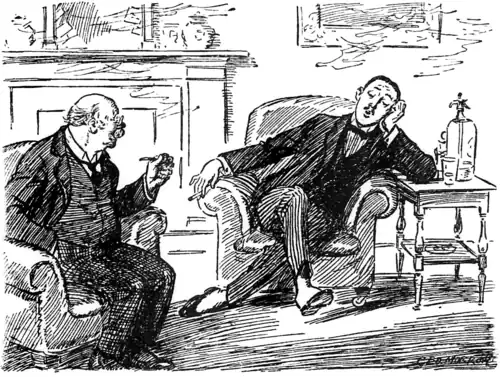
The Young Man. "As a matter of fact I think I've done rather well. You see, I've given four cousins and an uncle to the Army, three nephews to the Navy, and a sister and two aunts to the Red Cross organisation."