Page:Punch Vol 148.djvu/363
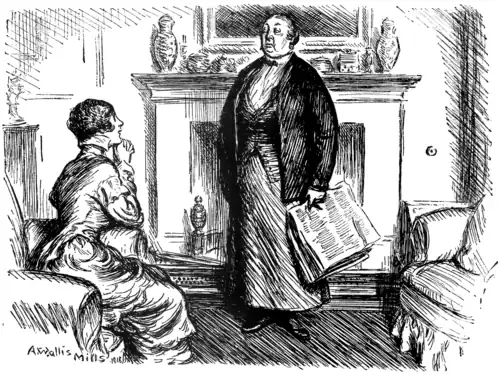
The Aunt. "I shall certainly volunteer to do men's work. But the position must be a dignified one."
The Niece. "I know, Aunt. Go as a butler."
LIFE-SAVING AT SEA.
The publication of a Navy Supplement in his present issue furnishes Mr. Punch with an excuse for appealing on behalf of a cause—closely associated with our sea-service—which is liable to be overlooked among the many claims that the War makes upon his readers. It is the cause of the Royal National Life-boat Association. The extinction of lights and beacons, the removal of buoys, and the presence in many unascertained spots of floating mines have enormously increased the dangers to shipping and added yet further risks to the hazardous work of our Life-boatmen. Since the beginning of the War our Life-boats have on over 60 occasions rendered service to Cruisers, Torpedo Boats, Military Transports, Mine Sweepers, Submarines, etc., and 216 lives were saved from these vessels up to the end of last year. The assistance given to the hospital-ship Rohilla involved the complete loss of one Life-boat and serious damage to three others. The total additional cost up to the 31st of December amounted to over £6,000. No grant whatever is received from the Government, and the whole work of the Life-boat Institution, entailing an expenditure of about £112,000 a year, is supported entirely by Voluntary Contributions.
Subscriptions, greatly needed, should be addressed to The Royal National Life-boat Institution, 22, Charing Cross Road, London, W.C.
How History is Written.
"A number of poor children, some of them the shoeless, had got on the pavement outside the awning, and as Queen Alexandra approached they pushed their heads under the canvas to get a better view. Her Majesty was much amused, and, stooping down, patted some of the heads."—Times.
"As soon as Queen Alexandra arrived she noticed some little dogs poking their heads under the awning, and she laughed and stooped down to pat them."—Evening News.
Personally we prefer The Times' version of the incident.
The Chancellor of the Exchequer says that there is nearly as much alcohol in ginger-ale as in light beer. Clearly dolus latet in gingeralibus!
DAWN
(By our Spring Poet.)
Down to the nadir drops;
The amber oriflamme of morn
Flaunts on the mountain tops;
And sybaritic airs that come
From far translunar shores
Bring wafts of fragrant galbanum
And melting madrepores.
The pipit pours its lay;
The polyanthus seems to make
Perpetual holiday;
The owl his limber jerkin dons
To brave the heats of noon,
And panoplied in living bronze
Darts o'er the dim lagoon.
Their velvet curves on high,
And lend a choriambic gloss
To nature's revelry;
While rhadamanthine shapes afloat
In fields of asphodel
From holophote to holophote
Proclaim that all is well.