Page:Punch Vol 148.djvu/356
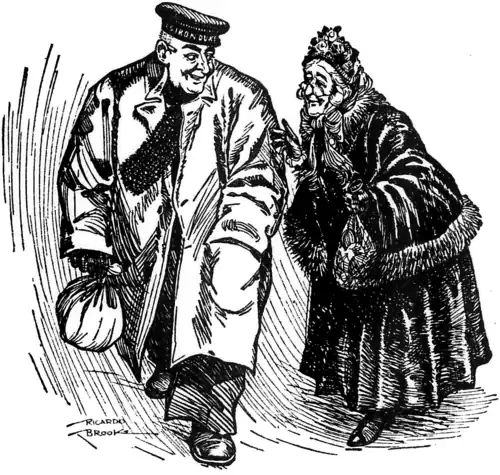
Elderly Knitting Enthusiast. "Excuse me, young man. Could you tell me what size in socks Admiral Jellicoe takes?"
THE WATCH DOGS.
XV.
Dear Charles,—We've just paid a flying visit to the trenches. Having nothing better to do, we made our way to the place where the noise is and, in batches, spent a couple of nights with the Umpty Umpths in their eligible residential villas known as Cheyne Walk. To get there from the billets you take the high road from Qu'est que c'est que ça to Cela va sans dire and keep on with it until the machine guns open up on your left flank. You then take a sharp turn to the right, until you observe the beam of a searchlight playing across the field in front of you. You then lie flat on the ground and pretend you are not in France at all, and when the searchlight has come to the conclusion that, wherever you are, you are not worth bothering about, you get up and go on, keeping the searchlight well on your right, the machine gun well on your left, and stepping decorously out of the path of any sniper's bullet which happens to be passing.
Proceeding quietly but quickly along the line of least resistance, you are suddenly confronted by a figure emerging from the dark, who tells you to halt or he'll fire. "Et tu, Brute!" you murmur reproachfully, as you halt and wonder to yourself why it is that you have suddenly become so unpopular. The figure says his name isn't Brutus, but that he is come from the trench to guide you to it, and thereupon you throw your arms round his neck, which he takes to mean that you love him and wish never to be parted from him. As to the love, that all depends; you'll be better able to say in the morning when you've seen him in the daylight, but as to the sticking together he is well on the right side there.
"And now," you say, "what about that trench? Shall we be getting on towards it? We love being out here in the open, but we feel we oughtn't to keep your friends sitting up all night for us." He is inclined to be discursive and to go through a list of the casualties which have occurred at the very spot whereon you stand. He then tells you to follow him, and suddenly disappears.
Seeing that there are now searchlights and machine guns in all directions, it doesn't much matter which road you take, so you go straight ahead and hope for the best and fear for the worst and fall into a pit-hole and find the guide. And one by one your men behind you fall into the same hole and use the same suppressed but disgraceful expression with regard to it.
"It is a scandal," you tell the guide in an indignant whisper as you fix your arms round his neck even more affectionately than before,—"it is a scandal, the shocking state of repair in which French turnip fields are kept. Where are the police, where the gendarmerie, where the writers of letters to The Times? In an English field such holes would never be allowed."
He explains that it isn't a hole, it's a trench, and may he have his neck to himself for a bit? You relax your hold and examine the spot to which he has brought you. Felicitating him upon the ingenuity with which one tortuous ditch is made to combine the uses of a roadway, a water-main, a sewer and a home, you bid him good-night and hand yourself over to the Captain. Having introduced yourself to the Captain and apologized for continuing to exist in spite of the desire, apparently universal, to get rid of you, you remark that this is one of the most attractive and well-aired trenches in which you ever remember making a bit of war. You then go along with him to settle your men in, only to find that they have done this for themselves and are already giving valuable advice to the occupants of the place as to how trench-fighting should, and will in future, be conducted.
The Captain then says that trenches are all very well in their way, but dugouts are better, and you resort with him to an elegant pig-sty round the corner. You have not been there long before his servant arrives with a cup of tea; this is followed by a cup of coffee; this is followed by a cup of cocoa, and this is followed by a cup of soup. If you pine for another cup of cocoa, you have just got to go without, because it is now getting on for dawn and your cup (there is only one) is required for your early morning tea. You then settle down as best you can to a wee drappie of whisky from a flask (his) just to keep off your ravaging thirst. And all the time the bullets go pit-a-pat, and no one seems to care as long as there's water boiling for the next brew.
Stepping down the trench to see the sights, you discover the men employed in the constant and reprehensible habit of tea-drinking. The sentries lean against the parapet with their backs to you and appear as men who are watching a dog-fight which has lost for them all its excitement but not all its interest. Every now and then they loose off their rifles into the dim beyond, not in any real hope of hitting anything, but just to show there is ill-feeling. On most nights there is a gentleman opposite who addresses our trench when he comes on duty, "It is I, Fritz, the Bunmaker of London. What is the football news?" They shout out the latest information and pass him over a couple of bullets. This is no doubt because they recollect his buns, over-priced and under-curranted. He replies in kind, feeling perhaps that he has already lost his customer and may as well make a proper job of it.
The rest of the day you spend in admiring the legitimate handiwork of your own artillery and regretting the inexcusable criminality of the enemy's. You improve your trench, you do a little sniping yourself, admittedly killing at least one Bosch with every shot, and defeat the Captain time after time at piquet. He is worried by his responsibilities, you with the thought that so sound a fellow should have been tucked away in a Flanders turnip field for so long. And that is all there is about it.
Yours ever, Henry.
"Speaking of the rôle of Spain in the present war, Herr Ziminerman concluded the interview with the following words: 'The triumph of the Allies in the present war would definitely establish Anglo-French influence in the Siberian Peninsula. Consequently patriotic Spaniards ought to range themselves on Germany's side."-Exeter Express and Echo.
For fear, we suppose, lest the French and English should exile them to the other Peninsula—though not, of course, with Dr. Lyttelton's approval.