Page:Punch Vol 148.djvu/331
CHARIVARIA.
The Kaiser has been presented with another grandson. It has not yet been broken to the poor little fellow who he is.
⁂
What, we are asked again, has become of the German Crown Prince? According to our information the Kaiser consigned him some time since to a place the name of which has been censored.
⁂
The Austro-Hungarian army authorities have condemned 75,000 pairs of boots destined for the troops, the soles being found to consist of paper. Austria, like its distinguished ally, will have nothing to do with scraps of this material.
⁂
"The Germans," writes a correspondent from the French front, "have done much in Champagne which they will regret in their sober moments." We believe it.
⁂
A shocking case of ingratitude has come to our notice. Mr. Irvin S. Cobb, the American journalist, after being an official guest of the German Army at the Front, has issued an account of his experiences under the title The Red Glutton.
⁂
The Berliner Tageblatt states that four English trainers have been released from the concentration camp at Ruhleben. This is supposed to mark the Germans' appreciation of our decision not to abandon horseracing.
⁂
A number of German prisoners of war are, it is announced, to be interned in the Crystal Palace. Our ambition, we understand, is ultimately to find palaces for all of them.
⁂
"THE CARPATHIANS FIGHTING,"
announces a contemporary. We have heard of mountains "skipping like rams." Now, apparently, they are butting one another
⁂
"RHINO FIGHTS FOR GERMANY."
Daily Express.
We must keep a Watch on the Rhino.
⁂
German aviators have been dropping more bombs in the sea. They seem to be getting a little careless.
⁂
According to Le Matin, a German Staff Officer recently confessed, "We have lost the rubber." And he might have added, "We also have a difficulty in getting the copper."
⁂
"HEADMASTER OF ETON AND
GIBRALTAR"
Daily Mail.
We think this headline is scarcely fair to Dr. Lyttelton. He particularly does not wish any Englishman to be master of Gibraltar.
⁂
Ready shortly, by Dr. Lyttelton, a brochure entitled, "On the importance of saying what you mean, and meaning what you say."
⁂
Meanwhile we are informed that the outbreak of German measles at Eton has nothing whatever to do with the Headmaster's famous utterance.
⁂
In London, we learn from The Daily Mail, classes are being organised to teach women "how to do the grocery trade." This looks like retaliation.
⁂
"Mr. Stephen Scrope," says The Liverpool Daily Post, "has deposited an additional £500 for the first vessel to sink an enemy submarine with 'The Yorkshire Post.'" We should have thought that one of our quarterly Reviews would have been better adapted for the purpose, and we shall be surprised if The Yorkshire Post does not resent this insinuation of heaviness.
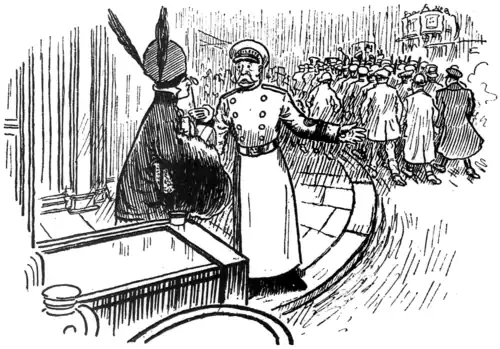
Lady (who has spend some time in the shop). "Where's my chauffeur?"
Commissionaire. "Just this moment joined, Madam."
"The Red Cross Ladies, by working in shifts, are able to keep the buffet open from 6 a.m. until midnight."―The Times.
Surely an inadequate costume.
What the "Star" Saw.
"Simultaneous with the resumption of the Allies' attack on the Dardanelles over the Gallipoli Peninsula, and from the mouth of the Straits, the Russian Baltic Fleet yesterday successfully bombarded the outside forts and batteries of the Bosphorus."―Star.
Our evening contemporary is the only journal to record this remarkable long-range performance―accomplished, we presume, with "star-shell."
Burning Questions.
"Fellow-Traveller Wanted, who was in 3rd class smoking compartment 9 p.m., King's Cross to Hitchin, Thursday, Jan. 14, 1915. Identification circumstance, who saw gentleman alight at Stevenage, and whose lighted match was blown on advertiser's overcoat; Urgent Appeal."―Morning Post.
As far as we can gather from this advertisement, which is not so illuminating as the subject demands, the incident affected three fellow-travellers, of whom two were ignited, and only one, the advertiser, is known to have been put out. The fate of the other who was last seen "alight at Stevenage" can only be conjectured.
"There is no 'h' in the Russian alphabet. Therefore the Russians spell Hartlepool 'Gartlepool' and call Field-Marshal Hindenburg 'Gindenburg'... and why we continue to miscall a town which is both written in Russian and pronounced Harkoff 'Kharkov' is more than one can tell."―Sunday Times.
At last we thought we had got the key to Russian phonetics, but this last sentence snatches it all away again.
Several correspondents have written to to tell us of the shocks they received on seeing this startling newspaper bill:―
"RUSSIANS
MARCHING
ON
PALL MALL."
Some of them feared that our Allies had suddenly turned round and become our invaders, while others found in the announcement a comforting confirmation of the hopes they have secretly cherished ever since the great Russian rumour first got afloat.
"Drogheda has sent many soldiers to the battlefield, but the marital spirit is not yet exhausted."―Drogheda Advertiser.
Three cheers for the brave wives of Drogheda!