Page:Punch Vol 148.djvu/310
small sister and brother sent out widespread invitations for a party of "theatrakulls" to the number of some two hundred, and only by a happy accident was the grown-up hostess warned of this entertainment. It seems characteristic that no attempt was made to avoid the undesigned responsibility, and the "theatrakulls" duly took place, with enormous success. Surely, much of the jollity of a family like that survives in its daughter's pages.
There is, or was, to be seen in the papers an advertisement of some profit-sharing tobacco company, of which the chief feature was a happy-looking person with a cigar in his mouth who was supposed to be saying through the clouds of the same, "I am paid to smoke." I achieved something of this man's happiness while reading The Voice of the Turtle. The thought that I was actually being paid to read it made my pleasure perfect, for as a rule, when I become absorbed in a book, an inconvenient conscience worries me with suggestions that I am a lazy devil well on the road to the workhouse. It is a shame to take money for reading The Voice of the Turtle. It is the pleasantest, most engaging book. Shallows, Mr. Frederick Watson's last novel, good as it was, had not prepared me for this excellent comedy. If Messrs. Methuen, who publish both books, have any influence with Mr. Watson, they will urge him to stick to comedy, for it is his line. He has the style, the sureness of touch, the gift for characterization, the humour and the instinct for the good phrase which command success in this branch (or twig) of literature. He can be delightfully amusing, and, like the lady in Mr. George Ade's fable, can "turn right around and be serious." As proof of the first statement I would adduce the description of Mr. Martin Floss's reasons for taking Deeping Hall, in Loamshire, his journey thither and his first attendance at church; as proof of the second, the various scenes in which the gradual alteration in his character is conveyed to the reader. Mr. Watson, as a writer, is the exact opposite of his Mr. Richards, the choir-singer. The latter, "with a reckless debauch of strength," produced no results whatever. The former has written an excellent novel without seeming to exert himself at all. He has just quietly thrown off a little masterpiece.
Mrs. Parry Truscott had intended to call her latest story Such Is Life, but discovered at the last minute that this title had been already requisitioned. She has hit on a second name that is meant, I suppose, to come to about the same thing as the first, since to be Brother-in-Law to Potts (Wener Laurie), or such as Potts, may be taken as a typical incident of every-day existence. For it is as a very ordinary person that he is introduced, and the same applies to his brother-in-law; in fact so humdrum did all my new acquaintances seem likely to be from the opening chapters that I had serious doubts whether I could ever call them friends. A fellowship in tube and bus is all very well, but on a winter evening I like the figures that people my hearthstone to bring in some finer air of mystery and romance. But the authoress, as I ought to have remembered, knew well what she was about, and showed me once more that the slangy bank clerk on the opposite seat was not only her hero, but a worthy knight of King Arthur's Table; that her commercial traveller carried about a lifework of regeneration with his bag. Indeed before I had gone far I was made to realise that, though the scene of the drama was a London common and a house or two in its dreary neighbourhood, the piece itself, humorous, romantic, tragic in turns, was really an old, old mystery play―consciously allegorical. Whether as an allegory it is entirely successful, or whether it will be remembered more for the fascinating intimacy of its characterisation and the almost uncanny penetration of its philosophy, I am not presuming to say. Perhaps you may think that the difficulty of knowing where to stop is not perfectly overcome―I admit I would rather have known either more or less of the Beautiful Lady―but that is a point you must consider after reading the book. Take my advice and do so at once.
Glad as I am to welcome Mr. Eden Phillpotts back to the Devonshire that is his by right of pen, I think that Brunel's Tower (Heinemann) is a little lacking in salt and also in West Country atmosphere. But it would be unfair to blame Mr. Phillpotts for these regrettable omissions because his main object here is to give us a very complex psychological study. "A tall, thin boy was stealing turnips, and, chance sending a man to look over a gate, that accident determined the whole future life of the turnip-stealer." At once my sympathy was enlisted on behalf of this lad―Harvey Porter―who preferred stealing to starving, but after he had found refuge in the pottery called Brunel's Tower and had become a favourite with the owner my interest in him began sadly to wane. With meticulous care Mr. Phillpotts sets forth his hero's character; no fairer statement of a case was ever made. But granted that a boy of Harvey's upbringing might be puzzled to distinguish clearly between right and wrong, I still wonder whether among his besetting foibles the vice of meanness need have figured so strongly. Specialists in the influences of heredity and environment will revel in a study that is marked by great sincerity, but I have such an affection for Mr. Phillpotts' former work that I cannot offer him a very enthusiastic welcome in his new role of psychologist.
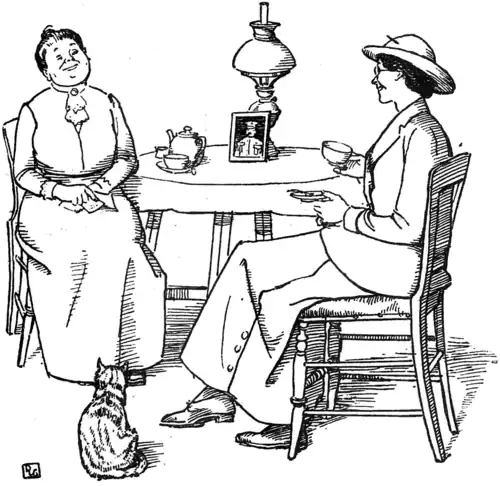
MORE GERMAN LOSSES.
"My brother writers that he's found one of those Uhlans' helmets, and he's sticking to it as a keepsake."
"My! won't the Kaiser be mad!"
"The Guillaume was congratulated by the British Admiralty on its bombardment of Dardanos fort. This vessel demolished powerful batteries, and was struck by two 150 kilometre calibre projectiles."
Dublin Evening Mail.
These 94-mile calibre guns would have been used in the West, no doubt, but that they are somewhat lacking in mobility.