Page:Punch Vol 148.djvu/279
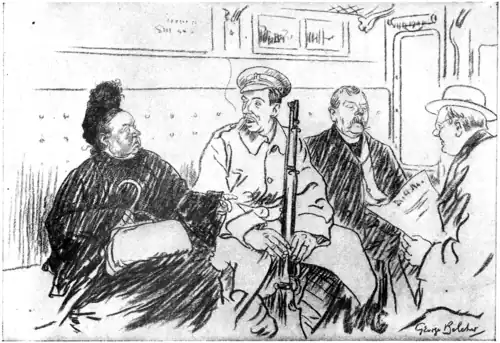
Nervous Old Lady. "Young man, if that gun's loaded, will you please hold the spout out of the window?"
PESTS.
Reports from the Continent state that the soil of the whole of Belgium and part of France has been devastated by hordes of maggots, insects, mealy bugs, weevils, parasites, lice and slugs; and that scabs, blight and fungi lie thickly everywhere, especially where there is little light and a lack of proper means of ventilation. The following list, though by no means complete, may be found useful:—
German Blight.—The bacteria producing this blight have a most remarkable culture. The blight destroys whatever it touches. A Joffre Sprayer, 75 millimetre nozzle, has been found to be most efficacious and is keeping the blight well under. Another method is to take some cuttings of the British oak and place them in trenches; these soon begin to shoot, and not only form an effective barrier but drive back the "blighters," as these devastating organisms are called.
The Kaiser Pest.—This preys everywhere. It is known by its bleeding heart and an insinuating proboscis associated with two upturned antennæ. It has an inflated head and is closely related to the Willy Bug. It likes a place in the sun or any strong light, and seems to thrive in close proximity to the Krupp plant. The only treatment for this loathsome pest is sulphur fumes and a constant temperature of 100° C.
The Kiel Slug.—This belongs to the order of Infanticidæ. Very few specimens have been seen, and these have at once succumbed to the application of a brush with British tar. The very excellent spirits of salts brought out by the firm Jellicoe has a paralysing effect upon this slug.
The Zeppelin Moth.—From its size this insect appears more harmful than it really is. It has been known to drop its eggs on and destroy cabbages. Many growers remove their young plants to cellars when they see this moth hovering about, as it seems to have an especial liking for anything young and tender.
The Spy Glowworm.—This has been observed on the East Coast. It has a well-developed motor nerve, which causes it to move about quickly. After dark it emits a bright light, and this attracts the Zeppelin moth. Any good copper preparation will arrest this evil.
The Sniper Maggot.—This is a nocturnal feeding grub and difficult to locate. Some are spotted and some are not. The spotted variety does not live long. The only remedy is to pick off each one when located and to be very careful when potting.
Constantinopolitana.
In spite of war's alarms the more thoughtful among the Turks continue their interest in Culture. Literature is not neglected. It is stated that the book most in demand in the local circulating libraries is Queen Elizabeth and Her anti-German Carden.
A Turkish War Fund is now being organised, and contributions are beginning to come in. A leading pasha heads the list with a donation of ten wives.
A serious shortage of cash prevails. It is noticed that the tram-conductors, following instructions to take payment in kind, say, "Fez, please."