Page:Punch Vol 148.djvu/263
ESSENCE OF PARLIAMENT.
(Extracted from the Diary of Toby, M.P.)
House of Commons, Monday, 1st March.―Another crisis in the War. Again a crowded House. Once more a great speech from Prime Minister. A special Providence ordains that at such a crisis we have at head of affairs a strong man endowed with gift of lucid speech, which from its very qualities of simplicity and honesty of purpose frequently, without visible effort, rises to height of eloquence. Rarely in its history, perhaps never, has House found its sympathies, convictions and aspirations so faithfully, so fully, so forcefully expressed as on several occasions during last seven months when Asquith has stood at Table and talked about the War, its purpose, its prospects, and its inevitable accomplishment.
True, few Prime Ministers have been sustained and inspired in equal degree by assurance of the confidence and sympathy of a unanimous nation represented by a united Parliament. That is a position difficult to win, hard daily to live up to. With increasing success the Premier has achieved both successes. His personality is worth to the Empire an army in the field, a squadron of Queen Elizabeths at sea.
There was notable in the speech―as usual brief, since it was not attenuated by a superfluous word―increased confidence in the triumphant ending of the War. From the day when, standing in the same place, on the part of Great Britain he practically declared war against Germany, Premier has always spoken with quiet assurance of certain victory. Without boastfulness he has reiterated that conviction. This afternoon he was more definite.
"I assure the Committee," he said, "that with all the knowledge and experience we have gained His Majesty's Government have never been more confident than they are to-day in the power of the Allies to achieve ultimate and durable victory."
Coming in the course of his speech to the submarine "campaign of piracy and pillage" undertaken by Germany under the name of blockade, he spread out a scrap of paper on the brass-bound box, and amid repeated volleys of cheering from both sides read the terms of British reply. It was terse and effective. Germany, having systematically violated the restraining rules and humane usages of civilised warfare, will, to quote an historic phrase peculiarly appropriate to the situation, be left to stew in her own juice. The Allied Fleets of Great Britain and France―not sneaking under water with intent to destroy peaceful merchant ships, but openly sailing the seas in defiance of the German fleet cooped up, as the Premier said, in "the safe seclusion of their mine-fields and their closely guarded forts"―will prevent commodities of any kind from reaching or leaving German ports.
Business done.―Supplementary Vote of Credit of 37 millions to meet War expenditure to end of financial year and a fresh Vote of Credit of 250 millions agreed to by acclamation.
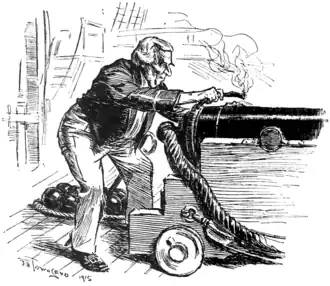
REPRISALS.
Tuesday.―Oxford University and her sister at Cambridge have between them many proud records. None more stirring than that recited by Prime Minister in moving Second Reading of awkwardly named Universities and Colleges (Emergency Powers) Bill. The attendance was scanty, but there was strong muster of University men, who listened with profound interest to words falling from lips of one in whom, as Walter Long felicitously said, "Oxford men claim a common possession, in regard to whom they feel they have abundant reason to be proud, not only for his record at the University but for the great part he is at the present moment playing in the history of the country."
Premier had moving story to tell of transformation wrought at the Universities. Their halls are deserted. Their examination schools and playing fields are occupied by hospitals. The pick of their scholars and the flower of their athletes have alike gone off to the War. No fewer than 4,000 University men, two-thirds of the full muster, are under arms. Of those that remain all the physically fit have joined the Officers Training Corps.
Amongst innumerable evidences of patriotism forthcoming since the Kaiser wantonly dragged unwilling Europe into the war pit this example of the Universities surely shines with unmatched splendour.
Financial consequences embarrassing. No undergraduates, no fees. At Cambridge revenue from this source, amounting in normal times to over £60,000 a year, is reduced by one-half. "As an old Oxford man, with great, undiminished, undying devotion to my own University," the Premier pleaded for new power to be conferred upon the heads of the Universities to meet the special claims and responsibilities that have sprung up. Walter Long, formerly of Christ Church, speaking on behalf of the Opposition, warmly welcomed the Bill, which was forthwith read a second time.
Business done.―Defence of the Realm Bill passed through Committee.
Thursday.―The case of Mr. Meyer, his timber purchases, and his modest commission, up again for discussion. Beck, on behalf of his Chief at Board of Works, gives frank and full explanation. Bonar Law chivalrously declares that method adopted by Government was "best possible in circumstances."
In interesting study of proclivities of contractors in war time, Mr. Barlow, who represents Salford in present Parliament, leaving for a while the company of his young friends, Sandford and Merton, told in his best form one of his many stories. A battalion of recruits being raised in provinces, a purchase of boots was arranged. It was found that the soles were liable to contract an inconvenient habit of parting from the uppers before first mile of march was completed.
Boots returned to contractor. A few months later further supplies required for increasing number of recruits. Application made to another firm. Goods delivered. There were found among them 1,500 pairs of the old lot.
"The only difference," Mr. Barlow added in his persuasive voice, "was that