Page:Punch Vol 148.djvu/255
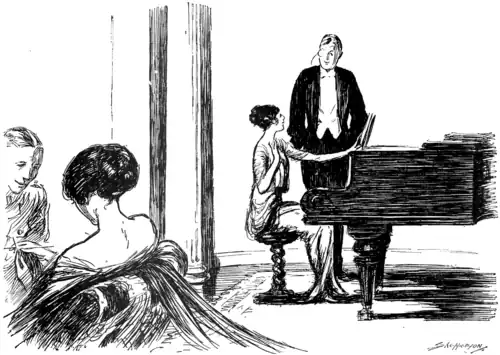
A PATRIOTIC SACRIFICE.
Very British Guest. "What! Brahms? You're surely not going to sing German?"
Hostess (apologetically). "Well, of course I shall take care to sing it flat."
A SINGING REFUGEE.
Gabrielle couldn't make it out. In the first place she had a conversational turn of mind, but, excepting her father and mother, three sisters and three brothers, there was nobody in this dull Sussex village to whom her remarks conveyed anything whatsoever. Men patted her on the head, women kissed her, and because her father had fought and bled for the brave King Albert little English gamins loudly cheered him and his family when he limped down the street. All these people had kind faces, but what was the use of that? In essentials they were precisely alike―she couldn't understand one of them, and it was very, very dull. And here was Gabrielle sitting on a hedgebank, playing with the fallen berries in her black pinafore, while overhead sang the chaffinch―a song she had heard before.
It was some silly rhyme about the big black tree-buds, perhaps, or the first celandine, with now and again a little "chink, chink, chinking" call to his mate, but the queer part was that he sang in Flemish. Only last Spring she had heard the very same song; he had sung it from the red-tiled roof at home, he had sung it from the stiff garden hedgerow, till Gabrielle, clattering over the stone-paved paths with her brothers and sisters, all in wooden sabots, frightened him away.
There could be no mistaking him; clearly they wouldn't have the chaffinch in Flanders this year. This was the reason he had followed Gabrielle all the way to England. But when she asked him questions about home at the rate of twenty a minute he didn't know the answers. Had he by any chance come across her big conscript brother, François; and how was Gustave getting on?―Gustave, who was to have married her sister Victorine next Easter, but instead was lying in a French hospital with a bullet through his leg. The chaffinch didn't know, didn't care, and merely hopped to the longest budding twig in sight, singing his heartless song, with the refrain over and over again: "Pink, pink, chinkety chink"―or sounds to that effect.
Perhaps he had called to pay his respects on Gabrielle at home and found her out; perhaps, looking into the white-walled cottage with his blue-capped head on one side, he had seen the old black cat playing with the bobbins of Victorine's lace pillow; that would have scared him off the windowsill, but not out of Flanders. What did it all mean? And why couldn't he tell her things that she wanted to know?
But the chaffinch couldn't, and Gabrielle, after calling him rude names, suddenly fell a-laughing and skipped about the road just because it was Springtime, and she was nine years old and had heard the first chaffinch of the year singing his careless chinking song―a song she had heard before.
At dinner, over the ragout and leeks, Gabrielle told her three sisters and three brothers how that another little Fleming, whom she knew very well indeed at home, had come to live in that village; he wore a red waistcoat and a chestnut-coloured coat with white-slashed sleeves, and sang sweet foolish songs about the Spring―and he didn't even know there was a War.