Page:Punch Vol 148.djvu/164
MORE THAN TWO.
Host. No, please don't sit there.
1st Guest. Oh yes, I much prefer it.
2nd Guest. Do let me.
Host. I can't have you sitting there.
1st Guest. I assure you I like being back to the driver.
2nd Guest. Do let me.
1st Guest. Not at all.
2nd Guest. I assure you I prefer it too.
'Host. No, sit here. When you're both comfortably settled, I'll get in.
1st Guest. Oh no, please. I'm sure you never sit there. I hate to take away your own place.
2nd Guest. Do let me.
Host. I insist.
1st Guest. Please don't say any more about it. See, I'm in now and quite comfy.
Host. It's very wrong of you to be there.
2nd Guest. Do let me.
Host. Can't I persuade you to change?
1st Guest. No.
2nd Guest. Do let me.
Host. Well, it's very wrong. I know that.
1st Guest. Please let us get on now. I never was more comfy in my life.
Host. You're sure?
2nd Guest. Do let me.
Host. But it's most unsatisfactory.
1st Guest. Not at all.
Host. Then you're sure you're all right?
1st Guest. Absolutely. I love it here.
Host. Very well then. (Sighs.)
2nd Guest. Do let me.
1st Guest. No, we're all fixed now.
Host. All right. (To chauffeur) Let her go! (To 1st Guest) It's a great shame, though.
1st Guest. I love it.
2nd Guest. I do wish you had let me.
And that is what happens whenever three polite people are about to ride in a motor-car.
Shares.
"A purse, containing sum of money; owner can have some."—Advt. in "Portsmouth Evening News."
And the finder may keep the rest for his trouble.
The Daily Chronicle (Kingston, Jamaica) says of the new Military Decoration:—
"It is of silver, and bears the imperial crown on each arm and in the centre the letters 'G.R.I.' (George, ex-Imperator)."
At least that's William's interpretation of it.
AT THE PLAY.
"A Busy Day."
I have always wanted to be a grocer. To spend the morning arranging the currants in the window; to spend the afternoon recommending (with a parent's partiality) such jolly things as bottled gooseberries and bloater paste; to spend the evening examining the till and wondering if you have got off the bad half-crown yet—that is a life. Many grocers, I believe, do not realise it, and envy (foolishly enough) the dramatic critic, knowing little of the troubles hidden behind his apparently spotless shirt-front; but even they will admit that to be a grocer for an hour would be fun.
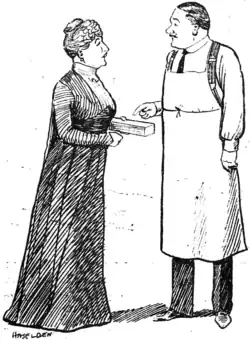
CLEAN BRITISH HUMOUR.
(As the saying is.)
Mr. Hawtrey and Miss Compton exchange badinage over a bar of soap.
And that (very nearly) was Lord Charles Temperleigh's luck. Being a spendthrift he was kept at The Bungalow, Ashford, without money; he escaped to the shop of his old nurse at Mudborough, with the idea of borrowing from her—and if you are a clever dramatist you can easily arrange that he should be left alone in the shop and mistaken for the genuine salesman. Unfortunately for my complete happiness (and no doubt Lord Charles's too) the shop was a chandler's; however, if that is not the rose, it is at least very near it. The chandler sells soap and the grocer sells cheese, and you can make a joke about the likeness as Mr. R. C. Carton did. And if Lord Charles should happen to be Mr. Charles Hawtrey and he should be accompanied by Miss Compton, you can understand that this and other jokes would lose nothing in their delivery.
Yet somehow the shop scene was not the success it should have been. The First and Third Acts wore better; they left more to Mr. Hawtrey. When Mr. Carton is trying to be funny, even Mr. Hawtrey cannot help him much; but when he is taking it easily then he and Mr. Hawtrey together are delightful. Mr. Edward Fitzgerald as an Irish waiter was a joy. Miss Compton was Miss Compton; if you like her (as I do), then you like her. The others had not much chance. It is a Hawtrey evening, and (as such) an oasis in a desert of War thoughts.
M.
A PRELUDE.
["Birds in London are already growing alive to the approach of Spring."—The Times.]
That carolled, on a wintry spray,
A crazy song of Spring-time—Hush!
No, not the one
By Mendelssohn
Victorian Britons used to play,
But just the sort of casual thing
An absent-minded bird might sing.
"Good friend, how premature your theme!
By some phenomenon misled,
You've overshot
The date a lot;
Things are so seldom what they seem!
"Then hear the simple truth," quoth he,
"For that's another rarity.
That sends great engines through the air
To deal destruction where they can,
To rain their fires
On ancient spires,
Ousting the birds that settle there,
And agitates, of fixed intent,
Our pleasaunce in the firmament.
Will see him pay the price of it,
So that is why I choose to sing
What isn't true—
But as for you,
Be off and do your little hit!
It's not for you to stand and quiz—
The season's what I say it is!"
"A Chicago Reuter message says that Hugh Henderson has won the American draughts championship by defeating Alfred Jordan, the London champion.
Draught horses were in most demand at Aldridge's, St. Martin's-lane, yesterday, and the sums obtained ranged from 30gs. to 49gs."
Daily Telegraph.
The forty-nine guinea one has challenged Hugh Henderson.