Page:Punch Vol 148.djvu/145
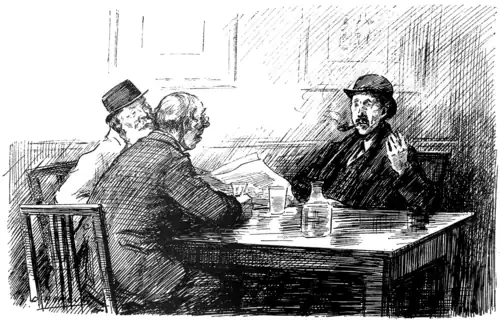
Old Farmer (to village Military Critic). "Strateegy? Dod, man, ye havena as muckle strateegy as wad tak' ye across Argyle Street unless a polisman helpit ye."
OUR BOOKING-OFFICE.
(By Mr. Punch's Staff of Learned Clerks.)
The German War Book (Murray) is a work in whose authenticity many of us would have refused to believe this time last year. It is a pity indeed that it was not then in the hands of all those who still clung to the theory that the Prussian was a civilised and humane being. However, now that everyone can read it, translated and with a wholly admirable preface by Professor J. H. Morgan, it is to be hoped that the detestable little volume will have a wide publicity. True, it can add little to our recent knowledge of the enemy of mankind; but it is something to have his guiding principles set down upon the authority of his own hand. Cynical is hardly an adequate epithet for them; indeed I do not know that the word exists that could do full justice to the compound of hypocrisy and calculated brutishness that makes up this manual. It may at first strike the reader as surprising to find himself confronted by sentiments almost, one might say, of moderation and benevolence. He will ask with astonishment if the writer has not, after all, been maligned. Before long, however, he will discover that all this morality is very carefully made conditional, and that the conditions are wide. In short, as the Preface puts it, the peculiar logic of the book consists in "ostentatiously laying down unimpeachable rules, and then quietly destroying them by debilitating exceptions." For example, on the question of exposing the inhabitants of occupied territory to the fire of their own troops—the now notorious Prussian method of "women and children first"—the War Book, while admitting pious distaste for such practice, blandly argues that its "main justification" lies in its success. Thus, with sobs and tears, like the walrus, the Great General Staff enumerates its suggested list of serviceable infamies. At the day of reckoning what a witness will this little book be! Out of their own mouths they stand here condemned through all the ages.
Mrs. Humphry Ward, chief of novelists-with-a-purpose, vehemently eschews the detachment of the Art-for-Art's-Saker, while a long and honourable practice has enabled her to make her stories bear the burden of her theses much more comfortably than would seem theoretically possible. Delia Banchflower (Ward, Lock) is a suffrage novel, dedicated with wholesome intent to the younger generation, and if one compares the talented author's previous record of uncompromising, and indeed rather truculent, anti-suffrage utterances one may note (with approval or dismay) a considerable broadening of view on the vexed question. For her attack here is delivered exclusively on the militant position. Quite a number of decent folk in her pages are suffragistically inclined, and there is a general admission that the eager feet that throng the hill of the Vote are not by any means uniformly shod in elastic-sided boots, if one may speak a parable. It is a very notable admission and does the writer honour; for such revisions are rare with veteran and committed campaigners. The story is laid in the far-away era of the burnings of cricket pavilions and the lesser country houses. Delia is a beautiful goddess-heiress of twenty-two, with eyes of flame and a will of steel, a very agreeable and winning heroine. Her tutor, Gertrude Marvell, the desperate villain of the piece, a brilliant fanatic (crossed in love in early youth), wins the younger girl's affections and inspires and accepts her dedication of self and fortune to the grim purposes of the "Daughters of Revolt." Mark Winnington, her guardian, appointed by her father to counteract the tutor's baleful influence, finds both women a tough proposition. For Gertrude has brains