Page:Prehistoric Times.djvu/111
as in those from New Zealand. Axes of the same type have been found by General Pitt Rivers in Wiltshire; they also occur in France, Egypt, and in the shell-mounds of Japan.
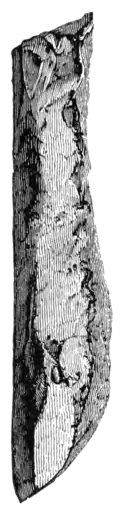
The chisels (fig. 105) resemble the Danish axes in having perpendicular sides, but they are narrower, and are almost always ground to a smooth surface. Many of them are slightly hollowed on one side, as in fig. 123.
Fig. 120.—Modern New Zealand adze, actual size. Upper surface. In the British Museum.
|
Fig. 121.—Ditto, under surface. |
Fig. 122.—Ditto, side view. |


Certain flat, semicircular flint instruments are common In Denmark and Scandinavia, but (with one exception) rarely, if ever, found elsewhere. The convex edge was fastened into a handle of wood, the marks of which are still, in many cases, plainly visible. The other edge, which is either straight or concave, is generally provided with a number of teeth, giving it more or less resemblance to a saw. In some cases it is so much worn away by use, that the implement takes the form of a new moon or of a boomerang. The edge is in many cases quite polished, evidently by continuous friction against a soft