mr. w.h.l. russell on the theory of definite integrals.
173
same factorials, so that we can deduce the value of many definite integrals from one series.
I shall now give an example of the summation of a factorial series of a somewhat different nature.
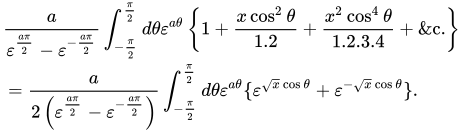
Consider the series—

we know that

Hence by substitution the above series becomes
There are other series of an analogous nature which may be summed in a similar manner: the object of introducing the above summation in this paper, is to point out the use of the integral 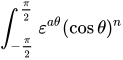 , when impossible factors occur in the denominators of the successive terms of a factorial series.
In the 'Exercices de Mathématiques,' Cauchy has proved that if  be a quantity of the form
  , and
, and  continually approach zero as
  indefinitely increases whatever be
  , then the residue of
  is equal to zero, the limits of being 0 and (
 ), and those of ,
  and
and  . From this theorem he deduces the sums of certain series, which I shall presently consider; but must first give certain results which will be useful in the sequel.
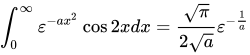
Since

Again, since
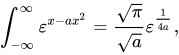
we find
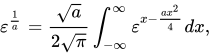
whence we have
