170
MR. W.H.L. RUSSELL ON THE THEORY OF DEFINITE INTEGRALS.
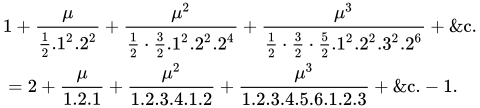
Again, from Laplace's theorem, we have

where

These theorems of course suppose the series from whence they were derived to be convergent.
As examples we may take the following.
Let
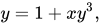
then

![{\displaystyle =2\pi {\frac {d}{dx}}\left\{{\sqrt[{3}]{{\Biggl (}{\frac {1}{2x}}+{\sqrt {\left({\frac {1}{4x^{2}}}-{\frac {1}{27x^{3}}}\right)}}{\Biggr )}}}+{\sqrt[{3}]{{\Biggl (}{\frac {1}{2x}}-{\sqrt {\left({\frac {1}{4x^{2}}}-{\frac {1}{27x^{3}}}\right)}}{\Biggr )}}}\right\}.}](../_assets_/eb734a37dd21ce173a46342d1cc64c92/db6b8ca4642277e24bf325c25a7f562138fbb490.svg)
Also let

then

which we may modify thus; by eliminating 

Analogous methods apply to series involving Bernouilli's numbers; thus we have
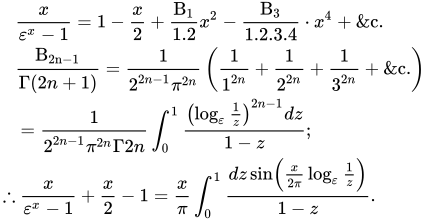
Hence we have

In this formula  must lie between 0 and 1, as it is necessary for the convergence of the above series that
  should be less than
  .
.
I now enter upon the consideration of the processes I have before mentioned for reducing multiple integrals to single ones. We easily see the truth of the following equation:—