mr. w.h.l. russell on the theory of definite integrals.
169

Let  , then we have

where  is of course less than unity; an integral given by Abel.
When  is less than unity we can always integrate with respect to
  , but may obtain a single integral more simply by proceeding as follows:—
We have


consequently we find by summing a geometrical progression,

When this result coincides with that last obtained. We may obtain a very general result by applying Fourier's theorem to the series of Lagrange and Laplace as follows:—
If  , and
, and 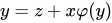 ,
,
we have


Now we generally have

whence

and

Hence substituting in the above series, we find

Consequently we find the following definite integral:
