Page:Midland naturalist (IA midlandnaturalis01lond).pdf/193
It would be very desirable, if possible, to remove the "Holstone" to the grounds of the Leicester Town Museum, where it would be secure from destruction, and where its ponderous proportions would form an object well fitted to attract the attention of visitors, and to awaken a desire in their minds to study the science of Geology.[1]
Many thanks are due to Mr. Kirby for his energy in the matter, and for the hospitable manner in which be entertained the party who came to inspect his "little stranger."
The Tamworth Treasure Trove and the Tamworth Mint.
By Arthur A. Clarson.
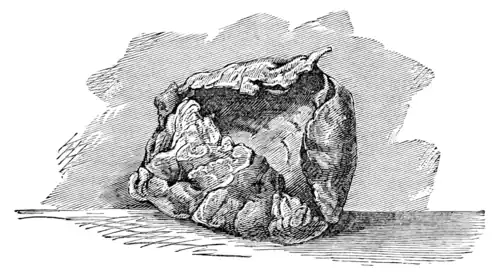
Fig 6.
The interest which has been excited by the recent discovery at Tamworth of coins of the date of the two first Williams, leads me to suppose that an account of the "find" would not be unacceptable. Nor do I think such an account out of place in a magazine especially devoted to the Natural History, Archæology, &c., of the district in which they were found.
A disquisition on the Antiquities of Tamworth would be foreign to the subject, yet some reference must be made, as they are indirectly connected with the discovery and rescue of the coins. Tamworth is the most ancient town in the county of Stafford, says the learned and pedantic Dr. Plot. We have, probably, an Ancient British mound, on which stands the present Castle, the keep of former extensive fortalice. Roman remains are found in the vicinity, and the town itself is encompassed by quadrangular castrametation, consisting of earthworks with a fosse, attributed to the Saxon period. It was also a seat of the Mercian Kings, an important place in the reign of Alfred the Great, the scene of the marriage of the sister of Athelstan, was thrice sacked by the Danes, and rebuilt by the "Ladie of the Mercians," Ethelfleda; few towns, indeed, can boast of such a history as the "ancient and loyal" borough of Tamworth.
- ↑ In the event the stone was not removed; see Humberstone and Hamilton which says
The stone is located at 52°39′29″N 1°04′44″W / 52.657951°N 1.078767°W (Wikisource contributor note)The "Humber stone" is a granite monolith of unknown (perhaps glacial) origin that lies in a field in Hamilton. Until 1750 it had been fully exposed, but was then truncated and the remainder buried by a farmer. In the 1980s it was partially uncovered and made accessible to the public. It was then fenced in when the Leicester north ring road was built and had a sign erected at the site, describing the stone's history.