Page:Material Culture of the Iglulik Eskimos.djvu/136
be allowed to remain and form the platform of the house. After the first line of blocks has been set it is cut so that it forms a spiral, ascending from right to left when seen from the inside of the house. Building then continues, the blocks continuing the spiral line; the builder lifts up the block with both hands and sets it on the underlayer; with the snow knife in his right hand he cuts the adjoining faces to fit while pushing the new block into place with his left.[1] Every new row inclines more and more inwards than the preceding one; each new block is supported by obliquely cut faces — one that of the preceding block and one underneath; the uppermost blocks
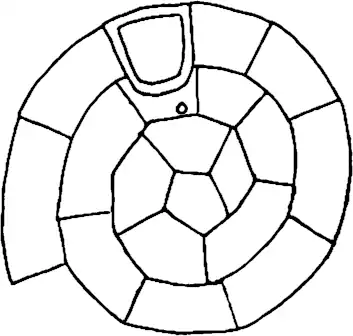 Fig. 76.Roof construction of snow house.
lie almost horizontally but nevertheless rest firmly and securely. The top block is pushed vertically up through the hole and cut above the hole into the requisite shape to fit it, whereafter it is let down into the hole. The roof construction of a snow house at Itibdjeriang is shown in fig. 76.
Fig. 76.Roof construction of snow house.
lie almost horizontally but nevertheless rest firmly and securely. The top block is pushed vertically up through the hole and cut above the hole into the requisite shape to fit it, whereafter it is let down into the hole. The roof construction of a snow house at Itibdjeriang is shown in fig. 76.
The size of the blocks depends upon the nature of the snow; if it is good and firm, the size is 60–80 cm long, 40–50 cm high and 15–20 cm thick; if the snow is very soft or poor. they must be made smaller. For an ordinary snow house about 3 m in diameter about 35 blocks are used.
If there is only one man to build a house with a diameter of about 3 m. the erection itself takes about 1½ hours; if there are two men, so that one can cut the blocks and hand them to the builder. it can be done in an hour, and in forty to fifty minutes when conditions are very favourable. There are men, however, who can build especially quickly; an old Aivilik, Aqaut, once built a snow house himself, big enough for four people, in 26 minutes; but this is the exception. When building large snow houses, two men can take part in the building together, each beginning his spiral at different places and their spirals then run between each other and form the house.
When the building of the house is finished there is still a lot of lighter work to do before it is habitable: holes between the blocks are to be plugged with loose snow or, if they are large, with small blocks cut to fit; the joints are tightened by cutting off the upper, outer edge of the blocks and pressing the snow into the crack with the mitten. If it is a snow house that is to be used for some time as a
- ↑ It is presumably due to a misunderstanding that one sees pictures of snow houses in which the spiral ascends in the opposite direction, from left to right (Parry 1824, Plate p. 499, Gilder p. 255, Boas 1888, fig. 492 b); I have never seen a snow house built in that manner and really it would be most unnatural, except for lefthanded builders.