Page:International Library of Technology, Volume 93.djvu/52
Solution. — Using formula 3 and substituting,
V = p1v1 + p2v2/P = 26+1/2 × 6 + 18 × 4+1/2/30 = 150 + 81/30 = 8 cu. ft. Ans.
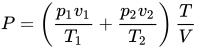
44. Mixture of Two Quantities of Air Having: Unequal Pressures, Volumes, and Temperatures. If a body of air having a temperature , a pressure , and a volume is mixed with another volume of air having a temperature , a pressure , and a volume to form a volume having a pressure and a temperature , either the new temperature , the new volume , or the new pressure may be found, if the other two quantities are known, by the following formula, in which , , and are the absolute temperatures corresponding to , , and :


(1)
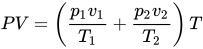
It follows from this formula that
(2)
(3)
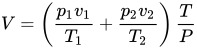
and (4)
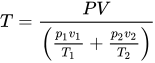
Example 1. — Five cubic feet of air having a pressure of 30 pounds per square inch and a temperature of 80° F. is to be compressed,
together with 11 cubic feet of air having a pressure of 21 pounds per square inch and a temperature of 45° F., in a vessel whose cubical
contents is 8 cubic feet; the new pressure is required to be 45 pounds per square inch. What is the temperature of the mixture?
Solution. — Substituting the given values in formula 4,
° ,nearly
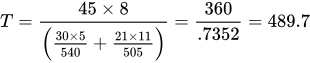
Then, ° F. Ans.

Example 2. — Fourteen cubic feet of air at 80 pounds pressure, and at a temperature of 100° F., is compressed with 26 cubic feet of air at 60 pounds pressure and 60° F. into a volume of 20 cubic feet; what is the resultant pressure, if the final temperature is 140° F.?