Page:Handbook of Precious Stones.djvu/42
This page has been validated.
26
PRECIOUS STONES.
be arranged into the two groups—(1) those having plane surfaces; (2) those having curved surfaces: but, under special circumstances, facets or plane surfaces are occasionally associated with curved surfaces in the same specimen. The further subdivision of the two groups of forms may be tabulated thus:
| Group 1. Plane surfaces | Brilliant-cut. | |
| Step or trap-cut. | ||
| Table-cut. | ||
| Rose-cut. | ||
| Group 2. Curved surfaces | Single cabochon. | |
| Doable cabochon. | ||
| Hollowed cabochon. | ||
| Tallow top. |
A few words descriptive of each of these modes of cutting stones may now be given.
The old brilliant-cut, though susceptible of many small modifications as to the size of the facets, their mutual proportions and inclinations, and even their number, requires, when perfect, 58 facets thus arranged:
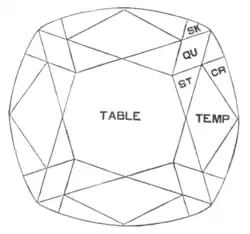
Fig. 12. | ||
| 1 Table | The "Crown," or upper part of the brilliant. | |
| 8 Star facets | ||
| 4 Templets or bezels | ||
| 4 Quoins or lozenges | ||
| 8 Cross or skew facets[1] | ||
| 8 Skill facets[1] | ||
| 33 |