Page:Encyclopædia Britannica, Ninth Edition, v. 2.djvu/18

Fig. 8.—Stowing a Sheet Anchor.
It should be observed that whenever a slip-stopper is fitted, care must be taken, by placing a pin at the back of it, or otherwise, to prevent the anchor being let go by accident.
Stern and stream anchors are stowed at the stern of the ship in the way described for sheet anchors.
The kedge anchors are generally stowed in the main-chains.
Sheet, stream, and stern anchors being very rarely used, have to be re-stowed by the aid of the yard-arm, without any special appliances being fitted.
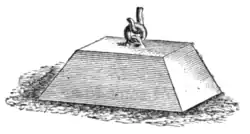
Fig. 9.—Buoy Mooring Block.

Fig. 10.—Cast-iron Mooring Anchor.

Fig. 11.—Mushroom Anchor.
Mooring anchors are those which are placed in harbours, &c., for the convenience of vessels frequenting them. A large buoy is attached to the end of the mooring cable, and the ship is made fast to a ring-bolt fitted on the buoy. Mooring anchors are not limited by considerations of weight, &c., as other anchors are, the only requirements being that they have sufficient holding power, and do not project above the ground, as any projection in the shallow waters in which they are usually placed would render ships liable to injury from grounding on them, and be dangerous to fishing-nets, &c. Mooring anchors may there- fore be of stone, as shown in fig. 9; or of cast-iron, as in fig. 10. Mushroom anchors (fig. 11), first proposed for ships, are now only used for moorings. An old anchor which has one arm dam- aged is frequently used as a mooring anchor, the damaged arm being bent down close to the shank; the anchor is sunk with the bent arm uppermost, and there is no projection above the ground. In harbours where there is not much room it is usual to place two anchors, connected by a cable, in a line at right angles to the direction of the tide; a swivel is fitted at the centre of this cable, and the buoy chain is made fast to the swivel. With this arrangement the ship does not sweep such a large circle in swinging.

Fig. 12.—Mooring Anchor.
The best mooring anchor which has yet been devised is shown in fig. 12. Its shank is a round bar of wrought iron, a, about 7 feet in length and 6 inches in diameter; it is increased at 6 to 9 inches diameter for about 1 foot of its length, and terminated at f similarly to the point of a gimlet; holes are made in the stout part b, and a screw flange of 3 feet diameter is cast around it; the molten metal gets into the holes and makes a good connection with the wrought-iron shank. A swivel c, to which a large shackle d, is attached, is fitted on as shown, and secured by a strong nut; the end of the shank e is made square. To place this anchor in about 8 fathoms of water, four iron bars, each about 17 feet in length, and provided with a socket at one end and a square head at the other, are used. As the anchor is lowered the socket of the first bar is fitted on at e, and the socket of the second bar in its turn fitted to the square end of the first, and so on till the anchor reaches the bottom. A drumhead, similar to a capstan, is then fitted on the last bar, and capstan bars shipped in it; by these means the anchor is turned round, and so screwed into the ground. It must be sunk through the soft mud or sand into the harder soil beneath it, and when this is done the holding power of the anchor is enormous. An anchor of the dimensions given weighs about 14 cwt., and will hold far more than a cast-iron mooring anchor of 7 tons. The only objections to it seem to be the difficulty of removing it if the moorings are required to be taken up, and that special appliances are required for putting it down.
A good anchorage is where there are from 10 to 20 fathoms of water, and the ground is not rocky or loose sand. Where there are more than about 20 fathoms the cable bears too nearly perpendicular, and is liable to trip the anchor. For anchoring in ordinary weather the length of cable veered out is about three times the depth of water.
(t. m.)