Page:Encyclopædia Britannica, Ninth Edition, v. 2.djvu/17
Rodger's, and the Admiralty find the most favour at the present time. Trotman's and the Admiralty have undergone no alteration, but Captain Rodgers has taken out two patents for improvements in his anchor since the committee reported.
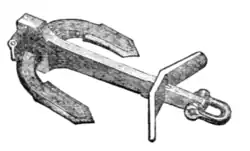
Fig. 6.—Martin's.
We now come to an anchor of entirely different shape from the preceding, patented by a Frenchman named Martin. The anchor is represented in fig. 6 in the position in which it lies on the ground just before taking hold. The shank is made in one forging, is of rectangular section having a shoulder for the stock to fit against, and is increased both in thickness and area at the crown; the arms with the palms are forged in one piece, and then bent to the required shape; one of the arms is passed through a hole in the crown and is kept in position by a bolt screwed through the end of the crown, so that its point reaches a little way into an indent made for it in the round part at the back of the arms. Until very recently this securing bolt was placed in the shank in a vertical position (supposing the anchor to be lying with the palms horizontal), so as to cut into the hollow part at the front of the bent arm. A very strong shoulder is worked on the arms, so as to fit in a groove on one side of the shank, in such a manner that the arms will revolve through an angle of 30° either way. The stock is fitted over the shank as shown, and secured by a key, which fixes it tightly against the shoulder left on the shank. The advantages of Martin's anchor are as follows—It is self-canting; it must fall in the position shown in the figure, and the weight of the arms, together with the pull of the cable, presses their sharp points into the soil, so that it takes hold immediately; it is impossible to foul it; it stows much more neatly than any other anchor; its holding power is very great, as both arms are in the soil at the same time, and the stock, which is flat and broad, adds materially to this quality; the strength is also very great. At an experiment made at Portsmouth dockyard in March 1867, two of the anchors were subjected to a strain of 50 per cent. over the Admiralty proof; the arms were deflected but three-tenths of an inch by this great strain, and when it was removed they regained their former shape. The anchor is made in three separate forgings without a weld. Unmasted turret ships, which have an all-round fire, are, almost without exception, fitted with Martin's anchor on account of the neatness with which it can be stowed, as the stock of any other anchor, if not unshipped, would obstruct the fire of the guns. The Admiralty allow a reduction of 25 per cent. in weight for Martin's anchor, using an 80 cwt. Martin where a 90 cwt. Admiralty or Rodger's anchor, weighing with its stock from 108 to 112 cwt., would be fitted, the weight given for Martin's anchor including the stock.
Smith's patent stockless anchor has been highly spoken of. It is a modification of Martin's anchor, but without the stock.
A bower anchor is stowed in H.M. service as shown in fig. 7. A, is the cathead; B, the fish davit; C, and E, bol- lards; D, the bill-board. The anchor is held in place by two chains, a and b, termed the cat-stopper and shank painter respectively, each of which is fitted with a long link at one end. A bolt b, about 5 or 6 inches long, is fixed on the side of the cathead, on a hinge at its lower end; it is held in the upright position by another bolt c, which passes through the cathead, and is worked by a lever d; d is provided with a hole at the end for a lanyard, so that two or three men can pull it. This whole arrangement is termed a slip-stopper. A somewhat similar combination of bolts and levers is fitted close to the bill-board D, e being a short bolt secured at its lower end with a hinge to the ship's side; and f a hooked lever which holds it in its upright position; f has a socket at its inboard end, to which a shifting arm, provided with a lanyard like the lever d, is fitted. The cat-stopper is rove through the shackle of the anchor, and the long link placed over the bolt b; it is then passed over a cleat g, on the side of the cathead, and belayed at the bollards C. The end of the shank painter is passed under the crown and over the shank; its long link is placed over the bolt e, and it is belayed at the bollards E. When it is desired to let go the anchor, the arm is shipped at f, and the lanyards at f and d are manned; then, at the word of command (given, if the ship is rolling, when she lurches towards the side on which the anchor is stowed), the men pull the lanyards, and b and e are released simultaneously, the links of the cat-stopper and shank painter drop off, and the anchor falls clear of the ship. In merchant ships it is not usual to fit the second slip-stopper, 6 and e; in this case it is necessary, before letting go, to "cock-bill" the anchor,—that is, to ease away the shank painter, so that the anchor hangs by the cathead alone. The next thing is to "weigh" the anchor. It is hove up by the capstan, and when it appears at the bows, the operations of "catting" and "fishing" have to be performed. A chain called the "cat pendant' is rove over the sheave in the cathead, and shackled to a short piece of a similar chain attached to the anchor at one end, and stoppered to the cable at the other; the inboard end of the cat pendant is taken to a leading block on the opposite side of the ship, and a purchase tackle attached to it, so as to give the men a run right aft. When all is ready, the word is given, and the men run away with the purchase until the anchor hangs from the cathead instead of the hawse-pipe; it is then said to be "catted." A chain rove through the block at the head of the fish davit, and having a large hook at the end, is then hooked to the inner arm of the anchor, which is then raised and swung inboard (the fish davit being made to revolve), so that the fluke rests upon the bill-board D, and the anchor is "fished." The cat-stopper and shank painter are then rove, and all made ready to let go again at a moment's notice.

Fig. 7.—Bower Anchor, and manner of stowing.
The cathead shown in the figure is made of plates and angle irons, and is similar in shape to the old wooden cat- heads; it is fitted with a single sheave h, made to swivel so as to give a fair lead for the chain when the anchor is at the hawse-pipe. Catheads are frequently made of solid forgings, with a block hanging from the head for the cat pendant or fall. In ships designed for ramming, the cat-head is made to revolve like the fish davit B, so that it can be turned inboard, and there will be no projection on the bow to foul the enemy's rigging.