Page:Encyclopædia Britannica, Ninth Edition, v. 11.djvu/36
markable for the charm of their personal character and for the careful education given them by their widowed mother. Tiberius served as quæstor in Spain in 137; and the respect still entertained by the Spaniards for his father's name enabled him to save the Roman army from utter ruin after its defeat by the Numantines. See Roman History.
GRACES is the name generally given to the Greek goddesses Charites. The chief seat of their worship was the ancient Boeotian city Orchomenus. They were three in number, but their names were not known; and stones fallen from heaven stood in their temple as symbols of the goddesses (Paus., ix. 35). Their worship was instituted by a king Eteocles, whose three daughters fell into a well while dancing in honour of the Charites (Westermann, Myth. Gr., p. 387). In no Greek legend is the pre-Greek Indo-Germanic character more strongly marked. Eteocles, he whose glory is real, is the Vedic Satyaçravas, the sun; and his genealogy consists of a string of epithets for sun and dawn. Charis (Skt. hari, bright), is an old adjective, originally an epithet of the light-illumined clouds which seem to escort the dawn, often applied in the Rig-Veda to the horses of the dawn or of the sun, and at last growing into a distinct deity who preserves the character of the ancient dawn-goddess (see Muller, Lect. Lang., ii.; Sonne in Kuhn, Zft., x.). The burning bright vasas (Ushas, ἠώς, Aurora, with a different suffix Ostara, Easter)—who restores the blessings lost during the night, who lights up what was dark and reveals the hidden wrong, who gives active labour and wealth to men, growth and fertility to plants—had been from the earliest time the centre of a great worship. To appearance these religious ceremonies have been lost in Greece; and in a people so retentive of all that relates to religion, this implies merely that the worship of the dawn has been changed in outward form. Eos is of slight importance; but Charis, Hebe, Aphrodite (in so far as the genuine Greek goddess has not given way to the Oriental deity) preserve and develop the original idea. Charis then was the goddess of the freshness and vigour of life, of fertility and growth; like Aphrodite, she closely resembles Persephone (see Gerhard, Venus Proserpina), and in later art the Graces often hold corn ears in their hands; like Hebe, she is often associated with Hera (see Welcker, Gr. Gott., iii. 174). The single goddess grew into a triad, as occurs often in Greek mythology; in Sparta, however, and in Athens only two Charites were known. Rites of peculiar antique character belong to the worship of the Charites: in Orchomenus nightly dances took place in their honour (compare the legend of Eteocles's daughters, who obviously are bye forms of the goddesses); in Paros their worship was celebrated without music or garlands; in Messene they were worshipped along with the Eumenides; in Athens their rites secret from the vulgar were held at the entrance of the Acropolis; one swore by the Charites as one did by the deities of the lower world (Pollux, viii. 106). Far as these characteristics seem removed from the nature of a dawn-goddess we find a similar double character in many other cases, such as Artemis-Hecate. They are thus brought into the cycle of older more purely nature worship, which we find in Greece alongside of the more moral religion of the Olympian deities, and which has in mythology its counterpart in the older generation of Titans destroyed by the younger gods. The Charites were received into the Olympian Pantheon only in a subordinate character. In Homer we have a transitional stage; they appear some times as distinct independent beings, one being wife of Hephæstus, another of Sleep (Il., xviii. 382, xiv. 231); often they are a set of nymphs attending on Aphrodite, herself then wife of Hephæstus (Od., viii. 364, &c.). The dawn is naturally the wife of Hephæstus, the fire of the sun in heaven and of the morning sacrifice on earth. In later literature this second form prevails. Obviously the noun charis and the connected verbs and substantives, which existed alongside of the mythological name, exercised a continually growing influence on it. The Charites become then the impersonation of the bloom of all sensuous appearance, of grace and cheerfulness, both in nature and in moral action. They form part of the train attendant on the greater gods, especially Aphrodite and Apollo. Their names, Aglaia, Euphrosyne, and Thalia, occur first in Hesiod (Theog., 907). Pindar, however, following the Bœotian belief, celebrates them (Ol., xiv.) as the queens of glittering Orchomenus and as the guardian goddesses of the ancient Minyæ. In art they were represented in earlier time as draped goddesses with varying attributes; gradually the one well-known conception predominated of the three beautiful nude figures gracefully intertwined. Jacobi (Wörterb. d. Myth.) gives a very complete list of ancient authorities.
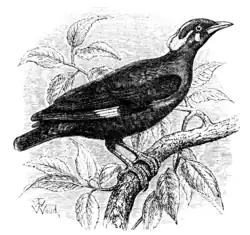
Gracula religiosa.
GRACKLE (Latin, Gracculus or Graculus), a word which has been much used in ornithology, but generally in a vague sense, though restricted to members of the families Sturnidæ belonging to the Old World, and Icteridæ belonging to the New. Of the former those to which it has been most commonly applied are the species variously known as Mynas, Mainas, and Minors of India and the adjacent countries, and especially the Gracula religiosa of Linnæus, who, according to Jerdon and others, was very probably led to confer this epithet upon it by confounding it with the Sturnus or Acridotheres tristis,[1] which is regarded by the Hindus as sacred to Ram Deo, one of their deities, while the true Gracula religiosa does not seem to be anywhere held in veneration. This last is about 10 inches in length, clothed in a plumage of glossy black, with purple and green reflexions, and a conspicuous patch of white on the quill-feathers of the wings. The bill is orange and the legs yellow, but the bird's most characteristic feature is afforded by the curious wattles of bright yellow, which, beginning behind the eyes, run backwards in form of a lappet on each side, and then return in a narrow stripe to the top of the head. Beneath each eye also is a bare patch of the same colour. This species is common in southern India, and is represented further to the north, in Ceylon, Burmah, and some of the
- ↑ By some writers the birds of the genera Acridotheres and Temenuchus are considered to be the true Mynas, and the species of Gracula are called "Hill Mynas" by way of distinction.