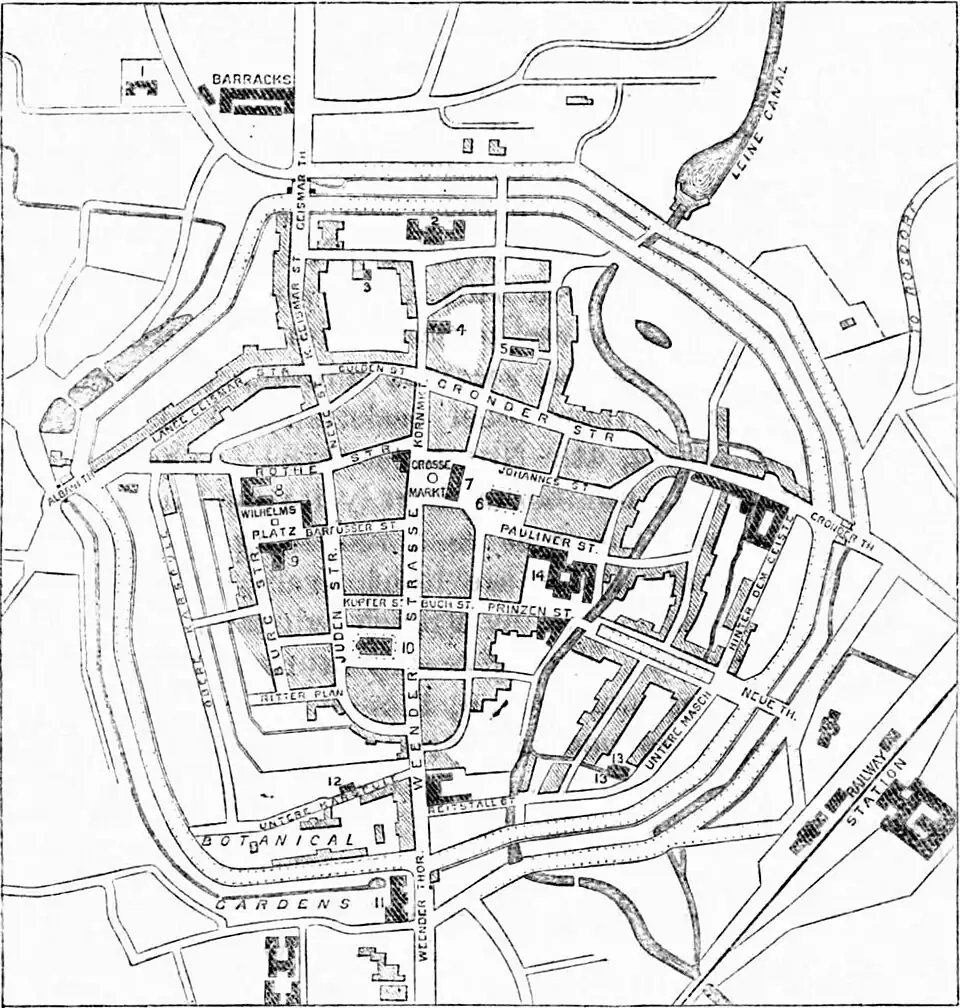
further reduced its prosperity. The events of 1848, on the other hand, told somewhat in its favour; and since the annexation of Hanover in 1866 it has been carefully cherished by the Prussian Government. In the winter session 1877–78, its students numbered 909, and the teaching staff 124,—its numerical strength thus entitling it to rank as the eighth on the list of German
universities. The present professoriate includes, among other distinguished names, those of Benfey, Lagarde, Lotze, Ritschl, and Weber. Amongst those who have been teachers within its walls may be mentioned, besides the seven already named, Haller, Gesner, Gatterer, Sprengel, Heyne, Blumenbach, Herbart, Heeren,
O. Müller,
K. F. Hermann, and Eichhorn. Neander, Ewald, and the distinguished chemist Bunsen, it may be added, were natives of Göttingen. The university library contains upwards of 500,000
printed volumes and 5000 manuscripts. There is a good chemical laboratory, as well as adequate zoological, ethnographical, and mineralogical collections, the most remarkable being Blumenbach’s famous collection of skulls. The other establishments more or less connected with the university, such as the observatory, botanical
garden, and various hospitals, do not call for special notice. The
Gesellschaft der Wissenschaften publishes the long-established and well known
Göttingische Gelehrte Anzeigen. The
population in 1875 numbered 17,057.
GOTTSCHALK, or
Goteschalcus, surnamed
Fulgestius, a prominent figure in one of the most important theological controversies of the
9th century, was the son of Berno, a Saxon count, and, having been devoted (
oblatus) from infancy by his parents to the monastic life, was trained at the monastery of Fulda, during the abbacy of Hrabanus Maurus, and while Walafridus Strabus was a member of the fraternity. At the approach of manhood he made strenuous efforts to be released from his vows; and he actually succeeded in obtaining from a synod held at Mainz in
829 the necessary dispensation; but through the hostile influence of his abbot this was afterwards cancelled by Louis the Pious, though as a slight mitigation of the harshness of this treatment he was permitted to remove to the monastery of Orbais, in the diocese of Soissons. Here he devoted himself to ardent study of
the writings of
Augustine, with the result that he became an enthusiastic believer in the doctrine of absolute predestination, in one point going even beyond
his master—Gottschalk believing in a predestination to condemnation as well as in a predestination to salvation, while
Augustine had contented himself with a doctrine of preterition as complementary to his doctrine of election. While returning from a pilgrimage to Rome in
the year 847, Gottschalk, happening to pass a night at a hospice in Friuli, came into contact with Notting, the newly
elected bishop of Verona, and expounded to him his peculiar views. The bishop, apparently without saying much at the time, carried word to Hrabanus Maurus, who, meanwhile, had become archbishop of Mainz; the latter lost no time in issuing two letters, one to his informant and another to Count Eberhard of Friuli, in both which he denounced the opinions of Gottschalk with some recklessness and great violence. On the one hand, he accused his adversary of neglecting the distinction between foreknowledge and foreordination; on the other hand, he himself refused to recognize any difference between predestination to punishment and predestination to sin. At a synod held in Mainz in presence of the
emperor in
848, Gottschalk presented himself with a written explanation and defence of his views; he was, however, very summarily found guilty of heresy, and handed over to his ecclesiastical superior, Hincmar of Rheims, to be dealt with as his crime might deserve. Having again assumed the defensive in an assembly at Chiersy in
849, he was once more
condemned,—on this occasion not only as a heretic, but also as a despiser of authority, and as a disturber of the church's
peace,—and sentenced to be whipped severely and rigorously imprisoned (
durissimis verberibus castigari et secundum ecclesiasticas regulas ergastulo retrudi). The place selected for his captivity was the monastery of Hautvilliers in the diocese of Rheims, and here he languished throughout the remainder of his life, a period of twenty
years, notwithstanding the efforts of influential friends and his own pitiful appeals. Prudentius of
Troyes, Wenilo of Sens, and Floras of Lyons successively expressed opinions more or less in favour of his views; nor did Hincmar derive much real aid from the dialectical skill of Erigena, whom he had called in as an authority on the other side. Various synods met, reached widely discrepant opinions on the burning question, and ultimately postponed its settlement to a future council in less troubled times. The summons of Pope Nicholas
I., in
863, calling Hincmar to account for his harsh conduct, unfortunately never took effect; and the result was that, after many renewed attempts at conviction and persuasion on the part of
Gottschalk—he even proposed to settle the question by
ordeal of fire—he was suffered to die unheeded in
868, and, by orders of his inhuman adversary, was buried in unconsecrated ground. It may be added that Gottschalk had attempted to establish a counter charge of heresy against Hincmar, on account of the latter's substitution