THERMODYNAMIC ANALOGIES.
185
where indeed the individual values of which the average is taken would appear to human observation as identical. This gives

(X)
whence

(493)
a value recognized by physicists as a constant independent of the kind of monatomic gas considered.
We may also express the value of  in a somewhat different form, which corresponds to the indirect method by which physicists are accustomed to determine the quantity
  . The kinetic energy due to the motions of the centers of mass of the molecules of a mass of gas sufficiently expanded is easily shown to be equal to

where

and

denote the pressure and volume. The average value of the same energy in a canonical ensemble of such a mass of gas is

where

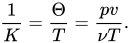
denotes the number of molecules in the gas. Equating these values, we have

(494)
whence
(495)
Now the laws of Boyle, Charles, and Avogadro may be expressed by the equation

(496)
where

is a constant depending only on the units in which energy and temperature are measured.

, therefore, might be called the constant of the law of Boyle, Charles, and Avogadro as expressed with reference to the true number of molecules in a gaseous body.
Since such numbers are unknown to us, it is more convenient to express the law with reference to relative values. If we denote by

the so-called molecular weight of a gas, that