Page:EB1911 - Volume 27.djvu/423
Market, London. This was done by the crown-bar method, the bars being built in with solid brickwork. The subsidence in the ground was from 1 to about 31/2 in. Several buildings were tunnelled under without any structural damage.
London has now some 90 m. of tunnels for railways, mostly operated by electric traction. Most of those which have been constructed since 1890 have been tunnelled by the use of cylindrical shields and walls of cast iron. Shields about 23 ft. in diameter were used in constructing the stations on the Central London railway, and one 32 ft. 4 in. in diameter and only 9 ft. 3 in. long was used for a short distance on the Clapham extension of the City and South London railway.
Paris has an elaborate plan for underground railways some 50 m. in length, a considerable number of which have been constructed since 1898 under the engineering direction of F. Bienvenüe. Instead of using completely cylindrical shields and cast-iron walls, as in London, roof-shields (boucliers de voûte) were employed for the construction of the upper half of the tunnel, and masonry walls were adopted throughout. In general, the upper half of the tunnel was executed first (figs. 9 and 10) and the lower part completed by underpinning.
Figs. 11, 12 and 13 illustrate a case of tunnelling near important buildings in Boston in 1896, with a roof-shield 29 ft. 4 in. in external diameter. The vertical sidewalls were first made in small drifts, the roof-shield running on top of these, and the core was taken out later and the invert or floor of the tunnel put in last. Each hydraulic press of the shield reacted against a small continuous cast-iron rod imbedded in the brick arch. In some large sewerage tunnels in Chicago the shields were pushed from a wall of oak planks, 8 in. thick, surrounding the brick walls of the sewer.
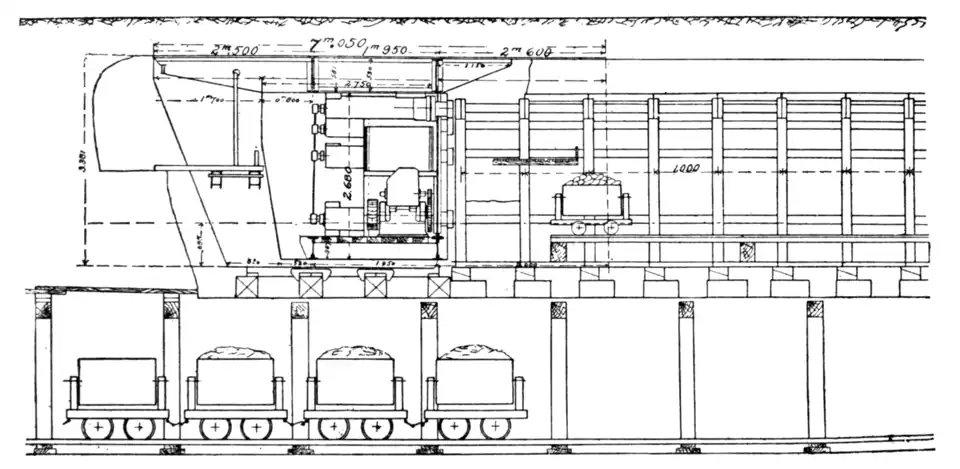
Fig. 10.—Paris Métropolitain Tunnel, longitudinal vertical section.
Ventilation of Tunnels.—The simplest method for ventilating a railway tunnel is to have numerous wide openings to daylight at frequent intervals. If these are the full width of the tunnel, at least 20 ft. in length, and not farther apart than 200 yds., it can be naturally ventilated. Such arrangements are, however, frequently impracticable, and then recourse must be had to mechanical means.

Fig. 11.—Boston Subway, first and second phases.