Page:EB1911 - Volume 26.djvu/126
of the sun's rays and record duration by a clock instead of allowing the sun to keep its own time. In the Marvin sunshine recorders of
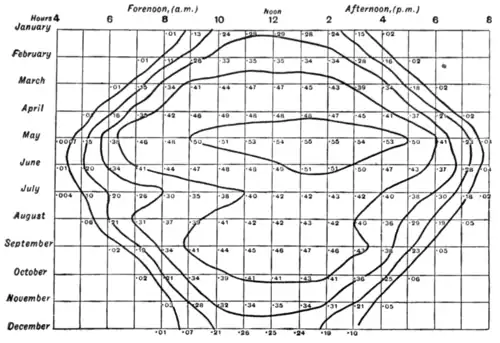
Fig. 6.—Monthly Average Duration of bright Sunshine for each hour of the day at Valencia (Ireland).
the United States weather bureau an electrical contact is made by the thermal effect of the sun and the duration of the contact is recorded. An instrument which gives a corresponding result is described by W. H. Dines (Quart. Journ. Roy. Met. Soc. xxvi. 243). These define sunshine by the effect necessary to produce or maintain a certain thermal effect, but the definition once accepted there is no uncertainty as to the record. The Callendar sunshine recorder[1] gives a record of the difference of temperature of two wires, one polarized and the other not, and it is therefore a continuous record of the thermal effect of solar and terrestrial radiation. It is vastly more detailed than that of other instruments (see fig. 5), but the interpretation of the record in terms suitable for meteorological or climatological purposes is a special study, which has not yet been attempted. In a somewhat similar way information about the duration and intensity of sunshine with an abundance of detail can be obtained from the record upon photographic paper passing under an aperture in a drum which revolves with the sun, as in the Lander recorder, but the study of such details has not been begun.
Sunshine Records for the British Isles.—The interest in the use of sunshine recorders is more widely extended in the British Isles than elsewhere, and it is, so far as the public are concerned, the most important meteorological element, but it is singular that up to the present a knowledge of the total amount of sunshine recorded during the day, the week, the month or the year is all that is apparently required. Except for the observatories in connexion with the meteorological office and a few others the distribution of sunshine during the day is not taken out, so that we are still some distance from attacking the problems presented by the finer details of solar records. Fig. 6 shows the average duration of bright sunshine for each hour of the day for each month at Valencia. The expectation of sunshine is greatest at 1 p.m. and 2 p.m. in May, while there is a well-marked secondary maximum in September.
Exposure.—We now consider what the daily sunshine record for a particular station means. An ideal exposure has an uninterrupted view of those parts of the horizon in which the sun rises or sets; and elsewhere the view of the sun must not be obstructed by the ground, buildings, trees or any other obstacle; but ideal exposures are not always to be obtained. In mountainous districts particularly it may be impossible to find a site in which the sun is not obstructed for an appreciable part of the day. In these circumstances it becomes a question whether the amount of sunshine recorded should be referred to the maximum possible for an uninterrupted horizon or the maximum possible for the particular exposure. The answer to the question really depends upon the purpose for which the information is wanted. As a climatological factor of the locality the shadow cast by the surrounding hills is of importance, it is part of the difference between the fertility of the southern and northern slopes of hill country. This importance is, of course, in many respects exclusively local, and indeed the possible duration of sunshine at any station is a local characteristic which it is desirable to know. Consequently as evidence of the peculiarity of the site the recorded sunshine might be referred to the total possible with a free horizon. On the other hand, taking the record of sunshine as indication of the clearness of the sky for the purposes of general meteorology, the screening of the sun by hills must be regarded simply as limiting the time during which observation is possible and the duration of the sunshine recorded should be referred to the possible duration at the particular site. It would, therefore, be desirable in publishing records of the duration of sunshine recorded to note also the possible amount for the instrument as exposed (see Hourly Means at Five Observatories under the Meteorological Council, 1891 No. 113 p. 10). The table shows the number of hours the sun is above the horizon during each month in the latitude of the British Isles.

Fig. 7.—Sunshine in the British Isles in 1908.
Possible Duration of Bright Sunshine in the Latitude of the British Isles.
50° 262 278 288 365 410 473 482 485 442 373 327 266 246 51° 257 276 286 365 411 477 487 489 444 373 -325 262 241 52° 251 273 284 365 412 481 491 494 446 374 324 258 236 53° 247 271 281 364 414 486 498 499 450 375 323 254 231 54° 243 268 279 363 417 490 503 505 453 375 322 251 225 55° 237 265 276 363 418 494 510 511 456 376 319 245 218 56° 232 263 273 362 420 499 516 516 459 376 316 239 2 1 1 57° 226 260 270 362 423 504 524 523 463 377 314 236 205 58° 219 257 267 361 426 510 532 530 467 378 312 232 197 59° 211 253 263 361 429 517 541 538 471 379- 309 225 187
By way of exhibiting the results obtained from sunshine records we reproduce (fig. 7) the sunshine map of the British Isles taken from the annual summary of the Monthly "Weather Report," 1908 (British Meteorological Year-Book, pt. ii.). Corresponding maps embodying data from over 130 stations are prepared each month; fig. 8 shows the variation in the distribution of sunshine that may take place in different months. Further, fig. 9 represents the average weekly distribution of sunshine in different sections of the British Isles according to the average of twenty-five years.
Sunshine in the Antarctic Regions.—It is clear that so far as concerns the zone from 50° to 60° N. in this particular region, the annual amount of sunshine diminishes as one goes northward. It would, however, not be safe to conclude that this diminution in the aggregate duration of sunshine during the year goes on without interruption as one proceeds northward. At least the corresponding statement would not be true of the southern hemisphere. No doubt
- ↑ Brit. Assoc. Report (1900), p. 44.