applying the theorem (7) to evaluate this expression, we have

the expression on the right side is  , the zonal surface harmonic; we have therefore
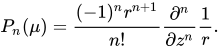
The zonal harmonic has therefore all its poles coincident with
the z axis. Next, suppose n - m axes coincide with the z axis,
and that the remaining m axes are distributed symmetrically in
the plane of x, y at intervals  , the direction cosines of one of
them being
, the direction cosines of one of
them being  . We have

Let  , the above product becomes
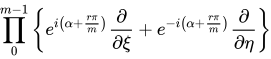
which is equal to
 ;
when
;
when  ,
,
this becomes
 and
and
![{\displaystyle e^{(m-1){\frac {i\pi }{2}}}\left[\left({\frac {\partial }{\partial \xi }}\right)^{m}+(-1)^{m}\left({\frac {\partial }{\partial \eta }}\right)^{m}\right]}](../_assets_/eb734a37dd21ce173a46342d1cc64c92/08fe20759a0364060bd01c7d545e55fa5d9fb36e.svg) .
.
From (7), we find
![{\displaystyle {\begin{aligned}{\frac {\partial ^{n-m}}{\partial z^{n-m}}}\left({\frac {\partial }{\partial x}}\pm i{\frac {\partial }{\partial y}}\right)^{m}{\frac {1}{r}}&={\frac {(2n)!}{2^{n}n!}}{\frac {1}{r^{2n+1}}}\left[1-{\frac {r^{2}\Delta ^{2}}{2.2n-1}}+\dots \right]z^{n-m}(x\pm iy)^{m}\\&=(-1)^{n}{\frac {(2n)!}{2^{n}n!}}{\frac {1}{r^{n+1}}}(\cos m\phi \pm i\sin m\phi )\sin ^{m}\theta {\Bigl \{}\cos ^{n-m}\theta \\&-{\frac {(n-m)(n-m-1)}{2.2n-1}}\cos ^{n-m-2}+\dots \theta {\Bigr \}}\end{aligned}}}](../_assets_/eb734a37dd21ce173a46342d1cc64c92/19b6617ed425f253296f9b640f4dfe8e28835a1d.svg)
hence

as we see on referring to (4); we thus obtain the formulae


It is thus seen that the tesseral harmonics of degree n and order
m are those which have  axes coincident with the z axis, and
the other m axis distributed in the equatorial plane, at angular
intervals . The sectorial harmonics have all their axes in the
equatorial plane.
axes coincident with the z axis, and
the other m axis distributed in the equatorial plane, at angular
intervals . The sectorial harmonics have all their axes in the
equatorial plane.
8. Determination of the Poles of a given Harmonic.—It has been
shown that a spherical harmonic  can be generated by means
of an operator
can be generated by means
of an operator
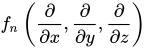 acting upon
  ,
,
the function  being so chosen that

this relation shows that if an expression of the form

is added to  , the harmonic is unaltered; thus
if
, the harmonic is unaltered; thus
if  be regarded as given,
  , is not uniquely determined,
but has an indefinite number of values differing by multiples
of
, is not uniquely determined,
but has an indefinite number of values differing by multiples
of  . In order to determine the poles of a given harmonic,
must be so chosen that it is resolvable into linear factors; it will
be shown that this can be done in one, and only one, way, so that
the poles are all real.
. In order to determine the poles of a given harmonic,
must be so chosen that it is resolvable into linear factors; it will
be shown that this can be done in one, and only one, way, so that
the poles are all real.
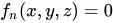
If x, y, z are such as to satisfy the two equations 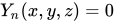 ,
,
 , the equation is also satisfied; the problem
of determining the poles is therefore equivalent to the algebraical
one of reducing to the product of linear factors by means of
the relation , between the variables. Suppose
, the equation is also satisfied; the problem
of determining the poles is therefore equivalent to the algebraical
one of reducing to the product of linear factors by means of
the relation , between the variables. Suppose

we see that the plane  passes through two of the
2n generating lines of the imaginary cone
passes through two of the
2n generating lines of the imaginary cone  in which
that cone is intersected by the cone . Thus a pole
in which
that cone is intersected by the cone . Thus a pole
 is the pole with respect to the cone , of a
plane passing through two of the generating lines; the number
of systems of poles is therefore
is the pole with respect to the cone , of a
plane passing through two of the generating lines; the number
of systems of poles is therefore  , the number of ways of
taking the 2n generating lines in pairs. Of these systems of poles,
however, only one is real, viz. that in which the lines in each pair
correspond to conjugate complex roots of the equations
, the number of ways of
taking the 2n generating lines in pairs. Of these systems of poles,
however, only one is real, viz. that in which the lines in each pair
correspond to conjugate complex roots of the equations  , . Suppose

gives one generating line, then the conjugate one is given by

and the corresponding factor  is
is
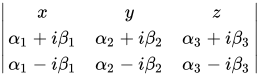
which is real. It is obvious that if any non-conjugate pair of
roots is taken, the corresponding factor, and therefore the pole, is
imaginary. There is therefore only one system of real poles of a
given harmonic, and its determination requires the solution of an
equation of degree 2n. This, theorem is due to Sylvester (Phil. Mag.
(1876), 5th series, vol. ii., "A Note on Spherical Harmonics").
9. Expression for the Zonal Harmonic with any Axis.—The zonal
surface harmonic, whose axis is in the direction
 , is
, is 
or  ; this is expressible as a
linear function of the system of zonal, tesseral, and sectorial harmonics
already found. It will be observed that it is symmetrical
with respect to
; this is expressible as a
linear function of the system of zonal, tesseral, and sectorial harmonics
already found. It will be observed that it is symmetrical
with respect to  and
and  , and must thus be capable of
being expressed in the form
, and must thus be capable of
being expressed in the form

and it only remains to determine the co-efficients  To find this expression, we transform
  , where
x, y, z satisfy the condition ; writing
, where
x, y, z satisfy the condition ; writing  , we have

which equals

the summation being taken for all values of a and b, such that
 ,
,  ; the values
  corresponding to the term
 . Using the relation
  , this becomes

putting  , the coefficient of
  on the right side is

from  to
to 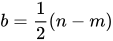 , or
, or 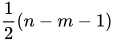 , according as
is even or odd. This coefficient is equal to
, according as
is even or odd. This coefficient is equal to

in order to evaluate this coefficient, put  ,
,  ,
,  , then this coefficient is that of
  , or of
 in the expansion of
  in powers of
 and
and  , this has been already found, thus the coefficient is
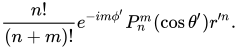
Similarly the coefficient of  is
is
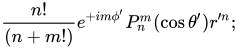
hence we have

In this result, change x, y, z into
