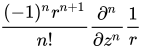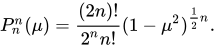
Every ordinary harmonic of degree n is expressible as a linear function
of the system of  zonal, tesseral and sectorial harmonics
of degree n; thus the general form of the surface harmonic is
zonal, tesseral and sectorial harmonics
of degree n; thus the general form of the surface harmonic is

In the present notation we have

if we put  , we thus have

from this we obtain expressions for  as definite
integrals
as definite
integrals


4. Derivation of Spherical Harmonics by Differentiation.–The
linear character of Laplace's equation shows that, from any solution,
others may be derived by differentiation with respect to the variables
x, y, z; or, more generally, if
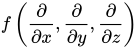
denote any rational integral operator,
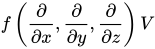
is a solution to the equation, if V satisfies it. This principle has
been applied by Thomson and Tait to the derivation of the system
of any integral degree, by operating upon  , which satisfies Laplace's
equation. The operations may be conveniently carried out by
means of the following differentiation theorem. (See papers by
Hobson, in the Messenger of Mathematics, xxiii. 115, and Proc. Lond. Math. Soc.,
vol. xxiv.)
, which satisfies Laplace's
equation. The operations may be conveniently carried out by
means of the following differentiation theorem. (See papers by
Hobson, in the Messenger of Mathematics, xxiii. 115, and Proc. Lond. Math. Soc.,
vol. xxiv.)
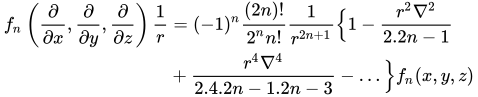
which is a particular case of the more general theorem
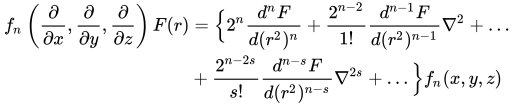
where  is a rational integral homogeneous function of
degree n. The harmonic of positive degree n corresponding to
that of degree
is a rational integral homogeneous function of
degree n. The harmonic of positive degree n corresponding to
that of degree  in the expression (7) is

It can be verified that even when n is unrestricted, this expression
satisfies Laplace's equation, the sole restriction being that of the
convergence of the series.
5. Maxwell's Theory of Poles.—Before proceeding to obtain by
means of (7), the expressions for the zonal, tesseral, and sectorial
harmonics, it is convenient to introduce the conception, due to
Maxwell (see Electricity and Magnetism, vol. i. ch. ix.), of the
poles of a spherical harmonic. Suppose a sphere of any radius
drawn with its centre at the origin; any line whose direction-cosines
are l, m, n drawn from theo rigin, is called an axis, and the point
where this axis cuts the sphere is called the pole of the axis. Different
axes will be denoted by suffixes attached to the direction-cosines:
the cosine  of the angle between the radius
vector r to a point
of the angle between the radius
vector r to a point  and the axis
  will be denoted
by
will be denoted
by  ; the cosine of the angle between two axes is
  ,
which will be noted by
,
which will be noted by  . The operation
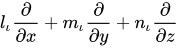
performed upon any function of x, y, z, is spoken of as differentiation
with respect to the axis , and is denoted by  . The
potential function
. The
potential function  is defined to be the potential due to
a singular point of degree zero at the origin;
is defined to be the potential due to
a singular point of degree zero at the origin;  is called the strength
of the singular point. Let a singular point of degree zero, and
strength , be on an axis
is called the strength
of the singular point. Let a singular point of degree zero, and
strength , be on an axis  , at a distance
  from the origin, and
also suppose that the origin is a singular point of strength
from the origin, and
also suppose that the origin is a singular point of strength  ;
let be indefinitely increased, and indefinitely diminished, but
so that the product
;
let be indefinitely increased, and indefinitely diminished, but
so that the product  is finite and equal to ; the origin is then
said to be a singular point of the first degree, of strength
is finite and equal to ; the origin is then
said to be a singular point of the first degree, of strength  , the
axis being . Such a singular point is frequently called a doublet.
In a similar manner, by placing two singular points of degree, unity
and strength, ,
, the
axis being . Such a singular point is frequently called a doublet.
In a similar manner, by placing two singular points of degree, unity
and strength, ,  , at a distance
  along an axis
  , and at the
origin respectively, when is indefinitely increased, and diminished so that
, and at the
origin respectively, when is indefinitely increased, and diminished so that  is finite and
  , we obtain a singular point of degree 2,
strength
, we obtain a singular point of degree 2,
strength  at the origin, the axes being
  . Proceeding in this
manner we arrive at the conception of a singular point of any degree
n, of strength
. Proceeding in this
manner we arrive at the conception of a singular point of any degree
n, of strength  at the origin, the singular point having any n given
axes
at the origin, the singular point having any n given
axes 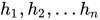 . If
. If  is the potential due to a
singular point at the origin, of degree
is the potential due to a
singular point at the origin, of degree  , and strength
  ,
with axes
,
with axes  , the potential of a singular point of degree
n, the new axis of which is
, the potential of a singular point of degree
n, the new axis of which is  is the limit of

when

this limit is
 , or
, or 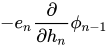 .
.
Since  , we see that the potential V, due to a singular point
at the origin of strength and axes is given by
, we see that the potential V, due to a singular point
at the origin of strength and axes is given by

6. Expression for a Harmonic with given Poles.—The result of
performing the operations in (8) is that  is of the form

where  is a surface harmonic of degree n, and will appear as a
function of the angles which r makes with the n axes, and of the
angles these axes make with one another. The poles of the n
axes are defined to be the poles of the surface harmonics, and are
also frequently spoken of as the poles of the solid harmonics
is a surface harmonic of degree n, and will appear as a
function of the angles which r makes with the n axes, and of the
angles these axes make with one another. The poles of the n
axes are defined to be the poles of the surface harmonics, and are
also frequently spoken of as the poles of the solid harmonics
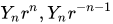 . Any spherical harmonic is completely specified by
means of its poles.
. Any spherical harmonic is completely specified by
means of its poles.
In order to express in terms of the positions of its poles, we
apply the theorem (7) to the evaluation of in (8). On putting
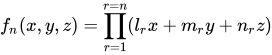 , we have

By 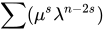 we shall denote the sum of the products of
  of the
quantities
of the
quantities  , and
, and  of the quantities
  ; in any term each
suffix is to occur once, and once only, every possible order being
taken. We find
; in any term each
suffix is to occur once, and once only, every possible order being
taken. We find

and generally

thus we obtain the following expression for , the surface harmonic
which has given poles ;
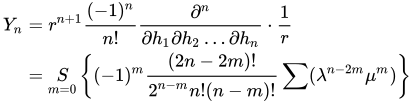
where S denotes a summation with respect to m from  to
to
 , or
, or  , according as n is even or odd. This is Maxwell's
general expression (loc. cit.) for a surface harmonic with given
poles.
, according as n is even or odd. This is Maxwell's
general expression (loc. cit.) for a surface harmonic with given
poles.
If the poles on a sphere of radius r are denoted by A, B, C. . .,
we obtain from (9) the following expressions for the harmonics of
the first four degrees:—



7. Poles of Zonal, Tesseral and Sectorial Harmonics.—Let the n
axes of the harmonic coincide with the axis of z, we have then by
(8) the harmonic