Page:EB1911 - Volume 22.djvu/966
destroyed by Jenghiz Khan in the 13th century, has the four pegs
in the side of the head. Finally, we find the instrument on the
doorway of the Hôpital du Moristan[1] (Cairo), carved work of the
13th century.
 |
| |
| From Marc. Aurel. Stein, Ancient Khotan, by permission of the Clarendon Press. | ||
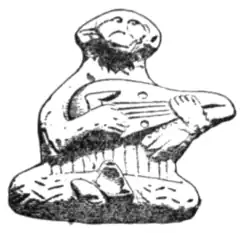
| Fig. 3.—Pear-shaped rebab, from Khotan. |
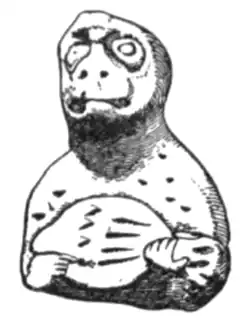
Fig. 4.—Spoon-shaped rebab, from Khotan. | |
In all these examples it is noteworthy that the strings are vibrated by plucking them with the fingers, not by means of the bow, the use of which, in conjunction with those structural features, constitutes the violation of an acoustic principle, and therefore accounts for the failure of the instrument as Rebab and its successful development as Lute. There are, however, two early examples of bowed rebabs of Byzantine origin to be cited. A pear-shaped rebab, held like a violoncello and played by means of a very long and slender bow, is carved on one of the reliefs of an ivory casket of Italo-Byzantine work of the 8th or 9th century, belonging to the Carrand Collection, Florence (see Rebec). Another bowed instrument, of still earlier date, is to be seen among the wonderful mural paintings of the necropolis and monastery of Baouît,[2] assigned to the 8th century at the latest, but probably dating from the 6th or 7th.
The examination of all these representations of the rebab, ranging from 1000 B.C. to the 13th century A.D., tends to show that the instrument had its origin in the East, and was widely distributed over Asia Minor, India and Persia before the 6th century A.D. Similar archaeological documents of the middle ages suggest the possibility that we are not indebted to the Arabs alone for the introduction of the rebab and bow and of the lute into Europe by way of Spain, early in the 8th century, but that they had probably already made their way into southern and central Europe from the East through the influence of the Byzantine Empire and of the Christian East generally.
It is clear also that the instruments of the rebab type were at first twanged with the fingers, and the bow was apparently not invented for the rebab but only applied to it. All arguments in favour of including the rebab among the ancestors of the violin on the score of the bow lose their force, and as the rebab possessed no structural feature in common with the violin the question may be considered settled negatively.
REBATE (Fr. rabat, from rabattre, to beat back), a term used
in commerce, banking, &c. In banking, a rebate is an allowance
made to a drawee taking up a bill of exchange before it is due.
This allowance is the interest on the unexpired period of the bill,
and in practice may be either a fixed or arbitrary rate; more
often it is 1/2%, about the usual bank deposit rate. In
commerce, rebate is sometimes used to mean a discount allowed
for prompt payment; it is often equivalent to drawback, i.e.
the repayment of part of the duty on imported goods when such
goods are subsequently exported in their original or in another
form. By the Customs Consolidation Act, 1853, a rebate or
deduction is allowed at the custom-house from the fixed duties
on certain kinds of goods, on account of damage or loss sustained
in warehouses.
REBEC, or Rebeck (Med. Fr. rubèbe, rebelle, rebec, gigue;
Ger. Rubeba, Rebek, Geige, Lyra; Ital. ribeba, ribeca, lyra; Sp.
rabel, rabeca, ravé, rabé), a medieval stringed instrument played
with a bow, derived from the Oriental rebab. Like the rebab
(q.v.), the rebec assumed at first one of two forms—the pear-shaped
body with a wide base, strung with three strings, or the
long, narrow pear- or boat-shaped body with two strings and, in
addition, the other Oriental characteristics of the rebab, i.e. the
vaulted back, the absence of ribs and pegs set in the back of the
head. Except for the addition of a fingerboard, what is now
recognised as the rebec underwent no structural development
and never entered the domain of art. When the guitar-fiddle
and the oval vielle with five strings made their appearance in
Europe, apparently during the 11th century, a number of
hybrids combining characteristics of both types of construction
spread rapidly over western Europe.
A spoon-shaped instrument, in most cases without neck, the head being joined directly to the wide shoulders of the body, must not be confounded with these hybrids; the compass and capabilities of the instrument, which sometimes had but one single string, must have been extremely limited. What the name of the instrument was in the various ages is not known, but it may be classed with the rebab and rebec, from which it only differs in the outline of the body. The present writer discovered an Oriental archetype on a small terra-cotta figure[3] in the style of the Gandhara school, unearthed at Yotkan on the site of the ancient Khotan. The round head is fastened directly to the shoulders, the three strings are thrown into relief by deep indentations, the bridge tail-piece has three notches. The instrument (assigned to some period between the 5th and 8th centuries A.D.) may be compared with the European medieval type, such, for instance, as the bowed spoon-shaped rebec on the capital of the left pillar in the miniature[4] of King David and his musicians, belonging to the 10th-century psalter of Labeo Notker at St Gallen; also with the musicians’ lyra on the western doorway of the church at Moissan;[5] and with the British Museum Add. MS. 17333, in which several of these spoon-shaped, neckless instruments are to be found.
The pear-shaped rebec with wide base was in all probability introduced into Europe through the Byzantine Empire, and the narrow boat-shaped by the Moors by way of Spain. The first of these types is represented on one of the sides of an ivory casket of Italo-Byzantine workmanship preserved among the Carrand Collection[6] in the Palazzo del Podesta in Florence. It belongs to the same group as the Veroli casket at the South Kensington Museum, all of which are assigned to the 9th century at the latest.
The pear-shaped rebec on the ivory casket, although like all rebecs it had no separate neck, was elongated to form one, and terminated in a lozenge-shaped head all in one piece with back and neck, the soundboard being cut to the same outline and glued to the back. There were four strings to these rebecs, of which there are many examples in English MSS. from the 11th century. One of the best known, sometimes described as the Anglo-Saxon fythele, is the one played by Jeduthun in the usual illustration of King David and his musicians prefaced to the Psalms in an Anglo-Saxon psalter (Cotton MS., Tib. C. VI., Brit. Mus.). Other examples are to be found in a Latin psalter illuminated by an English artist at the beginning of the 12th century (Lansd., 383, Brit. Mus.), in which the rebec has but one string and resembles the lyra teutonica mentioned above.[7]
Medieval documentary evidence points to the fact that the long boat-shaped rebec had survived in Spain and spread by way of France over western Europe. The much-quoted 14th-century
- ↑ See Prisse d’Avennes, L’Art arabe d’après les monuments du Caire du viiᵉ au xviiiᵉ siècle (Paris, 1877). The unnumbered plates are to be identified by the list given at the beginning of the work.
- ↑ For the illustration, see Jean Clédat, “Le monastère et la nécropole de Baouît,” Mém. de l’Inst. fr. d’archéol. orient. du Caire, tome xii., 1904. Chapelle, xviii. pl. lxiv. (2). Descriptive text, p. 92. See also article “Baouît” by the same author, descriptive of the paintings in F. Cabrol’s Dict. d’arch. chrét. et de liturgie (Paris, 1907), fasc. xii. B., p. 250b.
- ↑ See Marc. Aurel Stein, Ancient Khotan: Detailed Report of the Archaeological Explorations in Chinese Turkestan carried out by H.M. Indian Government (Clarendon Press, 1907), vol. i. pl. xlvii. No. y0011d.
- ↑ See Laurent Grillet, Les ancêtres du violon (Paris, 1901), vol. i. p. 29. The author calls these instruments lyra, which is a synonym of rebab.
- ↑ See Kathleen Schlesinger, The Instruments of the Orchestra, part ii., “Precursors of the Violin Family” (London, 1910), pl. iv. p. 154. The spoon-shaped instrument with a long neck on pl. v. (9th century) must be referred to the pandoura family.
- ↑ The casket has been reproduced by A. Venturi in Gallerie Naz. Ital., vol. iii., 1897, p. 263; and L’Arte, vol. i. 1896, p. 24.
- ↑ See also English psalters of the 13th century in the British Museum, Lansd. MS., 420, and Arundel, 157, fol. 71b.