Page:EB1911 - Volume 22.djvu/965
The two principal forms of rebab with which we are concerned as prototypes of European instruments of the middle ages are: (1) the long and narrow boat-shaped rebab, which may be traced back to Persia in the 8th century B.C., and is still in use in that country; and (2) the lute-shaped rebab, with rudimentary neck consisting of the gradual narrowing of the body, which has the outline of a longitudinal section of a pear. This variety became very popular in medieval Europe under the names of rebec, gigue, geige and lyra; the archetype has been traced back to 1000 B.C. The most characteristic feature in the construction of the rebab, and of all instruments derived from it, was the body, composed of a back originally scooped out of a solid piece of wood, to which was glued without the intermediary of ribs (an important structural feature of the violin) a flat sound-board of parchment or thin wood.
The rebab-esh-sha’er, or “poet’s rebab,” had a body consisting of an almost rectangular box covered with parchment and supported on an iron foot; the instrument was held like the modern violoncello. No evidence has yet been brought forward that the rebab-esh-sha’er was in use among the Arabs who conquered Spain in the 8th century; if the instrument was indeed ever introduced into Spain it has left no trace.
The bowed instruments of the middle ages fall naturally into two distinct classes, according to the principles observed in construction. One is the type having a body formed on the model of a Greek or a Roman cithara, from which it was evolved by the addition of a neck and finger-board (see Guitar and guitar fiddle). Instruments of this type were at all times recognized as superior and belonging to the realm of art, whereas type 2, derived from the Eastern rebab, never attained to any artistic development, and at the time when the first type had nearly reached its apogee the second was placed beyond the pale of art.
According to Al-Farabi, the rebab had either one string, two strings or four, obtained by doubling these two; they were tuned most often in minor thirds or in major thirds.[1] The Arab scholar Ash-Shakandi, who flourished in Spain about A.D. 1200, states that the rebab had been known for centuries in Spain, but was not mentioned on account of its want of artistic merit. Juan Ruiz, archipreste de Hita, in his enumeration[2] of the musical instruments in use in his day (14th century), mentions two rebabs, and speaks of il ravé gritador con su alta nota and il rabé morisco; the “shrill rebab” (or rather rebec) “with its high note” is thus quoted somewhat contemptuously already in the 14th century.
The history of the origin of the rebab had until now not gone back beyond the 7th century A.D., and has been a matter of conjecture founded on the word rubāb or rūbab, which is of Persian origin, and on the statement that the Arabs themselves declare they obtained the instrument from the Persians. Recent archaeological discoveries, however, provide abundant evidence of archetypes of both pear-shaped and boat-shaped rebabs in high antiquity. We have at present no clue to the name of the archetype, but it is clear that the el-Oud or lute of the Arabs and the wide pear-shaped rebab were practically one and the same instrument, until the advent of the bow, which had probably also been made known to the Arabs through the Persians, since their word for the bow, kamān, is borrowed from the Persian, but at what date is unknown. Al-Farabi does not mention the bow,[3] and his chapter on the rabâba does not deal with the construction of the instrument so much as with the production of sound and the divisions of the scale.
 |
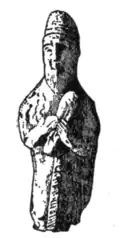 | |
Fig. 1.—Prototype of Lute—Pear-shaped Rebab. 1000 B.C. Discovered by Professor Flinders Petrie in the cemetery at Goshen. |
Fig. 2.—Boat-shaped Rebab. 789 B.C. From J. de Morgan, Délégation en Perse, by permission of Ernest Leroux.
|
As far as is known at present, the archetype of the rebab and lute family is the instrument shown in fig. 1. The terra-cotta figure of the musician discovered in Egypt (1905–6) by Professor Flinders Petrie during the course of excavations in the cemetery of Goshen[4] is Greek work of the post-Mycenaean age; it was found in surroundings assigned to the XXth Dynasty (c. 1000 B.C.), and shows the earliest pear-shaped instrument yet discovered. This statuette clearly establishes the origin of the instruments named by some lyra,[5] by others (including the present writer) rebab or rebec, common all over western Europe from the 11th century, whose main characteristic is an almost entire absence of neck. Two terra-cotta statuettes of musicians playing upon ancient Persian rebabs (see fig. 2) have been excavated] from the
Tell at Suza[6] amongst objects referred to the reign of Shutruk-Nakhounta,
who was king of Elam c. 789 B.C. The pear-shaped
instrument, wide at the base and elongated to form a neck, with
the head bent back at right angles and the strings plucked by
the fingers,—the lute of the 6th century A.D.,—is seen first on a
frieze from Afghanistan, forming one of the risers of steps to the
tope of Jamal-Garhi. These sculptures, preserved at the British
Museum, are assigned to the 2nd or 3rd century, and are said to
show traces of classical influence. The same instrument is found
engraved on a Sassanian silver dish in the British Museum,[7] of
workmanship assigned to a period not later than the 7th century
A.D., but probably earlier, as well as on other dishes of similar
origin; one in the Hermitage, St Petersburg, was found at Irbit
in 1880, on which Eros is depicted playing the lute and riding on a
lion.[8] A third, found at Perm, forms part of Count Stroganov’s collection.[9]
Excavations carried out in ancient Khotan[10] or Ilchi (Turkestan, on the caravan route to Kashgar) have brought to light further evidence of the ubiquity of the rebab type in Asia. In addition to the two principal types of rebab (fig. 3) mentioned above there is also to be found the spoon-shaped instrument with no neck and large round head (fig. 4), sometimes seen in European medieval sculptures and MSS. of the 11th and 12th centuries.[11]
The pear-shaped rebab or lute appears also among the celebrated paintings in the Buddhist cave temples of Ajanta,[12] assigned to the 6th century A.D. A later example at the British Museum, a fragment of a dish found at Rhajes or Ray,[13] in northern Persia,
- ↑ See J. P. N. Land’s paper, “Recherches sur l’histoire de la gamme arabe,” VI. Intern. Orient. Congress, part ii. (Leiden, 1884) (Brit. Mus. press-mark, acad. 8806), p. 130, and also p. 56.
- ↑ See Mariano Soriano Fuertes, loc. cit.
- ↑ The copy of Farabi’s MS., used for their translations by Kosegarten and Land, Escorial, No. 911, dates from the middle of the 12th century. See Michael Casiri, Bibl. Arab. Hisp., vol. i. p. 347, and Forkel, Allgemeine Litteratur der Musik (Leipzig, 1792), p. 487; also R. G. Kiesewetter, Die Musik der Araber nach Originalquellen dargestellt (Leipzig, 1842), p. 64 and preface. Another MS. copy of Al-Farabi, in the Bibliotheca Ambrosiana in Milan, is described by Hammer von Purgstall in the Bibliotheca Italiana, tom. xciv. (Milan, 1839), p. 44; cf. preface in Kiesewetter, p. viii.
- ↑ Excavations carried out by the Brit. School of Archaeology in Egypt and by the Egyptian Research Account. See “Hyksos and Israelite Cities,” by W. M. Flinders Petrie and J. Garrow Duncan, Mem. Brit. Sch. of Arch., 1906.
- ↑ See Laurent Grillet, Les ancêtres du violon, &c. (Paris, 1901), tome i. p. 29. “Portail occidental de l’église de Moissac,” 12th century.
- ↑ See Délégation en Perse, by J. de Morgan (Paris, 1900), vol. i. pl. 8, Nos. 8 and 9, text, pp. 130 and 131.
- ↑ See Ormonde M. Dalton, The Treasures of the Oxus, catalogue of the Franks bequest to the British Museum, 1905, pl. xxvi. No. 190.
- ↑ See for an illustration and description, Comptes rendus de la commission impériale d’archéologie pour l’année 1881 (St Petersburg, 1883), text, p. 53, and atlas of the same date, pl. ii; No. 10.
- ↑ See J. R. Aspelin, Antiquités du nord, p. 141, No. 608.
- ↑ See Ancient Khotan, a detailed report of archaeological explorations in Chinese Turkestan, carried out by H.M. Indian government, by Marc Aurel Stein (Oxford, Clarendon Press, 1907), vol. ii. pl. xlvi. Nos. y0011k, y001d (spoon-shaped rebab), pl. xliii. Nos. y0028 and y009i.
- ↑ See, for instance, Psalter of Labeo Notker, 10th century, Bibl. Stift St Gallen, on the top of left-hand gable pillar. Illustration in Kathleen Schlesinger, The Instruments of the Orchestra (London, 1910), part ii., “Precursors,” pl. iv. p. 154.
- ↑ See reproductions by John Griffiths (London, 1896), vol. ii. pl. 105, cave I., 10, e.
- ↑ Brit. Mus., Ceramic Gallery, case A, Henderson Bequest, 1891.