Page:EB1911 - Volume 22.djvu/791
may be credited, he had not learnt even Latin. But in middle life he inherited some property, and he was thus able to devote himself to the practice of poetry, in which he was the faithful, and perhaps the most distinguished, disciple of Malherbe. He had known Malherbe when he was a page at the court of Henry IV., and had early contributed to the fashionable albums of the day. In 1625 he published his most important work, Bergeries, a dramatic pastoral in five acts, a part of which, entitled Arthénice, was played in 1618. Racan was also the author of Sept psaumes (1631), Odes sacrées tirées des psaumes de David (1651), Dernières œuvres et poésies chrétiennes (1660), in all of which he was hampered by his inability to read the sacred writings except in other French paraphrases. He was one of the original members of the French Academy. He died in February 1670.
His Œuvres complètes were edited by Tenant de Latour in 1857, and the edition includes a biographical notice. See Sainte-Beuve, Causeries du lundi.
RACCONIGI, a town of Piedmont, Italy, in the province of Cuneo, 24 m. S. of Turin, and 31 m. N. of Cuneo by rail, 837 ft. above sea-level. Pop. (1901) 7364 (town); 9077 (commune). It has a royal château built in 1570, with a large park laid out in 1755 by the French gardener Molard from designs by Le Notre, and enlarged in 1835. Since 1901 it has been the summer residence of the king of Italy.
RACCOON (or Racoon), a name borne by the typical representative of a group of American arboreal placental mammals belonging to the order Carnivora (q.v.) and the family Procyonidae. The word is a corruption of the North-American Indian “arrathkune” or “arathcone.” The Fr. raton or raton laveur, Ger. Waschbär, and other European names are derived from a curious habit the raccoon has of dipping or washing its food in water before eating it. The typical raccoon (Procyon lotor) is a thickly built animal about the size of a badger, with a coat of long coarse greyish-brown hairs, short ears, and a bushy black-and-white-ringed tail.
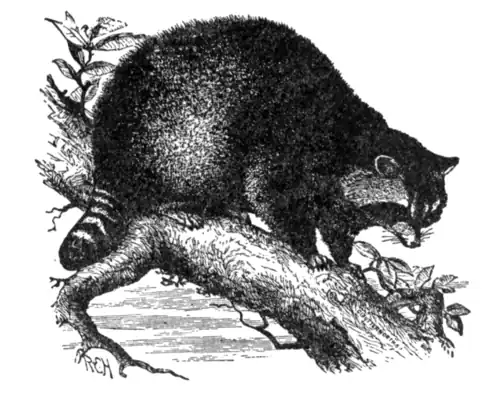
The Raccoon (Procyon lotor).
Its range extends over the whole of the United States, and stretches on the west northwards to Alaska and southwards well into Central America, where it attains its maximum size. The following notes on the habits of the raccoon are from Dr C. Hart Merriam’s The Mammals of the Adirondacks:—
“Raccoons are omnivorous beasts and feed upon mice, small birds, birds’ eggs, turtles and their eggs, frogs, fish, crayfish, molluscs, insects, nuts, fruits, maize and sometimes poultry. Excepting alone the bats and flying-squirrels, they are the most strictly nocturnal of all our mammals, and yet I have several times seen them abroad on cloudy days. They haunt the banks of ponds and streams, and find much of their food in these places, such as crayfish, mussels and fish, although they are unable to dive and pursue the latter under water, like the otter and mink. They are good swimmers and do not hesitate to cross rivers that lie in their path. . . . The raccoon hibernates during the severest part of the winter, retiring to its nest rather early, and appearing again in February or March, according to the earliness or lateness of the season. It makes its home high up in the hollow of some large tree, preferring a dead limb to the trunk itself. It does little in the way of constructing a nest, and from four to six young are commonly born at a time, generally early in April in this region. The young remain with the mother about a year.”
The South-American species, P. cancrivorus, the crab-eating raccoon, is very similar to P. lotor, but differs by its shorter fur, larger size, proportionally more powerful teeth and other minor characters. It extends over the whole of South America, as far south as the Rio Negro, and is common in all suitable localities. Its habits are similar to those of the North-American species.
RACCOON-DOG (Nyctereutes procyonoides), a small wild dog, with sharp-pointed muzzle, short rounded ears, bushy tail and long fur, found in China, Japan and Amurland. The total
length is about 32 in., of which the tail measures 4 in. The
prevailing hues are black and dusky yellow, the distribution of which varies in different individuals. In habit these dogs are chiefly nocturnal; and they are said to hibernate. In winter they feed on fish, and in summer on mice, forming small packs to hunt their prey.
RACE, an homonymous word of which the principal meanings are (1) a trial or contest of speed; (2) a tribe, breed, a group of individuals descended from a common ancestor. In the first case the word is an adaptation of O.Nor. rás, a cognate form in
O.E. being raés, rush, onset; while the O.E. descendant reese
was frequently used in medieval poetry. The particular use
of the word for a swift current of water running through a narrow
channel, e.g. the Race of Alderney, and for the water conducted
in an artificial channel to a point where its power is to be used, as
in “mill-race,” may be due to the O.Fr. raz or raze, probably
of Breton origin. The second word, an ethnical or national
stock, comes from Fr. rase, adapted from Ital. razzo, cf. Span.
raza. It has been referred to an O.H.G. reiza, line, mark,
cognate with Eng. “write,” i.e. the line marking descent.
RACHEL (1821–1858), French actress, whose real name
was Elizabeth Felix, the daughter of poor Jew pedlars, was born
on the 28th of February 1821, at Mumpf, in the canton of Aargau,
Switzerland. At Reims she and her elder sister, Sophia, afterwards
known as Sarah, joined a troupe of Italian children who
made their living by singing in the cafés, Sarah singing and
Elizabeth, then only four years of age, collecting the coppers.
In 1830 they came to Paris, where they sang in the streets,
Rachel giving such patriotic songs as the Parisienne and the
Marseillaise with a rude but precocious energy which evoked
special admiration and an abundant shower of coppers. Étienne
Choron, a famous teacher of singing, was so impressed with the
talents of the two sisters that he undertook to give them
gratuitous instruction, and after his death in 1833 they were
received into the Conservatoire. Rachel made her first appearance
at the Gymnase in Paul Duport’s La Vendéenne on the 4th
of April 1837, with only mediocre success. But on the 12th of
June in the following year she succeeded, after great difficulty,
in making a début at the Théâtre Français, as Camille in
Corneille’s Horace, when her remarkable genius at once received
general recognition. In the same year she played Roxane in
Racine’s Bajazet, winning a complete triumph, but it was in
Racine’s Phèdre, which she first played on the 21st of January
1843, that her peculiar gifts were most strikingly manifested.
Her range of characters was limited, but within it she was
unsurpassable. She excelled particularly in the impersonation
of evil or malignant passion, in her presentation of which there
was a majesty and dignity which fascinated while it repelled.
By careful training her voice, originally hard and harsh, had
become flexible and melodious, and its low and muffled notes
under the influence of passion possessed a thrilling and penetrating
quality that was irresistible. In plays by contemporary
authors she created the characters of Judith and Cleopatra in
the tragedies of Madame de Girardin, but perhaps her most
successful appearance was in 1849 in Scribe and Legouvé’s
Adrienne Lecouvreur, which was written for her. In 1841 and
in 1842 she visited London, where her interpretations of Corneille