Page:EB1911 - Volume 22.djvu/710
Pyromorphite has resulted from the alteration of galena in the oxidized portions of metalliferous veins, and is frequently met with in the upper levels of lead mines. Finely crystallized specimens have been found at Braubach and Ems in Nassau, Wheal Alfred in Cornwall, Roughten Gill in Cumberland, Leadhills in Scotland, Phoenixville in Pennsylvania, Huelgoat in Finistère, Brittany, &c. At the last-named locality, as well as at Wheal Hope, near Truro in Cornwall, there were formerly found curious pseudomorphs of galena after pyromorphite, known as “blue lead ore.” (L. J. S.)
PYRONES, in chemistry, a group of heterocyclic compounds, containing a six-membered ring composed of five carbon atoms and one oxygen atom. Two types are known, namely, the α-pyrones, which may be regarded as the lactones of δ-oxydiolefine carboxylic acids, and the γ-pyrones, which may be regarded as anhydrides of diolefine dioxyketones:—
As a class, the pyrones are rather unstable compounds, the ring being readily broken. When digested with ammonia, the oxygen atom is replaced by the imino (:NH) group, and pyridones or oxypyridines are formed.
α-Pyrones.—The coumalic compounds belong to this series, and were first obtained by A. Hantzsch in 1884 (Ann. 222, p. 1) and H. v. Pechmann (Ber., 1884, 17, p. 936).
α-Pyrone or coumalin, C5H4O2, is obtained by distilling the mercury salt of coumalic acid (from malic acid and sulphuric acid) in a current of hydrogen. It is an oily liquid which boils at 206-209° C., and with alkalis it gives formyl crotonic acid, HO2C·CH:CH·CH2·CHO. α′γ-Dimethyl-α-pyrone or mesitene lactone, C7H8O2, is obtained from iso-dehydracetic acid (from aceto-acetic ester and sulphuric acid). Phenylcoumalin or α′-phenyl-α-pyrone, C5H3(C6H5)O2, is found in coto-bark. When heated with alkalis it yields benzoic acid and ace top hen one; reduction by hydriodic acid gives α′γ-phenyl valeric acid, and when heated with ammonium acetate and ammonia it yields phenylpyridone. It forms an addition product with phenol and with aniline; the latter gives diphenylpyridone when boiled with concentrated hydrochloric acid. Paracotoin, C18H8O4, which also occurs in coto-rind, appears to be a bisoxymethylene phenylpyrone, C5H3O2·C6H3(CH2O2).
Various pyronones (keto-dihydropyrones) derived from the compound having formula I. (below) are known, the most important of which is dehydracetic acid, C8H8O4, first obtained by Geuther (Jena’sche Zeit, 1866, p. 8). It may be prepared by distilling acetoacetic ester alone, by heating it with acetic anhydride to 200° C. or by heating acetyl chloride with pyridine to 200–220° C. J. N. Collie regards it as having formula II., whilst Feist (Ann. 1890, 257, p. 253) favours formula III.
It crystallizes in tables which melt at 108–109° C., and is a weak acid. Alcoholic potash converts it into aceto-acetic ester, and with concentrated aqueous caustic potash it is completely decomposed into acetone, acetic acid and carbon monoxide.
γ-Pyrones.—Many of these compounds are found as naturally occurring substances: thus chelidonic acid is found in Chelidonium majus and meconic acid in opium, and the more complex flavone and flavonol derivatives are also found in various plants. The γ-pyrones may be synthesized by eliminating water from the 1·3·5 triketones:—
γ-Pyrone or pyrocomane, C5H4O2, melting at 32° C. and boiling at 210–215° C., is obtained by eliminating carbon dioxide from chelidonic acid (obtained as above), or from comanic acid, obtained by heating chelidonic acid. αα′-Dimethyl-γ-pyrone, C5H2(CH3)2O2, is obtained by the action of hydriodic acid on the ester of the corresponding acid (Feist, Ann., 1890, 257, p. 272); by the action of carbonyl chloride on the copper derivative of acetoacetic ester, and by the action of concentrated hydrochloric acid on dehydracetic acid. It forms a barium salt which with an acid yields diacetyl acetone. The most striking property of this compound is that it forms salts with mineral acids (J. N. Collie and Tickle, Journ. Chem. Soc., 1899, p. 710). For example, hydrochloric acid adds on at the oxygen atom, since the salts so formed are relatively unstable and undergo complete hydrolysis in dilute aqueous solution. The oxygen atom is probably tetravalent, and the salts are to be regarded as oxonium salts (see Oxygen). Collie (Journ. Chem. Soc., 1904, 85, p. 971) is of the opinion that both oxygen atoms are to be regarded as tetravalent in these salts and gives the second formula below for the molecule:—
Meconic acid, or oxypyrone tricarboxylic acid (3·2·6) C5HO2(OH) (CO2H)2, found in opium, crystallizes in prisms and gives a characteristic deep red colour with ferric chloride. On heating to 200° it gives comenic acid, C5H2O2(OH)(CO2H), and on distillation pyromeconic acid or β-oxypyrone. On comenic acid see A. Peratoner, Gazz., 1906, 36 (i.), p. 1.
The tetrahydro-γ-pyrones may be obtained by the condensation of aldehydes with acetone-dicarboxylic ester in the presence of hydrochloric acid.
Benzopyrones.
Compounds of this type are known in both the α and γ series, the former including the coumarins (q.v.) and isocoumarins, and the latter a number of naturally occurring dyestuffs which may be considered as derivatives of flavone (see under).
The isocoumarins (annexed formula) may be prepared by the action of acid chlorides or anhydrides on orthocyanbenzyl cyanide (Ber., 1892, 25, p. 3563); by the molecular rearrangement of the benzal or alkylidene phthalides (S. Gabriel, Ber., 1885, 18, p. 2443; 1887, 20, p. 2363), and by the action of manganese dioxide and hydrochloric acid on β-naphthoquinone.
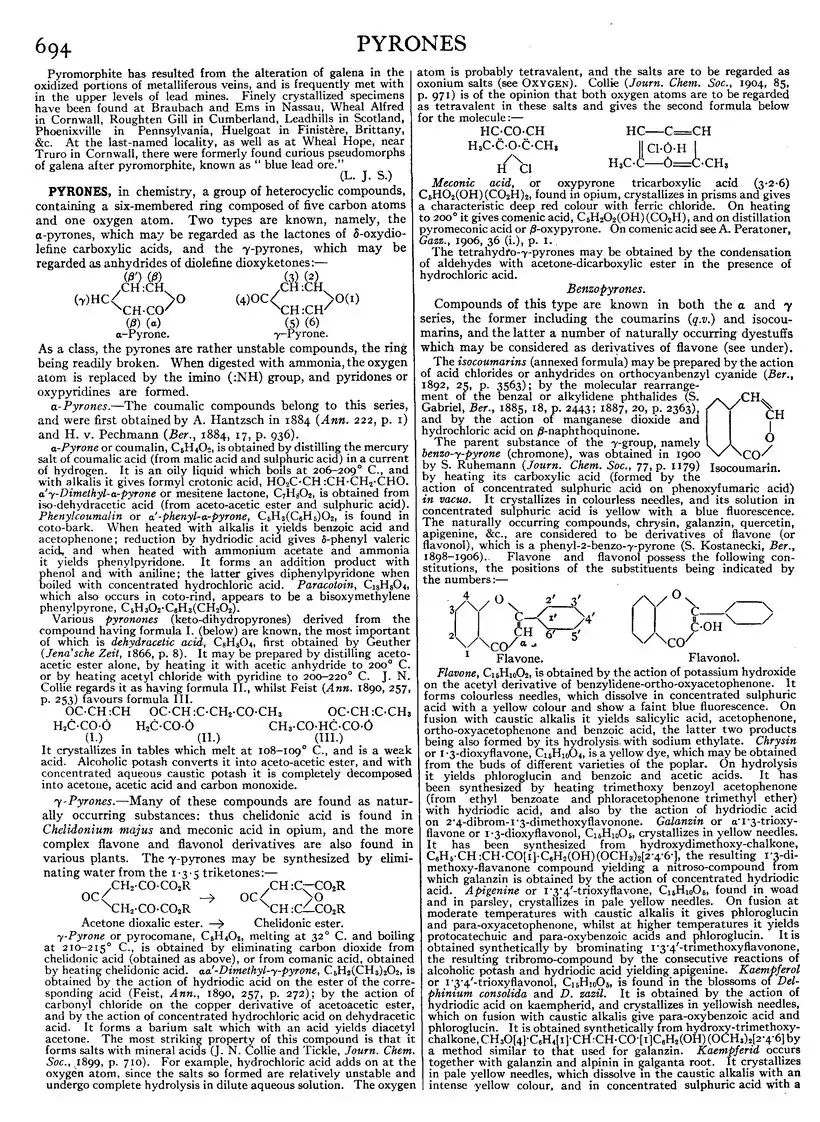
The parent substance of the γ-group, namely benzo-γ-pyrone (chromone), was obtained in 1900 by S. Ruhemann (Journ. Chem. Soc., 77, p. 1179) by heating its carboxylic acid (formed by the action of concentrated sulphuric acid on phenoxyfumaric acid) in vacuo. It crystallizes in colourless needles, and its solution in concentrated sulphuric acid is yellow with a blue fluorescence. The naturally occurring compounds, chrysin, galanzin, quercetin, apigenine, &c., are considered to be derivatives of flavone (or flavonol), which is a phenyl-2-benzo-γ-pyrone (S. Kostanecki, Ber., 1898–1906). Flavone and flavonol possess the following constitutions, the positions of the substituents being indicated by the numbers:—
Flavone, C15H10O2, is obtained by the action of potassium hydroxide on the acetyl derivative of benzylidene-ortho-oxyacetophenone. It forms colourless needles, which dissolve in concentrated sulphuric acid with a yellow colour and show a faint blue fluorescence. On fusion with caustic alkalis it yields salicylic acid, acetophenone, ortho-oxyacetophenone and benzoic acid, the latter two products being also formed by its hydrolysis. with sodium ethylate. Chrysin or 1·3-dioxyflavone, C15H10O4, is a yellow dye, which may be obtained from the buds of different varieties of the poplar. On hydrolysis it yields phloroglucin and benzoic and acetic acids. It has been synthesized by heating trimethoxy benzoyl acetophenone (from ethyl benzoate and phloracetophenone trimethyl ether) with hydriodic acid, and also by the action of hydriodic acid on 2·4-dibrom-1·3-dimethoxyflavonone. Galanzin or α·1·3-trioxyflavone or 1·3-dioxyflavonol, C15H10O5, crystallizes in yellow needles. It has been synthesized from hydroxydimethoxy-chalkone, C6H5·CH:CH-CO[1]·C6H2(OH)(OCHs)2[2·4·6·], the resulting 1·3-dimethoxy-flavanone compound yielding a nitroso-compound from which galanzin is obtained by the action of concentrated hydriodic acid. Apigenine or 1·3·4′-trioxyflavone, C15H10O5, found in woad and in parsley, crystallizes in pale yellow needles. On fusion at moderate temperatures with caustic alkalis it gives phloroglucin and para-oxyacetophenone, whilst at higher temperatures it yields protocatechuic and para-oxybenzoic acids and phloroglucin. It is obtained synthetically by brominating 1·3·4′-trimethoxyflavonone, the resulting tribromo-compound by the consecutive reactions of alcoholic potash and hydriodic acid yielding apigenine. Kaempferol or 1·3·4′-trioxyflavonol, C15H10O5, is found in the blossoms of Delphinium consolida and D. zazil. It is obtained by the action of hydriodic acid on kaempherid, and crystallizes in yellowish needles, which on fusion with caustic alkalis give para-oxybenzoic acid and phloroglucin. It is obtained synthetically from hydroxy-trimethoxychalkone, CH3O[4]·C6H4[1]·CH:CH·CO·[1]C6H2(OH)(OCH3)2 [2·4·6] by a method similar to that used for galanzin. Kaempferid occurs together with galanzin and alpinin in galganta root. It crystallizes in pale yellow needles, which dissolve in the caustic alkalis with an intense yellow colour, and in concentrated sulphuric acid with a