Page:EB1911 - Volume 22.djvu/679
acid; and 7-methylxanthine or heteroxanthine, which is found in
human urine, may be obtained from theobromine (E. Fischer, Ber.,
1897, 30, p. 2400; see also ibid., 1898, 31, p. 117).
Theophylline, C5(CH3)2H2O2N4, or 1·3-dimethyl-2-6-dioxypurin, was isolated by A. Kossel from tea-leaves (Ber., 1888, 21, p. 2164). It was synthesized by E. Fischer and L. Ach (Ber., 1895, 28, p. 3135) from 1·3-dimethyl uric acid, which on treatment with phosphorus pentachloride yields chlortheophylline, from which theophylline is obtained by reduction with hydriodic acid. W. Traube (Ber., 1900, 33, p. 3035) formed the nitroso derivative of iminodimethyl barbituric acid (obtained by the action of phosphorus oxychloride on cyan acetic acid and dimethyl urea), and reduced it by ammonium sulphide to 1·3-dimethyl-4·5-diamino-2·6-dioxypyrimidine, the formyl derivative of which, when heated to 250° C., loses the elements of water and yields theophylline (cf. Xanthine). It behaves as a weak base. When oxidized by potassium chlorate and 'hydrochloric acid it yields dimethylalloxan. Its silver salt on methylation yields caffeine.
The isomeric Paraxanthine, or 1·7-dimethyl-2·6-dioxypurin, occurs in urine. It has been obtained from theobromine (E. Fischer, Ber., 1897, 30, p. 2400); from 1·7-dimethyl uric acid (E. Fischer and H. Clemm, Ber., 1898, 31, p. 2622); and from 8-chlorcaffeine (E. Fischer, Ber., 1906, 39, p. 423). On methylation it yields caffeine.
A third isomer Theobromine, or 3·7-dimethyl-2·6-dioxypurin, is found in the cocoa-bean (from Theobroma cacao) and in the kola-nut. It is obtained by methylating xanthine, or from 3·7-dimethyl uric acid (E. Fischer, Ber., 1897, 30, p. 1839). This acid, by the action of phosphorus oxychloride and pentachloride, is converted into 3·7-dimethyl-6-chlor-2-8-dioxypurin, which with ammonia gives the corresponding amino compound. This substance with phosphorus oxychloride yields 3·7-dimethyl-6-amino-2-oxy-8-chlorpurin, which on reduction with hydriodic acid leads to 3·7-dimethyl-6-amino-2-oxypurin, from which theobromine is obtained by the action of nitrous acid. It is also obtained by W. Traube’s method (Ber., 1900, 33, p. 3047) from cyanacetyl methyl urea, which gives 3-methyl-4·5-diamino-2·6-dioxypyrimidine, whose formyl derivative yields 3-methylxanthine, from which theobromine is obtained by methylation. It crystallizes in anhydrous needles which sublime at 290–295° C. It behaves as a weak base. Potassium chlorate and hydrochloric acid oxidize it to methyl alloxan and methyl urea, chromic acid mixture oxidizes it to carbon dioxide, methylamine and methylparabanic acid. When boiled with baryta it yields carbon dioxide, ammonia, methylamine, formic acid and sarcosine. Methylation of its silver salt yields caffeine.
Caffeine, C5H(CH3)3N4O2, is 1·3·7-trimethyl-2·6-dioxypurin. For its general properties and method of extraction see Caffeine. It may be synthesized by methylating chlortheophylline and reducing the resulting product (E. Fischer and L. Ach, Ber., 1895, 28, p. 3135); by the action of phosphorus oxychloride on tetramethyl uric acid, the resulting chlorcaffeine being reduced (Ber., 1897, 30, p. 3010); from dimethylalloxan (Ber., 1897, 30, p. 564); from 3-methyl uric acid (Ber., 1898, 31, p. 1980), and from 1·3-dimethyl-4-5-diamino-2·6-dioxypyrimidine (W. Traube, Ber., 1900, 33, p. 3042). The three latter methods may be outlined as follows. Dimethylalloxan (I.) condenses with methylamine in the presence of sulphurous acid to form an addition product (II.), which on hydrolysis yields 1·3·7-trimethyl uramil; this substance gives with potassium cyanate, 1·3·7-trimethyl uric acid (III.), which on dehydration yields 1·3·7-trimethyl uric acid (hydroxycaffeine); this substance with phosphorus pentachloride gives chlorcaffeine, which yields caffeine (IV.) on reduction:—
| H3C·N·CO | H3C·N·CO | H3C·N·CO | H3C·N·CO | |||
| | | | | | | | | |  |
CH3 | | |   |
CH3 |
| OC CO→ | OC CH·NHCH3→OC CH·N | → OC C·N | ||||
| | | | | | | | | | CO·NH2 | | | CH | ||
| H3C·N·CO | H3C·N·CO | H3C·N·CO | H3C·N·C·N | |||
| (I.) | (II.) | (III.) | (IV.) | |||
3-Methyl uric acid (I.) (H. Hill, Ber., 1876, 9, p. 370) by the action of phosphorus oxychloride is converted into 3-methyl-2·6-dioxy-8chlorpurin (3-methyl-chlorxanthine) (II.), which, on treatment with methyl iodide in alkaline solution, gives chlortheobromine (III.), groin which chlorcaffeine (IV.) can be obtained by further methylation:—
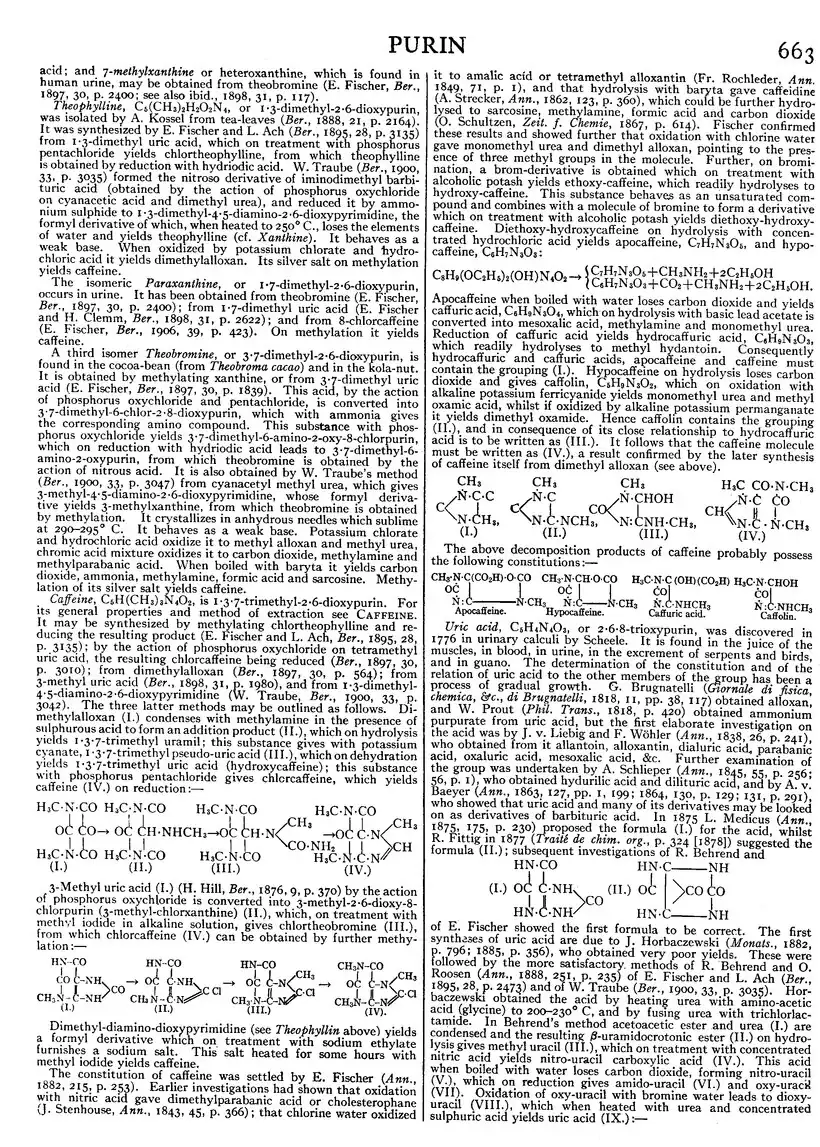
Dimethyl-diamino-dioxypyrimidine (see Theophyllin above) yields a formyl derivative which on, treatment with sodium ethylate furnishes a sodium salt. This salt heated for some hours with methyl iodide yields caffeine.
The constitution of caffeine was settled by E. Fischer (Ann., 1882, 215, p. 253). Earlier investigations had shown that oxidation with nitric acid gave dimethylparabanic acid or cholesterophane (J. Stenhouse, Ann., 1843, 45, p. 366); that chlorine water oxidized it to amalic acid or tetramethyl alloxantin (Fr. Rochleder, Ann. 1849, 71, p. 1), and that hydrolysis with baryta gave caffeidine (A. Strecker, Ann., 1862, 123, p. 360), which could be further hydrolysed to sarcosine, methylamine, formic acid and carbon dioxide (O. Schultzen, Zeit. f. Chemie, 1867, p. 614). Fischer confirmed these results and showed further that oxidation with chlorine water gave monomethyl urea and dimethyl alloxan, pointing to the presence of three methyl groups in the molecule. Further, on bromination, a brom-derivative is obtained which on treatment with alcoholic potash yields ethoxy-caffeine, which readily hydrolyses to hydroxy-caffeine. This substance behaves as an unsaturated compound and combines with a molecule of bromine to form a derivative which on treatment with alcoholic potash yields diethoxy-hydroxycaffeine. Diethoxy-hydroxycaffeine on hydrolysis with concentrated hydrochloric acid yields apocaffeine, C7H7N3O5, and hypocaffeine, C6H7N3O3:
| C8H9(OC2H5)2(OH)N4O2→ | C7H7N3O5+CH3NH2+2C2H5OH |
| C6H7N3O3+CO2+CH3NH2+2HC2H5OH. |

Apocaffeine when boiled with water loses carbon dioxide and yields caffuric acid, C6H9N3O4, which on hydrolysis with basic lead acetate is converted into mesoxalic acid, methylamine and monomethyl urea. Reduction of caffuric acid yields hydrocaffuric acid, C6H9N3O3, which readily hydrolyses to methyl hydantoin. Consequently hydrocaffuric and caffuric acids, apocaffeine and caffeine must contain the grouping (I.). Hypocaffeine on hydrolysis loses carbon dioxide and gives caffolin, C5H9N3O2, which on oxidation with alkaline potassium ferricyanide yields monomethyl urea and methyl oxamic acid, whilst if oxidized by alkaline potassium permanganate it yields dimethyl oxamide. Hence caffolin contains the grouping (II.), and in consequence of its close relationship to hydrocaffuric acid is to be written as (III.). It follows that the caffeine molecule must be written as (IV.), a result confirmed by the later synthesis of caffeine itself from dimethyl alloxan (see above).
The above decomposition products of caffeine probably possess the following constitutions:—
Uric acid, C5H4N4O3, or 2·6·8-trioxypurin, was discovered in 1776 in urinary calculi by Scheele. It is found in the juice of the muscles, in blood, in urine, in the excrement of serpents and birds, and in guano. The determination of the constitution and of the relation of uric acid to the other members of the group has been a process of gradual growth. G. Brugnatelli (Giornale di fisica, chemica, &c., di Brugnatelli, 1818, 11, pp. 38, 117) obtained alloxan, and W. Prout (Phil. Trans., 1818, p. 420) obtained ammonium purpurate from uric acid, but the first elaborate investigation on the acid was by J. v. Liebig and F. Wöhler (Ann., 1838, 26, p. 241), who obtained from it allantoin, alloxantin, dialuric acid., parabanic acid, oxaluric acid, mes oxalic acid, &c. Further examination of the group was undertaken by A. Schlieper (Ann., 1845, 55, p. 256; 56, p. 1), who obtained hydurilic acid and dilituric acid, and by A. V. Baeyer (Ann., 1863, 127, pp. 1, 199; 1864, 130, p. 129; 131, p. 291), who showed that uric acid and many of its derivatives may be looked on as derivatives of barbituric acid. In 1875 L. Medicus (Ann., 1875, 175, p. 230) proposed the formula (I.) for the acid, whilst R. Fittig in 1877 (Traité de chim. org., p. 324 [1878]) suggested the formula (II.); subsequent investigations of R. Behrend and of E. Fischer showed the first formula to be correct.
The first syntheses of uric acid are due to J. Horbaczewski (Monats., 1882, p. 796; 1885, p. 356), who obtained very poor yields. These were followed by the more satisfactory. methods of R. Behrend and O. Roosen (Ann., 1888, 251, p. 235) of E. Fischer and L. Ach (Ber., 1895, 28, p. 2473) and of W. Traube (Ber., 1900, 33, p. 3035). Horbaczewski obtained the acid by heating urea with amino-acetic acid (glycine) to 200-230° C, and by fusing urea with trichlorlactamide. In Behrend’s method acetoacetic ester and urea (I.) are condensed and the resulting β-uramidocrotonic ester (II.) on hydrolysis gives methyl uracil (III.), which on treatment with concentrated nitric acid yields nitro-uracil carboxylic acid (IV.). This acid when boiled with water loses carbon dioxide, forming nitro-uracil (V.), which on reduction gives amido-uracil (VI.) and oxy-uracil (VII). Oxidation of oxy-uracil with bromine water leads to dioxyuracil (VIII.), which when heated with urea and concentrated sulphuric acid yields uric acid (IX.):—