this by  we have
 ![{\displaystyle [a,b]+\upsilon =[a+b,b]>[a,b],[a,b]\times \upsilon =[a,b]}](../_assets_/eb734a37dd21ce173a46342d1cc64c92/f4441d04aa2eb031a2736590c0dce3c93ee44e33.svg) , so that is the ground element of the new aggregate.
, so that is the ground element of the new aggregate.
Again  , and by induction
 ![{\displaystyle m\upsilon =[m,1]}](../_assets_/eb734a37dd21ce173a46342d1cc64c92/8c75ebc1a9bf0919671b7025c48a21c5f47b1bf2.svg) . Moreover, if
. Moreover, if  is a multiple of
  , say
, say  , we may denote
 ![{\displaystyle [a,b]}](../_assets_/eb734a37dd21ce173a46342d1cc64c92/9c4b788fc5c637e26ee98b45f89a5c08c85f7935.svg) by
by  .
.
11. The new aggregate of couples will be denoted by  . It differs from
  and
and  in one very important respect, namely, that when its elements are arranged in order of magnitude (that is to say, by the rule above given) they are not isolated from each other. In fact if
 ![{\displaystyle [a,b]=\alpha }](../_assets_/eb734a37dd21ce173a46342d1cc64c92/f84d6c83706b814aceba0cb3d63af2d593478489.svg) , and
, and ![{\displaystyle [a',b']=\alpha '}](../_assets_/eb734a37dd21ce173a46342d1cc64c92/be152d069a00eeb2819744476a97addb31e5c909.svg) , the element
, the element ![{\displaystyle [a+a',b+b']}](../_assets_/eb734a37dd21ce173a46342d1cc64c92/0dba3797df8c5bdfc8b71b47961c693d1e575b50.svg) lies between
lies between  and
and  ; hence it follows that between any two different elements of we can find as many other elements as we please. This property is expressed by saying that is in close order when its elements are arranged in order of magnitude. Strange as it appears at first sight, is a countable aggregate; a theorem first proved by G. Cantor. To see this, observe that every element of R may be represented by a “reduced” couple , in which
  are prime to each other. If
 ![{\displaystyle [a,b],[c,d]}](../_assets_/eb734a37dd21ce173a46342d1cc64c92/d49ef287ff9c1c2656e176554d474f1f8783b569.svg) are any two reduced couples, we will agree that is anterior to
are any two reduced couples, we will agree that is anterior to ![{\displaystyle [c,d]}](../_assets_/eb734a37dd21ce173a46342d1cc64c92/d85b3b21d6d891d97f85e263d394e3c90287586f.svg) if either (1)
if either (1)  , or (2) but
  . This gives a new criterion by which all the elements of R can be arranged in the succession
![{\displaystyle [1,1],[1,2],[2,1],[1,3],[3,1,],[1,4],[2,3],[3,2],[4.1]...}](../_assets_/eb734a37dd21ce173a46342d1cc64c92/38665e41c3ef5f1a9f6ce707c9252a1c68db8cf1.svg)
which is similar to the natural scale.
The aggregate , arranged in order of magnitude, agrees with
in having no least and no greatest element; for if denotes any element , then ![{\displaystyle [2a-1,2b]<\alpha }](../_assets_/eb734a37dd21ce173a46342d1cc64c92/70e04528214ec2a238cfb0ae91355409f868b726.svg) .
.
12. The division of one element of by another is always possible; for by definition
![{\displaystyle [c,d]\times [ad,bc]=[acd,bcd]=[a,b]}](../_assets_/eb734a37dd21ce173a46342d1cc64c92/3a29acb5c22a42809020cdb3ba42458108c97125.svg) ,
,
and consequently ![{\displaystyle [a,b]\div [c,d]}](../_assets_/eb734a37dd21ce173a46342d1cc64c92/b36d1a905145644e004aacb96d1ded693f494ddb.svg) is always interpretable as
is always interpretable as ![{\displaystyle [ad,bc]}](../_assets_/eb734a37dd21ce173a46342d1cc64c92/c1998bde69e8ab6b3a1701d8483a8cdf461967bb.svg) . As a particular case
. As a particular case ![{\displaystyle [m,1]\div [n,1]=[m,n]}](../_assets_/eb734a37dd21ce173a46342d1cc64c92/ce8295e789d12f3b2049eec94451070811f4e6e3.svg) , so that every element of is expressible in one of the forms
, so that every element of is expressible in one of the forms  . It is usual to omit the symbol altogether, and to represent the element
 ![{\displaystyle [m,n]}](../_assets_/eb734a37dd21ce173a46342d1cc64c92/96654677b42a0d452d661331233f97a1facc9a1e.svg) by
by  , whether
  is a multiple of
  or not. Moreover,
  is written , which may be done without confusion, because
  , and
, and  , by the rules given above.
13. Within the aggregate  subtraction is not always practicable;
but this limitation may be removed by constructing an
aggregate
subtraction is not always practicable;
but this limitation may be removed by constructing an
aggregate  related to in the same way as
  to
to  . This may be done in two ways which lead to equivalent results. We may
either form symbols of the type
. This may be done in two ways which lead to equivalent results. We may
either form symbols of the type  , where
  denote elements
of , and apply the rules of § 7 ; or else form symbols of the type
denote elements
of , and apply the rules of § 7 ; or else form symbols of the type
![{\displaystyle [\alpha ,\beta ]}](../_assets_/eb734a37dd21ce173a46342d1cc64c92/878fce9eb3ba664f0ad4d025f04214fa85ee9583.svg) , where denote elements of , and apply the rules of § 10. The final result is that contains a zero element,
, where denote elements of , and apply the rules of § 10. The final result is that contains a zero element,  , а
ground element , an element
, а
ground element , an element  such that
  , and a set
of elements representable by the symbols (
, and a set
of elements representable by the symbols ( . In this notation the rules of operation are
 ;
;
 ;
;


 ;
;
 .
.
Here and  denote any two elements of
  . If
. If  , then
 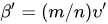 , and if
 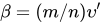 , then
 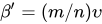 . If
. If  , then
14. When is constructed by means of couples taken from , we must put ![{\displaystyle [m\iota ,n\iota ]=[m\iota ',n\iota ']=(m/n)\upsilon }](../_assets_/eb734a37dd21ce173a46342d1cc64c92/f6c7fe334a41088cadee275b18ec1ffafd294d56.svg) ,
, ![{\displaystyle [m\iota ,n\iota ']=[m\iota ',n\iota ]=(m/n)\upsilon '}](../_assets_/eb734a37dd21ce173a46342d1cc64c92/feb036193cd52b309ac023173651ee496d0f2551.svg) , and
, and ![{\displaystyle [0,\alpha ]=0}](../_assets_/eb734a37dd21ce173a46342d1cc64c92/a345f90bfd99a87feb154a1ee26378868b0b5247.svg) , if is any element of except . The symbols
, if is any element of except . The symbols ![{\displaystyle [0,0]}](../_assets_/eb734a37dd21ce173a46342d1cc64c92/8e543f601fac1a6510c6fd606aee4cae29fc1a79.svg) and
and ![{\displaystyle [\alpha ,0]}](../_assets_/eb734a37dd21ce173a46342d1cc64c92/de8ac80277c4d5f7d81e142c784e326253604c09.svg) are inadmissible; the first because it satisfies the definition of equality (§ 10) with every symbol , and is therefore indeterminate; the second because, according to the rule of addition,
are inadmissible; the first because it satisfies the definition of equality (§ 10) with every symbol , and is therefore indeterminate; the second because, according to the rule of addition,
![{\displaystyle [\alpha ,0]+[\iota ,\iota ]=[\alpha \iota ,0]=[\alpha ,0]}](../_assets_/eb734a37dd21ce173a46342d1cc64c92/979fb6810a825a0f470b40379b72344450a7f837.svg) ,
,
which is inconsistent with 
In the same way, if denotes the zero element of , and  any other element, the symbol
  is indeterminate, and
  inadmissible, because, by the formal rules of operation,
 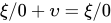 , which conflicts with the definition of the ground element . It is usual to write
  (or simply
  ) for
) for  , and
, and  for
for  . Each of these elements is said to have the absolute value . The criterion for arranging the elements of in order of magnitude is that, if
  are any two elements of it,
  when
when  is positive; that is to say, when it can be expressed in the form
  .
.
15. The aggregate is very important, because it is the simplest type of a field of rationality, or corpus. An algebraic corpus is an aggregate, such that its elements are representable by symbols , &c., which can be combined according to the laws of ordinary algebra; every algebraic expression obtained by combining a finite number of symbols, by means of a finite chain of rational operations, being capable of interpretation as representing a definite element of the aggregate, with the single exception that division by zero is inadmissible. Since, by the laws of algebra,  , and
, and  , every algebraic field contains , or, more properly, an aggregate which is an image of .
16. Irrational Numbers.—Let denote any element of ; then and all lesser elements form an aggregate,  say; the remaining elements form another aggregate
  , which we shall call complementary to , and we may write
  . Now the essence of this separation of into the parts and may be expressed without any reference to as follows:—
I. The aggregates  are complementary; that is, their elements, taken together, make up the whole of .
II. Every element of is less than every element of .
III. The aggregate has no least element. (This condition is artificial, but saves a distinction of cases in what follows.)
Every separation which satisfies these conditions is called a cut (or section), and will be denoted by  . We have seen that every rational number can be associated with a cut. Conversely, every cut
  in which has a last element is perfectly definite, and specifies without ambiguity. But there are other cuts in which has no last element. For instance, all the elements () of such that either
  , or
, or  , form an aggregate , while those for which
  and
and  , form the complementary aggregate . This separation is a cut in which has no last element; because if
  is any positive element of , the element
  exceeds , and also belongs to . Every cut of this kind is said to define an irrational number. The justification of this is contained in the following propositions:—
(1) A cut is a definite concept, and the assemblage of cuts is an aggregate according to definition; the generic quality of the aggregate being the separation of into two complementary parts, without altering the order of its elements.
(2) The aggregate of cuts may be arranged in order by the rule that  if is a part of
  .
.
(3) This criterion of arrangement preserves the order of magnitude of all rational numbers.
(4) Cuts may be combined according to the laws of algebra, and, when the cuts so combined are all rational, the results are in agreement with those derived from the rational theory.
As a partial illustration of proposition (4) let 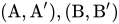 be any two cuts ; and let
  be the aggregate whose elements are obtained by forming all the values of
  , where is any element of and
  is any element of
  . Then if
  is the complement of , it can be proved that
  is a cut; this is said to be the sum of and
  . The difference, product and quotient of two cuts may be defined in a similar way. If
  denotes the irrational cut chosen above for purposes of illustration, we shall have
  where comprises all the numbers
  obtained by multiplying any two elements,
  which are rational and positive, and such that
  . Since
  it follows that is positive and greater than
  ; it can be proved conversely that every rational number which is greater than can be expressed in the form . Hence
  so that the cut actually gives a real arithmetical meaning to the positive root of the equation
  ; in other words we