in a withered form, as in some palms, Typha and Pothos. In
grasses the outer scales or glumes of the spikelets are sterile
bracts (fig. 5, gl); and in Cyperaceae bracts enclose the organs
of reproduction. Bracts are
frequently changed into complete
leaves. This change is
called phyllody of bracts, and
is seen in species of Plantago,
especially in the variety of
Plantago media, called the
rose-plantain in gardens,
where the bracts become leafy
and form a rosette round the
flowering axis. Similar changes
occur in Plantago major, P.
lanceolata, Ajuga reptans,
dandelion, daisy, dahlia and
in umbelliferous plants. The
conversion of bracts into
stamens (staminody of bracts)
has been observed in the case
of Abies excelsa. A lengthening
of the axis of the female
strobilus of Coniferae is not
of infrequent occurrence in
Cryptomeria japonica, larch (Larix europaea), &c., and this is
usually associated with a leaf-like condition of the bracts, and
sometimes even with
the development of
leaf-bearing shoots in
place of the scales.

|
|
Fig. 4.—Flowers of Narcissus
(Narcissus Tazetta) bursting from
a sheathing bract b.
|
|
|

|
|
Fig. 5.—Spikelet of Oat (Avena sativa)
laid open, showing the sterile bracts gl, gl,
or empty glumes; g, the fertile or floral
glume, with a dorsal awn a; p, the pale;
fs, an abortive flower.
|
|

|
| Fig. 6.—Peduncle of Fig (Ficus Carica), ending in a hollow receptacle, enclosing numerous male and female flowers.
|
The arrangement of
the flowers on the axis,
or the ramification of
the floral axis, is called
the inflorescence. The
primary axis of the
inflorescence is sometimes
called the rachis;
its branches, whether
terminal or lateral,
which form the stalks
supporting flowers or
clusters of flowers, are
peduncles, and if small
branches are given off
by it, they are called
pedicels. A flower
having a stalk is called
pedunculate or pedicellate;
one having no stalk is sessile. In describing a branching
inflorescence, it is common to speak of the rachis as the primary
floral axis, its branches as the secondary floral axes, their divisions
as the tertiary floral axes,
and so on; thus avoiding any
confusion that might arise from
the use of the terms rachis, peduncle
and pedicel.
The peduncle is simple, bearing
a single flower, as in primrose;
or branched, as in London-pride.
It is sometimes succulent, as in
the cashew, in which it forms the
large coloured expansion supporting
the nut; spiral, as in
Cyclamen and Vallisneria; or
spiny, as in Alyssum spinosum. When the peduncle proceeds
from radical leaves, that is, from an axis which is so shortened
as to bring the leaves close together in the form of a cluster, as
in the primrose, auricula or hyacinth, it is termed a scape.
The floral axis may be shortened, assuming a flattened, convex
or concave form, and bearing numerous flowers, as in the artichoke,
daisy and fig (fig. 6). The floral axis sometimes appears as
if formed by several peduncles
united together, constituting a
fasciated axis, as in the cockscomb,
in which the flowers form
a peculiar crest at the apex of
the flattened peduncles. Adhesions
occasionally take place
between the peduncle and the
bracts or leaves of the plant, as
in the lime-tree (fig. 7). The
adhesion of the peduncles to the
stem accounts for the extra-axillary
position of flowers, as
in many Solanaceae. When this
union extends for a considerable
length along the stem, several
leaves may be interposed between
the part where the peduncle
becomes free and the leaf
whence it originated, and it may
be difficult to trace the connexion.
The peduncle occasionally
becomes abortive, and in
place of bearing a flower, is transformed
into a tendril; at other
times it is hollowed at the apex,
so as apparently to form the
lower part of the outer whorl of
floral leaves as in Eschscholtzia.
The termination of the peduncle,
or the part on which the whorls
of the flower are arranged, is
called the thalamus, torus or receptacle.

|
| (From Vines’ Students’ Text-Book of Botany, by permission of Swan Sonnenschein & Co.)
|
|
Fig. 7.—Inflorescence of the
Lime (Tilia platyphyllos) (nat.
size).
|
| a,
|
Branch.
|
| b,
|
Petiole with axillary bud. Attached to the peduncle is the bract (h).
|
| k,
|
Calyx.
|
| c,
|
Corolla.
|
| s,
|
Stamens.
|
| f,
|
Ovary.
|
| kn,
|
Flower-bud.
|
|
|
|
| (From Strasburger’s Lehrbuch der Botanik, by permission of Gustav Fischer.)
|
|
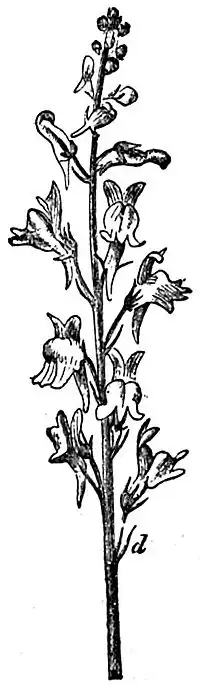
Fig. 8.—Raceme of Linaria
striata. d, bract.
|
|

|
|
Fig. 9.—Head of flowers (capitulum)
of Scabiosa atropurpurea. The inflorescence
is simple and indeterminate,
and the expansion of the flowers centripetal,
those at the circumference
opening first.
|
There are two distinct types of
inflorescence—one in which the
flowers arise as lateral shoots
from a primary axis, which goes
on elongating, and the lateral
shoots never exceed in their development the length of the
primary axis beyond their
point of origin. The flowers
are thus always axillary.
Inflorescence.
Exceptions, such as in cruciferous
plants, are due to the non-appearance
of the bracts. In the other
type the primary axis terminates
in a single flower, but lateral axes are
given off from the axils of the bracts,
which again repeat the primary axis;
the development of each lateral axis
is stronger than that of the primary
axis beyond its point of origin. The
flowers produced in this inflorescence
are thus terminal. The first kind
of inflorescence is indeterminate,
indefinite or axillary. Here the axis is either elongated,