there be several distinct paths, let  vary from coincidence with
  along the first-named path; the action will then cease to be a minimum when a configuration
  is reached such that two of the possible paths from to coincide. For instance, if and be positions on the parabolic path of a projectile under gravity, there will be a second path (with the same energy and therefore the same velocity of projection from
  ), these two paths coinciding when is at the other extremity (, say) of the focal chord through . The action from to will therefore be a minimum for all positions of short of . Two configurations such as and in the general statement are called conjugate kinetic foci. Cf. Variations, Calculus of.
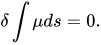
Before leaving this topic the connexion of the principle of stationary action with a well-known theorem of optics may be noticed. For the motion of a particle in a conservative field of force the principle takes the form

(10)
On the corpuscular theory of light  is proportional to the refractive index
  of the medium, whence
(11)
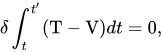
In the formula (2) the energy in the hypothetical motion is prescribed, whilst the time of transit from the initial to the final configuration is variable. In another and generally more convenient theorem, due to Hamilton, the time of transit is prescribed to be the same as in the actual motion, whilst the energy may be Hamiltonian principle.different and need not (indeed) be constant. Under these conditions we have
(12)
where  are the prescribed times of passing through the given initial and final configurations. The proof of (12) is simple; we have

![{\displaystyle =\left[\Sigma m({\dot {x}}\delta x+{\dot {y}}\delta y+{\dot {z}}\delta z)\right]_{t}^{t'}-\int _{t}^{t'}{\Sigma m({\ddot {x}}\delta x+{\ddot {y}}\delta y+{\ddot {z}}\delta z)+\delta \mathrm {V} }dt.}](../_assets_/eb734a37dd21ce173a46342d1cc64c92/e885e032069e19d1c76d15f68b2d2d4a2b0e6aa3.svg)
(13)
The integrated terms vanish at both limits, since by hypothesis the configurations at these instants are fixed; and the terms under the integral sign vanish by d’Alembert’s principle.
The fact that in (12) the variation does not affect the time of transit renders the formula easy of application in any system of co-ordinates. Thus, to deduce Lagrange’s equations, we have

![{\displaystyle ={\Big [}p_{1}\delta q_{1}+p_{2}\delta q_{2}+\ldots {\Big ]}_{t}^{t'}\ -\int _{t}^{t'}\left\{\left[{\dot {p}}_{1}-{\frac {\partial \mathrm {T} }{\partial q_{1}}}+{\frac {\partial \mathrm {V} }{\partial q_{1}}}\right)\delta q_{1}+\left({\dot {p}}_{2}-{\frac {\partial \mathrm {T} }{\partial q_{2}}}+{\frac {\partial \mathrm {V} }{\partial q_{2}}}\right)\delta q_{2}+\ldots \right\}dt.}](../_assets_/eb734a37dd21ce173a46342d1cc64c92/2afbcd5b5cdecc6a057b60f8374b5d3ea7364134.svg)
(14)
The integrated terms vanish at both limits; and in order that the remainder of the right-hand member may vanish it is necessary that the coefficients of  under the integral sign should vanish for all values of
  , since the variations in question are independent, and subject only to the condition of vanishing at the limits of integration. We are thus led to Lagrange’s equation of motion for a conservative system. It appears that the formula (12) is a convenient as well as a compact embodiment of the whole of ordinary dynamics.
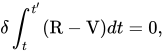
The modification of the Hamiltonian principle appropriate to the case of cyclic systems has been given by J. Larmor. If we write, as in § 1 (25),Extension to cyclic systems.

(15)
we shall have
(16)
provided that the variation does not affect the cyclic momenta  , and that the configurations at times
  and
and  are unaltered, so far as they depend on the palpable co-ordinates
  . The initial and final values of the ignored co-ordinates will in general be affected.
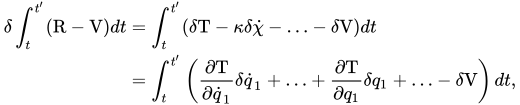
To prove (16) we have, on the above understandings,
(17)
where terms have been cancelled in virtue of § 5 (2). The last member of (17) represents a variation of the integral
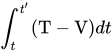
on the supposition that  throughout, whilst
  vanish at times and ; i.e. it is a variation in which the initial and final configurations are absolutely unaltered. It therefore vanishes as a consequence of the Hamiltonian principle in its original form.
Larmor has also given the corresponding form of the principle of least action. He shows that if we write

(18)
then

(19)
provided the varied motion takes place with the same constant value of the energy, and with the same constant cyclic momenta, between the same two configurations, these being regarded as defined by the palpable co-ordinates alone.
§ 8. Hamilton’s Principal and Characteristic Functions.
In the investigations next to be described a more extended meaning is given to the symbol  . We will, in the first instance, denote by it an infinitesimal variation of the most general kind, affecting not merely the values of the co-ordinates at any instant, but also the initial and final configurations and the times of Principal function.passing through them. If we put
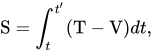
(1)
we have, then,
![{\displaystyle {\begin{aligned}\delta \mathrm {S} &=(\mathrm {T} '-\mathrm {V} ')\delta t'-(\mathrm {T} -\mathrm {V} )\delta t+\int _{t}^{t'}(\delta \mathrm {T} -\delta \mathrm {V} )dt\\&=(\mathrm {T} '-\mathrm {V} ')\delta t'-(\mathrm {T} -\mathrm {V} )\delta t+\left[\Sigma m({\dot {x}}\delta x+{\dot {y}}\delta y+{\dot {z}}\delta z)\right]_{t}^{t'}.\end{aligned}}}](../_assets_/eb734a37dd21ce173a46342d1cc64c92/3275464c47ae5b2741c9eefd4e4a432b5f0e89eb.svg)
(2)
Let us now denote by  , the final co-ordinates (i.e. at time
  ) of a particle
  . In the terms in (2) which relate to the upper limit we must therefore write
  for
for  . With a similar modification at the lower limit, we obtain

(3)
where  is the constant value of the energy in the free motion of the system, and
  is the time of transit. In generalized co-ordinates this takes the form

(4)
Now if we select any two arbitrary configurations as initial and final, it is evident that we can in general (by suitable initial velocities or impulses) start the system so that it will of itself pass from the first to the second in any prescribed time  . On this view of the matter,
  will be a function of the initial and final co-ordinates (
 and
and  ) and the time , as independent variables. And we obtain at once from (4)
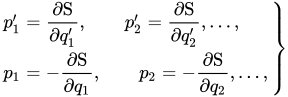
(5)
and

(6)
is called by Hamilton the principal function; if its general form for any system can be found, the preceding equations suffice to determine the motion resulting from any given conditions. If we substitute the values of  and
and  from (5) and (6) in the expression for the kinetic energy in the form
  (see § 1), the equation

(7)
becomes a partial differential equation to be satisfied by . It has been shown by Jacobi that the dynamical problem resolves itself into obtaining a “complete” solution of this equation, involving  arbitrary constants. This aspect of the subject, as a problem in partial differential equations, has received great attention at the hands of mathematicians, but must be passed over here.
There is a similar theory for the functionCharacteristic function.
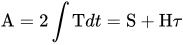
(8)
It follows from (4) that

(9)
This formula (it may be remarked) contains the principle of “least