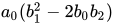
The general term of a seminvariant of degree  and weight
  will be

where  ,
,
 and
and 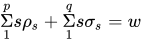 .
.
The number of such terms is the number of partitions of into  parts, the part magnitudes, in the two portions, being limited not to exceed
  and
and  respectively. Denote this number by
 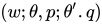 . The number of linearly independent seminvariants of the given type will then be denoted by
 ;
;
and will be given by the coefficient of  in
in
 ;
;
that is, by the coefficient of  in
in
 ;
;
which preserves its expression when  and and
  and are separately or simultaneously interchanged.
Taking the first generating function, and writing  ,
,  and
and  for
for  ,
,  and
and  respectively, we obtain the coefficient of
 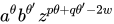 , that is of
  , in
, in
 ;
;
the unreduced generating function which enumerates the covariants of degrees in the coefficients and order  in the variables. Thus, for two linear forms,
  , we find
 ,
,
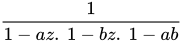
the positive part of which is
 ;
;
establishing the ground forms of degrees-order (1, 0; 1), (0, 1; 1), (1, 1; 0), viz:—the linear forms themselves and their Jacobian  . Similarly, for a linear and a quadratic,
  ,
,  , and the reduced form is found to be
 ,
,
where the denominator factors indicate the forms themselves, their Jacobian, the invariant of the quadratic and their resultant; connected, as shown by the numerator, by a syzygy of degrees-order (2, 2; 2).
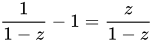
The complete theory of the perpetuants appertaining to two or more forms of infinite order has not yet been established. For two forms the seminvariants of degrees 1, 1 are enumerated by  , and the only one which is reducible is
  of weight zero; hence the perpetuants of degrees 1, 1 are enumerated by
 ;
;
and the series is evidently
one for each of the weights 1, 2, 3,...ad infin.
For the degrees 1, 2, the asyzygetic forms are enumerated by 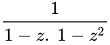 , and the actual forms for the first three weights are
amongst these forms are included all the asyzygetic forms of degrees 1, 1, multiplied by  , and also all the perpetuants of the second binary form multiplied by
  ; hence we have to subtract from the generating function and
  , and obtain the generating function of perpetuants of degrees 1, 2.
 .
.
The first perpetuant is the last seminvariant written, viz.:—
 ,
,
or, in partition notation,
 ;
;
and, in this form, it is at once seen to satisfy the partial differential equation. It is important to notice that the expression

denotes a seminvariant, if  be neither of them unity, for, after operation, the terms destroy one another in pairs:
when
be neither of them unity, for, after operation, the terms destroy one another in pairs:
when  ,
,  must be taken to denote and so for . In general it is a seminvariant of degrees , and weight
  ; for this there is an exception, viz., when , or when
  , the corresponding partial degrees are 1 and 1. When
  , we have the general perpetuant of degrees 1, 1. There is a still more general form of the seminvariant; we may have instead of any collections of non-unitary integers not exceeding in magnitude respectively, Ex. gr.
is a seminvariant; and since these terms are clearly enumerated by
 ,
,
an expression which also enumerates the asyzygetic seminvariants, we may regard the form, written, as denoting the general form of asyzygetic seminvariant; a very important conclusion. For the case in hand, from the simplest perpetuant of degrees 1, 2, we derive the perpetuants of weight ,
a series of  or of
or of  forms according as is even or uneven. Their number for any weight is the number of ways of composing
  with the parts 1, 2, and thus the generating function is verified. We cannot, by this method, easily discuss the perpetuants of degrees 2, 2, because a syzygy presents itself as early as weight 2. It is better now to proceed by the method of Stroh.
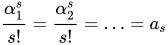
We have the symbolic expression of a seminvariant.

where
 ;
; 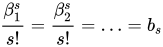 ;
;
and  .
.
Proceeding as we did in the case of the single binary form we find that for a given total degree , the condition which expresses reducibility is of total degree  in the coefficients
  and
and  ; combining this with the knowledge of the generating function of asyzygetic forms of degrees , , we find that the perpetuants of these degrees are enumerated by
 ,
,
and this is true for  as well as for other values of (compare the case of the single binary form).
Observe that, if there be more than two binary forms, the weight of the simplest perpetuant of degrees  is
is  , as can be seen by reasoning of a similar kind.
To obtain information concerning the actual forms of the perpetuants, write


where  .
.
For the case  ,
,  , the condition is
 ,
,
which since  , is really a condition of weight unity. For
  the form is
  , which we may write
  ; the remaining perpetuants, enumerated by
  , have been set forth above.
For the case ,  ,
the condition is
,
the condition is  ; and the simplest perpetuant, derived directly from the product
  , is
, is  ; the remainder of those enumerated by
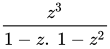 may be represented by the form
 ;
;
 and
and  each assuming all integer (including zero) values. For the case
  , the condition is
 .
.
To represent the simplest perpetuant, of weight 7, we may take as base either  or
or  , and since the former is equivalent to
  and the latter to
  ; so that we have,