we may write in general

the summation being for every partition  of
of  and
and  being
being 
Ex. gr. To operate with  upon
upon 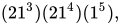 we have

and hence

Application to Symmetric Function Multiplication.—An example will explain this. Suppose we wish to find the coefficient of  in the product
 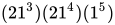 .
.
Write

then

every other term disappearing by the fundamental property of  Since
Since

we have:—
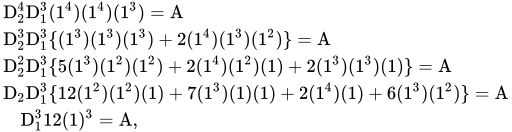
where ultimately disappearing terms have been struck out. Finally 
The operator  which is satisfied by every symmetric fraction whose partition contains no unit (called by Cayley non-unitary symmetric functions), is of particular importance in algebraic theories. This arises from the circumstance that the general operator

is transformed into the operator  by the substitution

so that the theory of the general operator is coincident with that of the particular operator  For example, the theory of invariants may be regarded as depending upon the consideration of the symmetric functions of the differences of the roots of the equation

and such functions satisfy the differential equation

For such functions remain unaltered when each root receives the same infinitesimal increment  but writing
  for
for  causes
  to become respectively
  and
and  becomes

and hence the functions satisfy the differential equation. The important result is that the theory of invariants is from a certain point of view coincident with the theory of non-unitary symmetric functions of the roots of  are symmetric functions of differences of the roots of

and on the other hand that symmetric functions of the differences of the roots of

are non-unitary symmetric functions of the roots of

An important notion in the theory of linear operators in general is that of MacMahon’s multilinear operator (“Theory of a Multilinear partial Differential Operator with Applications to the Theories of Invariants and Reciprocants,” Proc. Lond. Math. Soc. t. xviii. (1886), pp. 61-88). It is defined as having four elements, and is written

![{\displaystyle {\begin{aligned}={\frac {1}{m}}{\bigg [}&\mu a_{0}^{m}\delta _{an}+(\mu +\nu ){\frac {m!}{(m-1)!1!}}a_{0}^{m-1}a_{1}\delta _{an+1}\\&+(\mu +2\nu ){\bigg \{}{\frac {m!}{(m-1)!1!}}a_{0}^{m-1}a_{2}+{\frac {m!}{(m-2)!2!}}a_{0}^{m-2}a_{1}^{2}{\bigg \}}\delta _{an+2}\\&+(\mu +3\nu ){\bigg \{}{\frac {m!}{(m-1)!1!}}a_{0}^{m-1}a_{3}+{\frac {m!}{(m-2)!1!1!}}a_{0}^{m-2}a_{1}a_{2}\\&\qquad \qquad \qquad \qquad \qquad \qquad \quad \;\;+{\frac {m!}{(m-3)!3!}}a_{0}^{m-3}a_{0}^{3}{\bigg \}}\delta _{an+3}\\&+\ldots {\bigg ]},\end{aligned}}}](../_assets_/eb734a37dd21ce173a46342d1cc64c92/19b2fa737c7ccc683af69d21fad1cd278001490e.svg)
the coefficient of 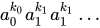 being
being 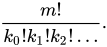 The operators
  are seen to be
  and
and  respectively. Also the operator of the Theory of Pure Reciprocents (see Sylvester Lectures of the New Theory of Reciprocants, Oxford, 1888) is

It will be noticed that

The importance of the operator consists in the fact that taking any two operators of the system

the operator equivalent to

where
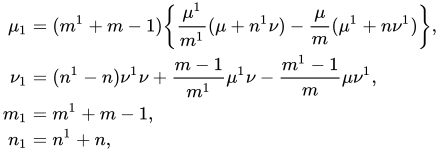
and we conclude that quâ “alternation” the operators of the system form a “group.” It is thus possible to study simultaneously all the theories which depend upon operations of the group.
Symbolic Representation of Symmetric Functions.—Denote the elementary symmetric function  by
by 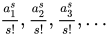 at pleasure; then, taking
  equal to
  we may write

where

Further, let

so that
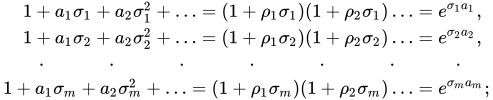
and, by multiplication,


Denote by brackets  and
and ![{\displaystyle [\;]}](../_assets_/eb734a37dd21ce173a46342d1cc64c92/47e011f5d24ee27d9223816cc69be5e8a51a5a9e.svg) symmetric functions of the quantities
symmetric functions of the quantities  and
and  respectively. Then
![{\displaystyle 1+a_{1}[1]+a_{1}^{2}[1^{2}]+a_{2}[2]+a_{1}^{3}[1^{3}]+a_{1}a_{2}[21]+a_{3}[3]+\ldots }](../_assets_/eb734a37dd21ce173a46342d1cc64c92/0e3e53e63da5fa00748d4ec777e117deb4285075.svg)
![{\displaystyle +a_{p_{1}}a_{p_{2}}a_{p_{3}}\ldots a_{p_{m}}{\big [}p_{1}p_{2}p_{3}\ldots p_{m}{\big ]}+\ldots }](../_assets_/eb734a37dd21ce173a46342d1cc64c92/7dd41f7e220eb5fbc9ed01babe084ced2227bc89.svg)

Expanding the right-hand side by the exponential theorem, and then expressing the symmetric functions of  which arise, in terms of
  we obtain by comparison with the middle series the symbolical representation of all symmetric functions in brackets appertaining to the quantities
  To obtain particular theorems the quantities
  are auxiliaries which are at our entire disposal. Thus to obtain Stroh’s theory of seminvariants put
![{\displaystyle b_{1}=\sigma _{1}+\sigma _{2}+\ldots +\sigma _{m}=[1]=0;}](../_assets_/eb734a37dd21ce173a46342d1cc64c92/0e84561a047bd196270f603a49b028a5a84b18d1.svg)
we then obtain the expression of non-unitary symmetric functions of the quantities as functions of differences of the symbols 
Ex. gr.  with
with  must be a term in

and since  we must have

as is well known.
Again, if  be the
  roots of
  and
and  leading to

and
