 and it is seen intuitively that the number
  remains unaltered when the first two of these partitions are interchanged (see Combinatorial Analysis). Hence the theorem is established.
Putting  and
and  we find a particular law of reciprocity given by Cayley and Betti,

and another by putting  , for then
  becomes
  , and we have


Theorem of Expressibility.—“If a symmetric function be symboilized by  and
and 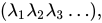
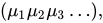
 be any partitions of
  respectively, the function is expressible by means of functions symbolized by separation of

For, writing as before,


 is a linear function of separations of
 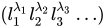 of specification
  and if
  is a linear function of separations of of specification
 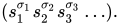 Suppose the separations of to involve
  different specifications and form the identities

where  is one of the specifications.
The law of reciprocity shows that

viz.: a linear function of symmetric functions symbolized by the specifications; and that  A table may be formed expressing the expressions
  as linear functions of the expressions
  ,
,  , and the numbers
  occurring therein possess row and column symmetry. By solving linear equations we similarly express the latter functions as linear functions of the former, and this table will also be symmetrical.
Theorem.—“The symmetric function whose partition is a specification of a separation of the function symbolized by is expressible as a linear function of symmetric functions symbolized by separations of and a symmetrical table may be thus formed.” It is now to be remarked that the partition can be derived from by substituting for the numbers  certain partitions of those numbers (vide the definition of the specification of a separation).
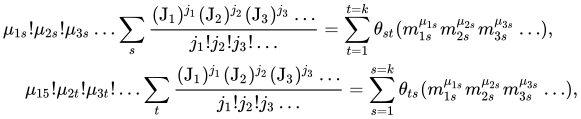
Hence the theorem of expressibility enunciated above. A new statement of the law of reciprocity can be arrived at as follows:—Since.

where  is a separation of of specification
  placing
  under the summation sign to denote the specification involved,
where  .
.
Theorem of Symmetry.—If we form the separation function
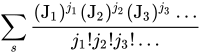
appertaining to the function 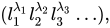 each separation having a specification , multiply by
  and take therein the coefficient of the function
  we obtain the same result as if we formed the separation function in regard to the specification multiplied by
  and took therein the coefficient of the function
Ex. gr., take  we find

The Differential Operators.—Starting with the relation

multiply each side by  thus introducing a new quantity
  we obtain

so that  a rational integral function of the elementary functions, is converted into

where

and  denotes, not successive operations of
  but the operator of order obtained by raising
  to the
  power symbolically as in Taylor’s theorem in the Differential Calculus.
Write also  so that

The introduction of the quantity  converts the symmetric function
  into
into

Hence, if 


Comparing coefficients of like powers of we obtain

while  unless the partition contains a part
  Further, if
  denote successive operations of
  and
and 

and the operations are evidently commutative.
Also  and the law of operation of the operators
  upon a monomial symmetric function is clear.
We have obtained the equivalent operations

where  denotes (by the rule over
  ) that the multiplication of operators is symbolic as in Taylor’s theorem.
  denotes, in fact, an operator of order
  but we may transform the right-hand side so that we are only concerned with the successive performance of linear operations. For this purpose write

It has been shown (vide ”Memoir on Symmetric Functions of the Roots of Systems of Equations,” Phil. Trans. 1890, p. 490) that

where now the multiplications on the dexter denote successive operations, provided that

 being an undetermined algebraic quantity.
Hence we derive the particular cases


and we can express  in terms of
  products denoting successive operations, by the same law which expresses the elementary function
  in terms of the sums of powers
  Further, we can express
  in terms of
  by the same law which expresses the power function in terms of the elementary functions
Operation of upon a Product of Symmetric Functions.—Suppose  to be a product of symmetric functions
  If in the identity
  we introduce a new root we change into
  and we obtain
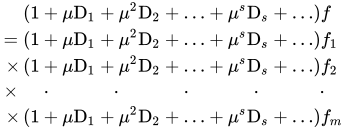
and now expanding and equating coefficients of like powers of

the summation in a term covering every distribution of the operators of the type presenting itself in the term.
Writing these results
