Page:Czecho-Slovak Student Life, Volume 18.djvu/440
ied organ and church music at Conception Abbey, Conception, Mo., under Rev. Gregory Huegle, and upon his return to Lisle, at the commencement of the school year, immediately began work on “America First”, the first operetta ever staged at Lisle. In that same year he organized a permanent band with a regular schedule for rehearsals.
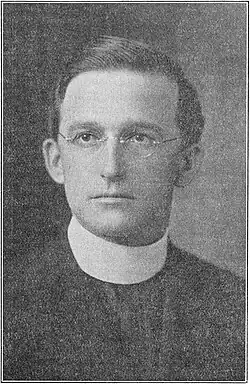
DR. FRANCIS SINDELAR, O.S.B.
From 1921 to 1923 inclusive, he studied composition, instrumentation and directing at the Chicago Conservatory of music under Dr. A. Cook and Mr. Clifford Thompson, receiving his doctorate in music in 1923. Since then he has repeatedly scored successes in music composition, all of which show him to be a musician of refined taste and deep feeling for his subject. In 1924 he entered the contest of First National Pictures Corporation for a prologue to their production, “The Hunchback of Notre Dame”. It is worthy of special notice that the three eminent musicians, Leopold Godowski, Hugo Reisenfeld and Carl Laemmie, who acted as judges for this contest, selected Father Sindelar’s composition out of the several hundred submitted as one of the eight to be finally considered for first prize.
It is evident from the foregoing that Father Sindelar’s musical education is thorough and explains the secret of the great success he has thus far had with any musical undertaking. His tours are especially worthy of note because of their huge success both musically and financially. As Dr. Cook said: “Few men would attempt such an undertaking with a group of college students, for no other reason than that it requires a mind of complex ability to succeed with it. One may be a wizard musically and yet be hopelessly lacking in business ability; and what is still more admirable in Father Francis is his ability to train a group of amateurs into a dependable musical organization”.
We may remark here that Father Sindelar and his orchestras have won many friends in America through their radio programs given from time to time from various Chicago broadcasting stations.
As further proof of his musical worth may be cited the fact that he was delegated to score all the music for all of the bands participating in the XXVIII International Eucharistic Congress in Chicago, besides mustering his own band of thirty six members into such military form that every appearance of the St. Procopius College Band at this occasion brought instant notice from the press, which waxed so enthusiastic over it as to compare the members to West Point cadets.