Page:Czecho-Slovak Student Life, Volume 18.djvu/420
and most insignificant happenings in the daily life of the people; for example, the opening of a new rosebud in the garden, or one neighbour’s geese invading another one’s field of clover and eating of it more than seems fair, and witty remarks about one another’s foibles. In their songs, all the Czecho-Slovak characteristics are revealed. They sang their joys, their woes, their affections, and their hatreds; they wooed and prayed in their songs, Old and young sang, and it is no wonder, therefore, that there are without exaggeration volumes of Czech folksongs.
| PROF. BEDŘICH SMETANA |
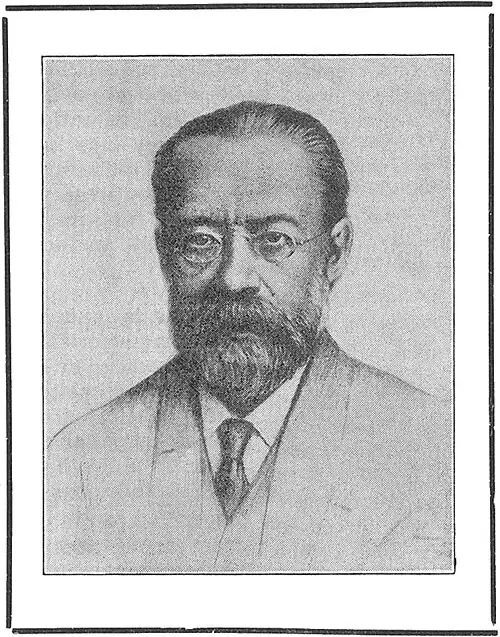 |
LEADING CZECH COMPOSER |
It also seems natural that with the revival of the Czech nationality in the 19th century a longing was aroused to express a national individuality in music. Attempts were made to introduce into the higher walks of musical arts the long forgotten or scorned popular songs. The year 1800 saw the foundation of a Conservatory of Music in Prague, and, in 1824, Bedřich Smetana was born in eastern Bohemia, whose works embody all these aspirations after musical art together with up-to-date technic and profound patriotism. Bedřich Smetana was a musical genius and the first great Czech composer. He possessed in a rare degree a thorough mastery of his art along with an appealing love for his country.
All subsequent Czech music is based on his doctrines. We find a similar national inspiration in the compositions of Antonín Dvořák and Zdeněk Fibich, who form a link between Smetana’s generation and the modern school, which, though using new means of expression, remains true to the national spirit of Smetana’s eight operas, of which only one is known in America. It is the comic opera, the “Bartered Bride”, of which the first performance was given at the Metropolitan Opera, New York, in 1909. The same was produced in Chicago the following year. Of his cycle of symphonie poems only two are sometimes played in the United States. One is the “Moldau”, depicting the river Vltava; the other is Vy-