Page:Czecho-Slovak Student Life, Volume 18.djvu/375
Later he left for Chicago where he entered the Academy of Fine Arts and also studied at the Art Institute.
Mr. Kellner showed such aptitude in his field that already at the age of twenty-three, despite the necessarily desultory and intermittent nature of his studies, he was a most successful commercial artist. However, he dreamed of studying abroad where, he felt, he could find the inspiration he needed.
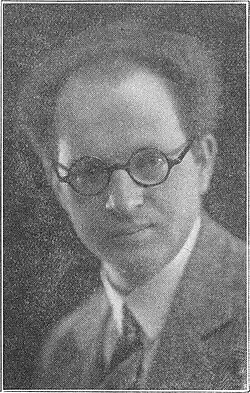
MR. CHARLES H. KELLNER
When America entered the World War, Mr. Kellner enlisted and was sent overseas with the A. E. F. After the armistice, he was transferred to Coblenz with the Army of Occupation in the Topographical Department. He had always wished paint historical landscapes and here, he thought, was his chance. He matriculated therefore at the American Art School in that city. His captain, an art lover and patron, induced him to apply for a scholarship at the American Art School at Bellevue Paris. He did and was one of the three hundred chosen from 30,000 contestants. While at this school he won first prizes in landscape and in portrait painting, and soon after returned to America.
The quaint beauty and quiet charm of the Normandy villages he had seen during his stay in France, however, had an irresistible attraction for him and he soon resumed his studies there. He also visited Italy, and there “sat at the feet of the Old Masters.” During this, his second European visit, he studied under Bonnard and Lachman, exhibiting both in Paris and in Rome.
After two years, spent in perfecting his technique and in painting landscapes which capture all the misty and colorful beauty of Normandy, Mr. Kellner returned to Chicago with his pianiste-wife, Mme. Sara Divinoff. Here he has since remained, working tirelessly, studiously, and well.
Strength, rather than temperamentalism and mood, say the critics, seems to be the chief charasteristic of this painter. He began as an avowed imitator of Corot and Bonnard, not only in method but in choice of subjects also. His development was not slow, however, for in his “French Kitchen Corner” his individuality is already manifest.
The picture represents a corner of a typical Normandy kitchen, and the distinctness of detail, even a certain hardness in it, directly in the foreground, mark an individual trait. The painter has combined here, moreover, an impression of atmosphere and light effect with excellent portraiture in the housewife at work in her corner. Here, too, we find the cleanness and solidity of coloring characteristic of Kellner’s work.
It is easy to see that the landscape has been, so far, Mr. Kellner’s favorite medium. He has preferred Italian and French scenes, particularly of the country about and in Normandy. The titles of his pictures explain the subjects sufficiently. Here are some of them: Arch of Constantine; A Misty Morning, Normandy; Bird’s Eye View of Grand Andely; An Old Roman