Page:Czecho-Slovak Student Life, Volume 18.djvu/373
of peace because of the conflicting interests of the three nations to which he was accredited, was made doubly difficult by the outbreak of the World War. As country after country entered the ranks of the belligerents, he, as the minister of the leading neutral nation, was entrusted with their interests and during the greater part of the war he was the diplomatic representative of seven countries besides the United States. Thus for four years his life was one of extraordinary activity and strain.
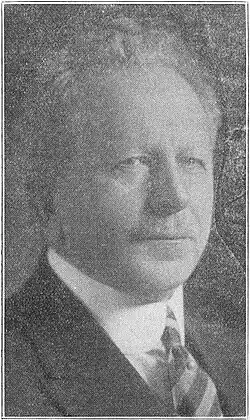
MR. CHARLES J. VOPICKA
He secured the exchange of thousands of women, children and old men between the fighting nations; obtained better food and medical attention, and more humane treatment, generally, for prisoners of war; hastened American relief work during the typhus epidemics; as chairman of an international commission he inspected the Serbian prison camps and furnished food and medical supplies for the Austrian and German prisoners. Upon him fell the task of serving an ultimatum of war on the Roumanian government on behalf of Germany and Turkey on Sept. 4, 1916. When the Roumanian court fled to Jassy upon the approach of the German army, he remained behind at Bucharest, but his continued efforts to protect American and other foreign interests committed to him, aroused the hostility of Gen. Von Mackensen, the German commander, who forced him to leave the country in January, 1917. Returning to the United States by way of Berlin, he proceeded, after the U. S. declaration of war against Germany, to Jassy, the temporary capital of Roumania. While at Jassy he visited the Russian military forces in that region, and through personal appeals to them to continue fighting, postponed by two months their defection from the allied cause. In this movement he was supported by the Allies and Roumania. Later, when thousands of the Russians sought to join the American army, he formulated a plan, together with American Military Attache, Col. Yates, to enlist 200,000 of them to fight under the American flag. The Washington government, however, had not received the telegram in time; and when the answer, granting the necessary authority came, it was too late and the project failed. After the war he prevented the execution of a widespread plot to massacre the Roumanian Jews by urgent personal appeals to the prime minister. As dean of the diplomatic corps, he presented the allied ultimatum to Roumania, requiring the approval of the Roumanian-Austrian treaty, under penalty of terminating diplomatic relations, and through his good service and the aid of his diplomatic colleagues, Roumania was persuaded to sign the document. Mr. Vopicka resigned his position in 1920 and re-entered business life in Chicago.