Page:Cyclopedia of Western Australia, volume 1.pdf/98
Company to proceed with the "Geelvinck" and two other vessels to carefully examine the west coast of New Holland for some trace of her. On Christmas Day, 1696, they sighted land, and on December 29 anchored off the shore of a large island, upon which they landed on the following day. On exploring it they were struck with the large number of rats' (wallabies) nests found, and from that fact gave it the name of Rottnest Island. Some pieces of wreckage were discovered, but there was nothing by which they could identify the vessel they were endeavouring to trace. From the higher parts they could see the mainland distinctly, and from the smoke rising here and there from among the trees they gathered that natives were present. On January 5, 1697, Vlaming with eighty-six well-armed men landed on the shore somewhere in the neighbourhood of Cottlesloe Beach, and marching eastward came upon what they described as "a large basin of brackish water." On the banks of this they met with traces of natives in the shape of footprints, a fire still burning, and a hut that would have disgraced a Hottentot, but the aborigines themselves were not to be seen. They camped near the fire, and on the following day separated into three parties for exploratory purposes and went off in different directions, to meet again at night having made no discovery of any importance beyond proving that the "basin of brackish water" was really a river. Some of the men foolishly partaking of nuts "having the taste of our large Dutch beans" which they found growing on a certain tree paid severely for their indiscretion—so much so that one wonders whether they really were Dutch beans. On the 9th they brought the ships in and anchored just off the mouth of the river, which Vlaming and a party explored on the following days for a distance of some 14 or 16 leagues. They were rewarded by the discovery of numbers of that hitherto unknown prodigy of Nature—the fabulous black swan described by Juvenal. Several specimens were secured and three were taken alive to Batavia. From the presence of these birds Vlaming named his discovery the "Swan River." However, having, according to the narrative, "found neither good country nor seen anything worthy of note" Vlaming continued his voyage northward, examining the shore carefully for traces of the lost ship, and occasionally landing to make some exploration of the coast. On February 4 they reached Shark Bay and on Dirk Hartog found the tin-plate previously referred to. This they took away, leaving another in its place. Resuming the voyage they reached the North-West Cape, and on the 21st of the month set the course direct for Batavia, after firing guns "as a signal of farewell to the miserable South Land." To Vlaming thus belongs the discovery of the Swan River, the most important so far of all the discoveries on the mainland, and he also had the honour of being the first to anchor in the harbour at Fremantle.
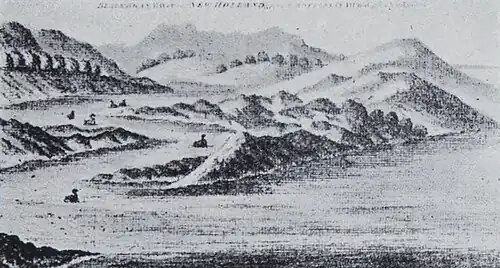
Black Swan River on New Holland, opposite Rottnest Island, from Vankeulen
Meanwhile Dampier had not been idle. For some years after his arrival in England he was engaged preparing a record of his voyage and adventures from 1683 to 1691. This was published in 1698 as "A New Voyage Round the World." From it the English gained their first accurate knowledge of these new South Lands. So impressed were they with the potentialities of the places described and so desirous of learning more about them that William III. was induced to send Dampier in the "Roebuck," under commission from the Admiralty, to make further exploration of the north-west coast and to solve, if possible, the question whether the new discoveries were a series of islands or part of a great continent.
Dampier sailed from England on January 14, 1699, taking the usual route round the Cape and thence eastward. On August 1 land was sighted, and on the 5th he anchored in Dirk Hartog Bay, to which, owing to the prevalence of sharks, he gave its present name of Shark Bay. Some eight days were spent in making trips to the mainland in search of water, but without result. During this time he surveyed a portion of the Bay and collected a good deal of valuable information about the coastal country, as well as interesting data concerning the fauna and flora. He tells us that the land was gently undulating, with stretches of sand along the seaboard, changing to a reddish soil of sandy nature farther inland. Upon this grew plants, grass, and shrubs, but no tree above 10 ft. in height. Of the tree blossoms blue was the predominating colour, and small and beautiful flowers of various hues, different from any- thing he had previously seen, abounded everywhere. The onlv large birds were some eagles, cormorants, pelicans, gulls, and ducks. The land animals were few in number, consisting in the main of kangaroos, iguanas, and lizards. The kangaroos were new to natural history, and Dampier's description of them is the first known. "The land animals," he writes, "were only a sort of racoons, different from those of the West Indies, chiefly as to their