Page:Cyclopedia of Western Australia, volume 1.pdf/70
Mathew:—"The ancestors of the now extinct Tasmanians were the original inhabitants of Australia, they were a short, black, or very dark-brown curly-haired race, congeners of the Papuans and Melanesians. But, unlike these two races, the Tasmanians, being absolutely separated from higher races, made virtually no advance in culture. At a time when Tasmania formed part of the mainland or was much more easily accessible from it than in historic times it was occupied by the then Australian race. There would not necessarily be absolute uniformity in physical characters and language among the primitive race in all places. There would be some differences, and these would probably be graduated from south to north so as to approximate to the Melanesians. … A superior race, akin perhaps to the Dravidians of India, the Veddahs of Ceylon, and the Toalas of Celebes, though not necessarily derived from one of these lands, migrated into Australia from the north-east. The newcomers were straight-haired, and though dark in complexion were not so dark as their predecessors. They pressed forward, gradually absorbing or exterminating the lowlier, earlier inhabitants until they overran the whole of Australia, the true autochthones leaving more traces of their presence in some places than in others. … The Australians of historic times are therefore a hybrid race, constituted mainly of the Tasmanian and Asiatic elements."
Mr. Mathew suggests that these two races are represented by the two classes or phratries into which Australian tribes are divided, generally designated by names indicating contrast of colour—light and dark. As corroboration he mentions a discovery made by him concerning the Kabi tribe, and quotes Mrs. Langloh Parker and Mrs. D. M. Bates, the one with regard to the Euahlayi tribe and the other respecting the aborigines of Western Australia. In all these cases the tribal classes are said to correspond to the terms light-blooded and dark-blooded. These blood distinctions have also been referred to, though not so definitely, by Leichhardt and Bunce.
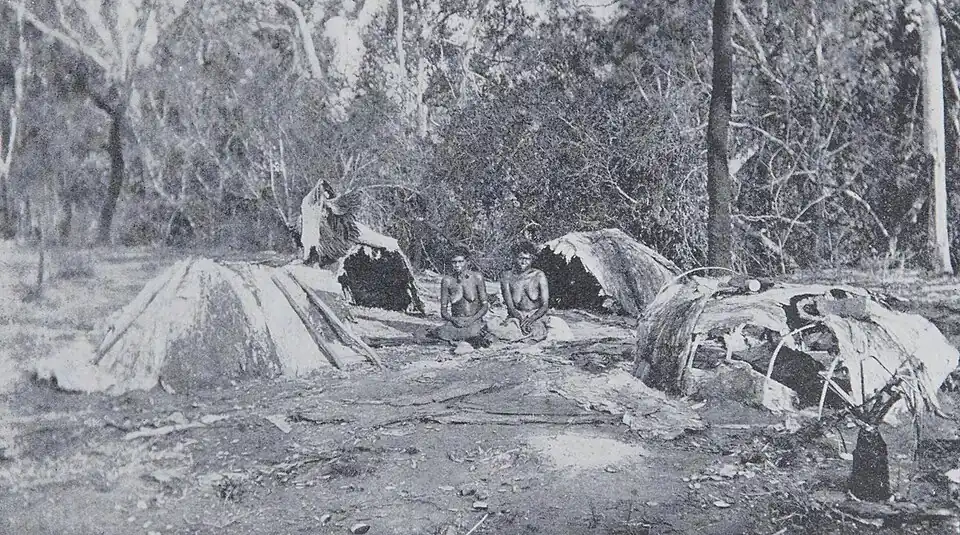
Aboriginal Dwellings
The chief objection to Mr. Mathew's solution appears to be its vagueness. While contending for a crossed origin, definition of the original stocks constituting the cross seems to be lacking. His evidence would perhaps be equally applicable to the solution proposed by Flower and Lydekker.
His indication of a further infusion of the Malay race is, upon the evidence brought forward, worthy of serious consideration. Mr. Howitt contends that the extent of this must have been very slight, but in that we cannot follow him. With some knowledge of the north-west of Australia the writer has long held the opinion that both the language and the physical and mental characteristics of the Malays are discernible not only in the aborigines of the extreme north of Western Australia, but in varying degree in those farther south. If detailed information concerning these tribes could be secured it would, we feel convinced, strongly bear out Mr. Mathew's contention. The rock-drawings and paintings of the north-west, to which reference will be made later, certainly point to the presence in former times in the northern portion of the State of a race